



The biggest winners were not random. They had clearer token economics, stronger products, and better alignment between what the protocol needed and what users actually did on-chain.
There is a huge difference between a token that lands in your wallet and a token that actually mattered.
In 2025, crypto users saw everything from carefully designed community distributions to over-farmed claims that felt dead on arrival. The winners were easy to spot in hindsight: they either plugged into real product usage, real governance, or a real ecosystem that needed committed participants instead of short-term mercenary volume.
This is not a vanity ranking and it is not based on random screenshots from X. It is an editorial shortlist built from verifiable launch material, official token pages, and live source documents. The goal is simple: identify which airdrops really paid out in a meaningful way, and what those winners had in common.
How we judged “actually paid out”
We used a stricter filter than the usual “big FDV on day one” approach. Airdrops only made this shortlist if they met most of four conditions: a large and clearly documented allocation, a live product or credible ecosystem around the token, a distribution model that made strategic sense, and a strong enough post-launch narrative that the token was more than a quick dump event.
This is an editorial ranking, not an exhaustive market map. Hyperliquid technically launched its genesis event in late 2024, but it is included because it remained the reference point for what a high-conviction airdrop looked like throughout 2025.
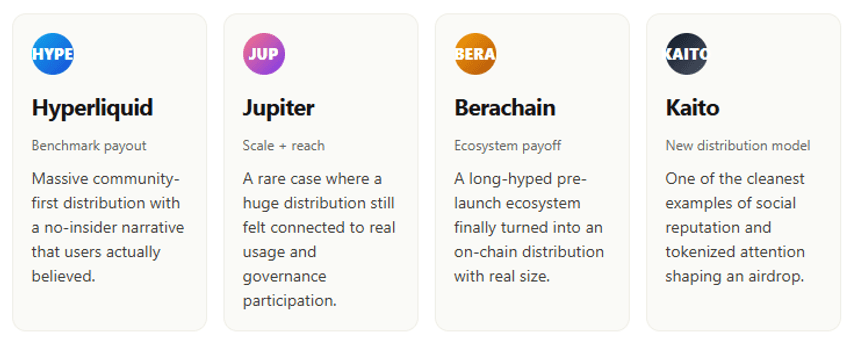
The four airdrops that defined 2025
Hyperliquid set the benchmark
Hyperliquid mattered because it solved the hardest part first: it already had product gravity. By the time HYPE landed, users did not need to be convinced the protocol was real. They had already been trading there, and the airdrop looked like a reward for actual usage rather than a subsidy for anonymous wallets.
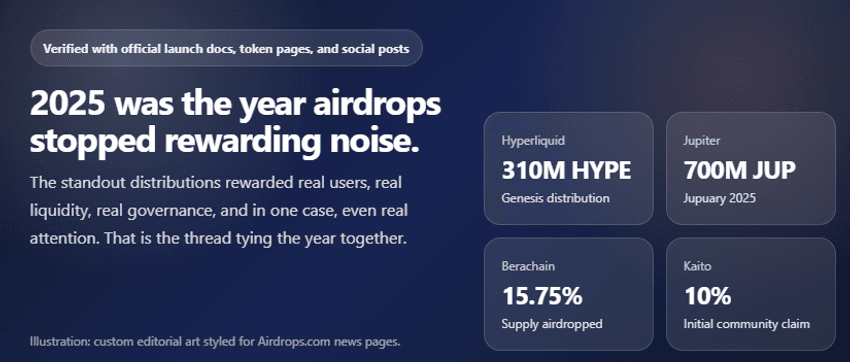
That community-first framing was reinforced by the token design. Multiple summaries of the genesis material reported that 31% of supply went to the initial distribution and that 310 million tokens were fully unlocked for eligible participants, while 76.2% of the total supply was community-aligned over time. That combination made the launch feel structurally different from the usual VC-heavy token debut.

Jupiter proved size does not automatically kill quality
Jupiter’s second major airdrop succeeded for a reason a lot of teams still ignore: it did not pretend community meant just one thing. Jupiter explicitly blended user behavior, staking, and voting into the distribution discussion, which made the event feel like part of a living DAO rather than a one-time token giveaway.
The official Jupuary hub called it the largest user airdrop in history to around 2 million qualified users, while the published DAO overview said 440 million of the 700 million JUP allocation would go to users. That kind of transparency matters because it shows the team was thinking about distribution as governance design, not only marketing design.
Berachain turned a long pre-launch culture into a real on-chain reward
Berachain’s launch worked because the project spent a very long time building a distinct culture before it asked people to care about the token. By the time BERA arrived, the market already understood the core pitch: Proof of Liquidity, a recognizable NFT-origin community, and an ecosystem that had been rehearsing its mainnet story for months.
The official overview said 15.75% of BERA would be airdropped to community members, applications, liquidity providers and more. That matters because it is one of the cleanest examples from 2025 of an airdrop being used to recognize an ecosystem, not just one narrow user funnel.
Kaito showed that attention can become an airdrop primitive
Kaito was different from the usual retroactive play because it leaned into social proof instead of pretending all valuable activity happens on-chain. The initial claim included the Kaito Yapper community, Genesis NFT holders, and ecosystem partners, while the project also carved out long-term creator incentives instead of trying to settle the entire attention economy in one shot.
That would have sounded flimsy if the product were not real. But Kaito’s own documentation says both Kaito Pro and Kaito Connect had reached profitability, which gave the token something many “social” launches never have: a clear business case behind the narrative.
Why Kaito matters beyond one token launch
Kaito’s Yaps Open Protocol frames attention as a public good that other builders can use for reward distribution and related applications. That is important because it hints at a broader 2026 trend: more projects may start mixing on-chain history with quantified mindshare instead of relying on one or the other.
What the winners had in common
The best airdrops of 2025 did not just give away tokens. They solved a distribution problem in a way that matched the protocol’s actual needs.
- They rewarded something the protocol truly valued. For Hyperliquid it was real trading usage. For Jupiter it was user activity plus governance alignment. For Berachain it was ecosystem participation. For Kaito it was tokenized attention and long-term creator value.
- They were documented clearly enough for users to trust the rules. This sounds basic, but it is one of the biggest separators between a memorable launch and a chaotic one.
- They sat on top of real products or real ecosystems. Tokens attached to empty shells did not age well in 2025.
- They gave users a reason to care after claim day. Governance, staking, product utility, or ecosystem identity all helped reduce the feeling that the airdrop was the whole story.
What this means for 2026 farmers
If 2025 taught anything, it is that the highest-quality airdrops are becoming less farmable in the lazy sense and more predictable in the strategic sense. The easy era of mindless task lists is fading. Teams are rewarding harder-to-fake signals: sustained product usage, governance behavior, social reputation, and ecosystem loyalty.
That does not mean users should stop hunting airdrops. It means the playbook is maturing. The best opportunities increasingly come from protocols that already have enough traction to be selective about who they want to reward.
Wallet safety still matters more than any claim page
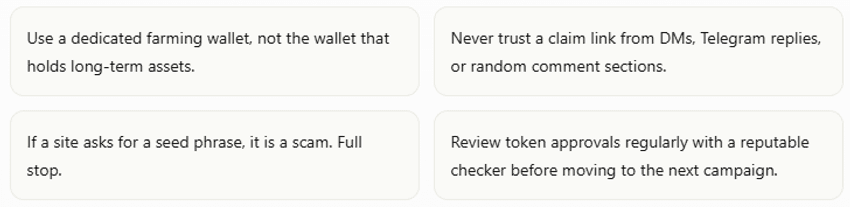
A good airdrop is never worth a drained wallet. Coinbase warns that dusting attacks can start with tiny unsolicited airdropped tokens and that fake claim pages often try to trick users into connecting wallets or revealing a seed phrase. Ethereum.org also explicitly recommends revoking malicious approvals if a user has been tricked into signing a bad contract.
Frequently Asked Questions
Why is Hyperliquid included if the genesis event was in 2024?
Because it remained the reference point for 2025. When traders and farmers talked about what a high-quality distribution looked like, Hyperliquid kept coming up as the benchmark.
Was Jupiter too large to be considered a high-quality airdrop?
No. Its size was part of the story, but the more important point was that the distribution still connected to real users and DAO behavior instead of only rewarding raw noise.
What made Kaito different from standard social farming?
Kaito did not frame the launch as generic social clout mining. Its docs tie the distribution to a broader InfoFi model, creator incentives, ecosystem participation, and products that the company says were already profitable.
What should users copy from these launches?
Look for protocols where the reward logic matches a real product need. If the project cannot explain why your behavior matters, the token distribution is usually weak as well.


