

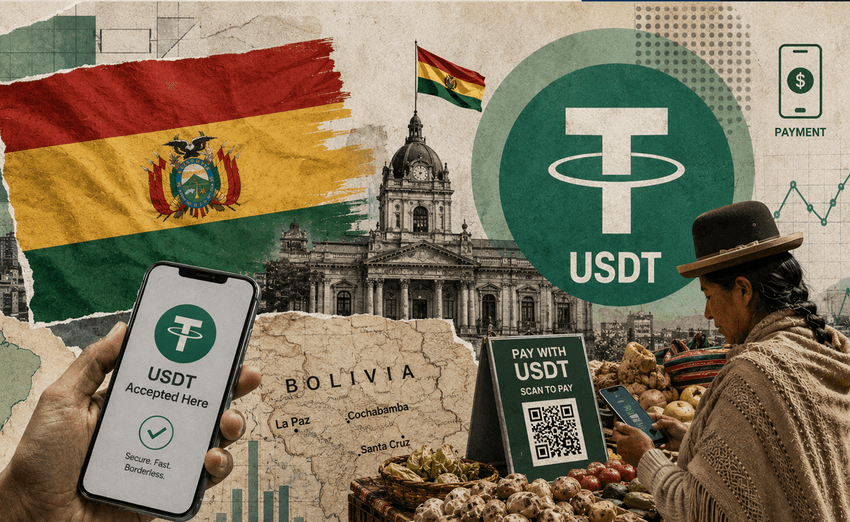

Bolivia is evaluating a proposal that could make Tether's USDT stablecoin an officially recognized payment option alongside the Bolivian boliviano and the U.S. dollar. The initiative reflects the country's rapidly evolving approach to digital assets following last year's decision to lift its long-standing ban on cryptocurrency transactions.
While the proposal is still under technical review, officials believe integrating USDT into the regulated financial system could help address growing demand for digital dollars as access to physical U.S. currency remains limited across the country.
Government Reviews USDT Integration
Economy Minister José Gabriel Espinoza confirmed that Bolivia is studying whether USDT can be incorporated into the country's official payment infrastructure. The proposal would allow banks, digital wallets, and payment providers to support the stablecoin under a regulated framework.
Speaking during a recent press conference, Espinoza emphasized that no final decision has been made and that USDT currently has neither legal tender status nor dedicated regulations within Bolivia.

If approved, USDT would function as an additional payment option rather than replacing the country's national currency.
Dollar Shortages Have Increased Stablecoin Demand
Bolivia's interest in USDT stems largely from the ongoing shortage of physical U.S. dollars throughout the economy.
As obtaining cash dollars has become increasingly difficult, many Bolivians have already turned to stablecoins to preserve savings, pay international suppliers, and send remittances without relying on traditional banking channels.
Legal recognition would allow these transactions to move from the informal crypto market into the country's regulated financial system, providing greater oversight while improving accessibility for consumers and businesses.
The shift follows the Central Bank of Bolivia's decision to lift its cryptocurrency ban in June 2024. Since then, crypto adoption has accelerated significantly. According to central bank figures, transaction volume increased from $46.5 million during the first half of 2024 to approximately $294 million in 2025, representing a 630% increase.
Bolivia also transitioned from a fixed exchange rate to a floating currency system earlier this year, signaling broader changes in its monetary policy.
Banks Already Offer USDT Services
Financial institutions have already begun expanding their digital asset offerings ahead of any formal regulatory approval.
Banco Bisa introduced USDT custody services in October 2024, while state-owned Banco Unión later enabled customers to purchase USDT through its Yasta digital wallet. More recently, Banco FIE launched its Cuenta Cripto, allowing customers to buy and sell USDT directly through the bank.
Beyond financial institutions, cryptocurrency adoption has also reached the retail sector. Several automobile dealerships now accept USDT for vehicle purchases, with Tether CEO Paolo Ardoino previously highlighting that dealers representing brands such as Toyota, BYD, and Yamaha have begun supporting stablecoin payments.
President Rodrigo Paz Pereira, who assumed office last November, has also expressed support for expanding the role of digital assets beyond payments into savings accounts and crypto-backed lending products.
Toyota, BYD, Yamaha accepting USDT in Bolivia
— Paolo Ardoino 🤖 (@paoloardoino) September 21, 2025
"Tu vehiculo en dolares digital"
USDT is the digital dollar for hundreds of millions in the emerging markets.
Ubiquity. pic.twitter.com/0X0SH3USXX
Toyota, BYD, Yamaha accepting USDT in Bolivia
— Paolo Ardoino 🤖 (@paoloardoino) September 21, 2025
"Tu vehiculo en dolares digital"
USDT is the digital dollar for hundreds of millions in the emerging markets.
Ubiquity. pic.twitter.com/0X0SH3USXX
Regulatory Challenges Still Remain
Despite growing momentum, several hurdles must be addressed before USDT can become part of Bolivia's official payment infrastructure.
One major concern is Bolivia's current inclusion on the Financial Action Task Force (FATF) grey list, reflecting international concerns over anti-money laundering controls. Any regulatory framework for stablecoins would likely require stronger compliance measures to meet global standards.
Analysts also stress that the proposal would not grant USDT legal tender status. Instead, regulated financial institutions would be permitted to offer crypto-related services while merchants would remain free to decide whether to accept stablecoin payments.
Additional questions remain regarding stablecoin liquidity, custody security, and the ability of banks to enforce robust anti-money laundering procedures. Limited banking access and unreliable internet connectivity in parts of Bolivia also present practical challenges that stablecoins alone cannot resolve.
Nevertheless, the proposal represents another important step in Bolivia's gradual embrace of digital assets, positioning the country among a growing number of nations exploring how regulated stablecoins can complement traditional financial systems rather than replace them.


