

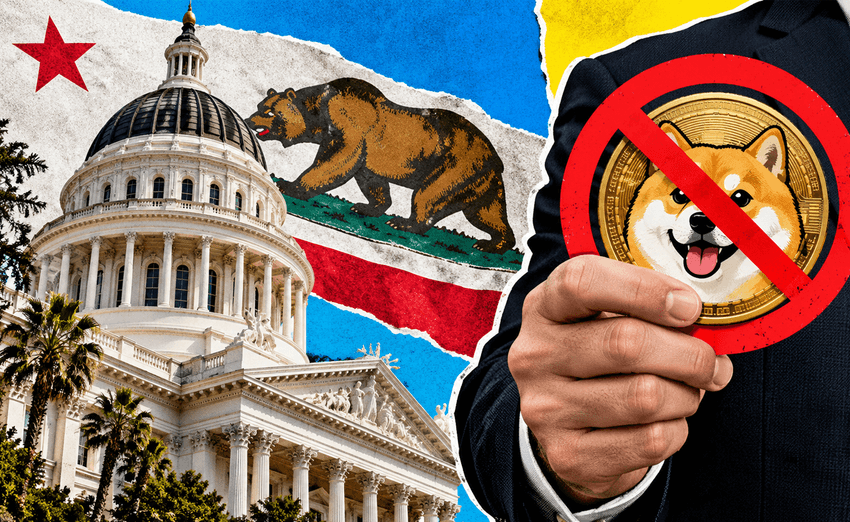

California has established new restrictions at the intersection of public office and speculative cryptocurrency, with Governor Gavin Newsom signing Assembly Bill 2409 on September 27.
The legislation prohibits California public officers and certain public employees from issuing memecoins. It also introduces restrictions for digital asset platforms dealing with tokens connected to public officials. California lawmakers framed the legislation around conflicts of interest and the principle that officials should not use public positions for private financial gain.
The platform provision takes effect on January 1, 2027. From that date, digital asset service providers cannot list for sale to California residents a qualifying memecoin issued on or after January 1, 2027, when it is offered by or in partnership with a federal, state or local public official.
The Law Is Not a Memecoin Trading Ban
Despite the restrictions, AB 2409 does not prohibit memecoin trading across California.
Residents can continue buying and selling tokens that do not meet the law's official-linked criteria. The platform restriction is also prospective, applying specifically to qualifying memecoins issued from January 1, 2027 onward.
That means the legislation does not automatically require exchanges to remove existing political tokens.
The law defines “issue” broadly as making a memecoin available for public purchase, donation or exchange of value, whether the asset is actively promoted or not. A memecoin is defined as a digital asset primarily associated with areas including internet memes, public figures, current events, celebrities or social trends, whose value is driven mainly by public interest, speculation or community engagement.
Who Falls Under AB 2409?
The legislation defines a public officer to include state and local elected or appointed officials, members of the California Legislature and members of government boards, commissions and similar bodies.
Its definition of public employee is narrower, covering state or local government employees with decision-making authority over bids and contracts.
The statute also separately defines federal public officials for purposes of the platform restriction, including federal elected and appointed officers and members of federal government boards and commissions.
California lawmakers described the policy as a conflict-of-interest safeguard. The legislative findings state that financial instruments issued or promoted by officials can create opportunities for conflicts of interest, pay-to-play arrangements and other forms of improper influence.
Trump Memecoin Featured in California's Announcement
Newsom's signing announcement specifically referenced President Donald Trump's TRUMP memecoin while presenting the legislation as part of a broader package focused on government accountability and consumer protection.
However, AB 2409's actual statutory language is important when determining which tokens platforms must restrict.
The governor's announcement described the measure more broadly as preventing companies from listing memecoins using a public official's likeness or image. The enacted text instead says the platform prohibition applies when a qualifying token is “offered by, or in partnership with” a federal, state or local public official.
Therefore, simply referencing a politician or using political imagery does not, by itself, establish that a token falls within that platform provision.
Platforms May Face Difficult Compliance Decisions
That distinction could create a significant challenge for crypto exchanges and other digital asset service providers once the platform rules begin in 2027.
Memecoins can be launched by anonymous developers, loosely connected teams or decentralized communities. Determining whether an official is genuinely involved may therefore require platforms to examine who controls the project, who receives proceeds and whether an official participated in the offering.
Political fame or family connections alone also do not automatically satisfy the statutory test. The central question is the relationship between the public official and the token offering.
California authorities will have enforcement powers under the new framework. The Attorney General can seek injunctions and disgorgement, while district attorneys, city attorneys and county counsel can enforce the prohibition against California public officers and covered employees.
The result is a targeted restriction rather than a broad cryptocurrency prohibition: California is limiting officials' ability to issue speculative memecoins while restricting platforms from offering certain newly issued official-linked tokens to residents beginning in 2027.


