

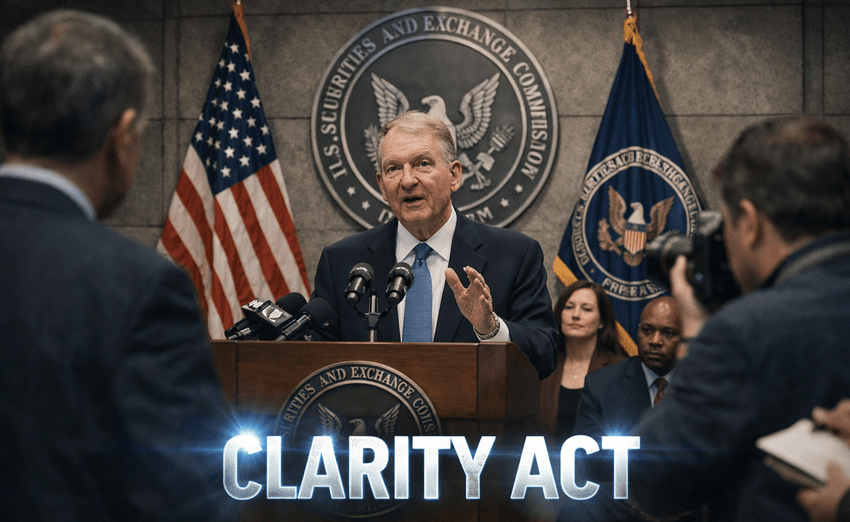

A Historic Shift in Crypto Regulation
The U.S. Securities and Exchange Commission (SEC) has delivered one of the most significant regulatory updates in crypto history, declaring that “most crypto assets” are NOT securities. The announcement marks a dramatic pivot after years of uncertainty and aggressive enforcement.
SEC Chair Paul Atkins made the stance clear, emphasizing that the agency is finally drawing boundaries the industry has long demanded:

This guidance aims to provide a structured framework for how digital assets are classified, offering clarity that could reshape the U.S. crypto landscape.
🚨JUST IN: The @SECGov and @CFTC have issued joint, Commission-level interpretive guidance outlining how federal securities laws apply to certain crypto assets and transactions.
— Eleanor Terrett (@EleanorTerrett) March 17, 2026
This follows a submission to OIRA earlier this month signaling the agencies’ intent, and was approved… pic.twitter.com/zMxHSlZUNB
🚨JUST IN: The @SECGov and @CFTC have issued joint, Commission-level interpretive guidance outlining how federal securities laws apply to certain crypto assets and transactions.
— Eleanor Terrett (@EleanorTerrett) March 17, 2026
This follows a submission to OIRA earlier this month signaling the agencies’ intent, and was approved… pic.twitter.com/zMxHSlZUNB
What Counts as a Security - and What Doesn’t
The SEC’s new guidance breaks crypto assets into defined categories, making it easier to understand which assets fall under its jurisdiction. Importantly, only “digital securities” are explicitly regulated by the SEC, while most other categories fall outside its direct oversight.
The regulator clarified that activities like mining, staking, and airdrops do not qualify as securities transactions, removing a major point of contention for years.
The framework introduces five classifications: digital commodities, digital collectibles, digital tools, stablecoins, and digital securities. Among these, Bitcoin and Ethereum are widely treated as digital commodities, meaning their value comes from decentralized network activity rather than centralized managerial efforts.
Meanwhile, NFTs and meme coins are likely to fall under “digital collectibles” while certain tokens used for access or identity may be categorized as digital tools.
This structured approach replaces years of ambiguity, where projects often relied on legal guesswork to determine compliance.
End of the Howey Test Era?
For years, the SEC leaned heavily on the Howey Test, a legal standard dating back decades, to determine whether crypto assets qualified as securities. This approach led to numerous enforcement actions against crypto firms, often criticized as inconsistent and unclear.
The statement reflects a broader shift away from case-by-case enforcement toward clearer regulatory definitions, something the industry has been demanding for years.
SEC and CFTC Finally Align
In a rare show of coordination, the Commodity Futures Trading Commission (CFTC) quickly backed the SEC’s interpretation, confirming it will align its oversight under the Commodity Exchange Act.
This alignment is critical, as regulatory fragmentation has long been a barrier to growth in the U.S. crypto sector. With both agencies now working from a shared framework, the path forward becomes significantly clearer for developers, investors, and institutions.
Investment Contracts Still Matter
Despite the broader classification shift, the SEC made it clear that investment contracts still exist within crypto. In some cases, tokens may be tied to promises or representations made by issuers, which could bring them under securities laws.
However, the guidance introduces an important nuance: a digital asset itself is not automatically a security, even if it was initially part of an investment contract.
Additionally, once issuer involvement fades and expectations of profit disappear, those assets may no longer fall under securities regulations-a major win for decentralization-focused projects.
Safe Harbor Could Unlock Innovation
Looking ahead, the SEC is preparing to introduce a “safe harbor” framework designed to support early-stage crypto innovation. Atkins revealed that startups could receive temporary exemptions while developing their projects.
The proposal may apply to: projects valued up to $5 million in their first four years, fundraising efforts up to $75 million tied to certain crypto assets, and networks that have achieved sufficient decentralization.
Atkins confirmed that formal proposals are expected within weeks, opening the door for public feedback.
A Turning Point for the Industry
This new guidance represents a foundational shift in how crypto is regulated in the United States. By clearly separating digital commodities from securities, regulators are laying the groundwork for a more predictable and innovation-friendly environment.
With both the SEC and CFTC now aligned, the era of regulatory uncertainty may finally be coming to an end, setting the stage for the next wave of crypto growth.


