


Bitcoin Education Gets a Second Chapter
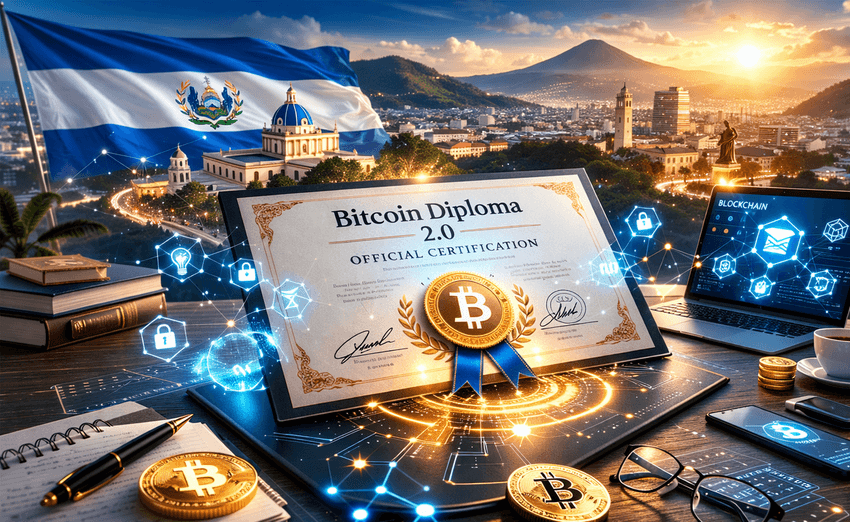
El Salvador is relaunching its national Bitcoin education effort with “Bitcoin Diploma 2.0” a revamped version of its original classroom initiative. According to the National Bitcoin Office, the first printed copies of the updated diploma will be distributed in the coming days, marking a renewed push to integrate Bitcoin into the country’s formal education system.
Stacy Herbert, director of the National Bitcoin Office, announced the update publicly, emphasizing that the program now uses simplified teaching methods designed for younger students.

The updated curriculum will complement other state-backed programs, including CUBO+ and the Higher School of Innovation in Public Administration.
What the New Diploma Covers
Local reports indicate that Bitcoin Diploma 2.0 expands its educational scope beyond basic wallet usage. The curriculum covers mining, economic incentives, monetary theory, and global financial systems, while encouraging students to think critically about how money functions.
One notable element is the inclusion of lessons that teach students how to design their own forms of money, reflecting the broader ideological foundation behind the country’s Bitcoin experiment. Officials argue that financial literacy - not just crypto adoption - is central to the long-term vision.
The program will now be formally embedded within El Salvador’s national education framework, rather than remaining a limited pilot effort.
The Legacy of Bitcoin Diploma 1.0
The original Bitcoin Diploma was launched in June 2022 in collaboration with the nonprofit Mi Primer Bitcoin (“My First Bitcoin”). The 10-week course introduced public school students to Bitcoin fundamentals, and by 2023 thousands had completed the program.
At its peak, more than 27,000 students reportedly received face-to-face Bitcoin education through the nonprofit partnership. In 2024, the Ministry of Education highlighted that 350 female students completed the diploma course.
However, the collaboration between the government and Mi Primer Bitcoin ended last April, raising questions about the continuity of the program. Diploma 2.0 appears to be a state-led restructuring rather than a nonprofit-driven initiative.
Esta mañana, la ministra @KarlaETrigueros participó en la ceremonia de graduación del Diplomado en Bitcoin, en el Instituto Nacional General Francisco Morazán (INFRAMOR), de San Salvador. 350 alumnas culminaron su formación en bitcoin, así como a las 8 jóvenes que terminaron su… pic.twitter.com/eLNce0yGaK
— Ministerio de Educación (@EducacionSV) August 21, 2025
Esta mañana, la ministra @KarlaETrigueros participó en la ceremonia de graduación del Diplomado en Bitcoin, en el Instituto Nacional General Francisco Morazán (INFRAMOR), de San Salvador. 350 alumnas culminaron su formación en bitcoin, así como a las 8 jóvenes que terminaron su… pic.twitter.com/eLNce0yGaK
— Ministerio de Educación (@EducacionSV) August 21, 2025
Adoption Challenges Remain
El Salvador became the first country to adopt Bitcoin as legal tender in 2021 under President Nayib Bukele. The government launched the Chivo wallet, offering a $30 sign-up bonus to incentivize adoption, and required businesses to accept BTC alongside the U.S. dollar.
Yet surveys later revealed that only about 20% of users continued using Chivo after spending the bonus, with researchers concluding that the primary driver of adoption was the initial incentive rather than organic demand.
By 2024, studies suggested that over 90% of Salvadorans were not regularly using Bitcoin for transactions. Technical issues with the Chivo wallet, including glitches and crashes, further dampened public enthusiasm.
Other high-profile initiatives - including Volcano Bonds and the proposed Bitcoin City near the Conchagua volcano - faced delays and limited investor appetite. Reports indicate that Bitcoin purchases by the government have not resumed since late 2024, with some reserve increases attributed to internal wallet consolidations rather than new acquisitions.
Can Education Succeed Where Policy Struggled?
Bitcoin Diploma 2.0 signals that El Salvador is doubling down on long-term cultural integration rather than short-term transactional adoption. By embedding Bitcoin education into classrooms and civil service training, the government appears focused on reshaping financial literacy at a generational level.
Whether this strategy succeeds will depend on public engagement, institutional consistency, and economic outcomes. While transactional adoption has lagged, the government’s educational push suggests that Bitcoin remains central to its national identity strategy.
As Diploma 2.0 rolls out across schools, El Salvador once again positions itself at the intersection of public policy and digital asset experimentation - this time through textbooks rather than incentives.


