

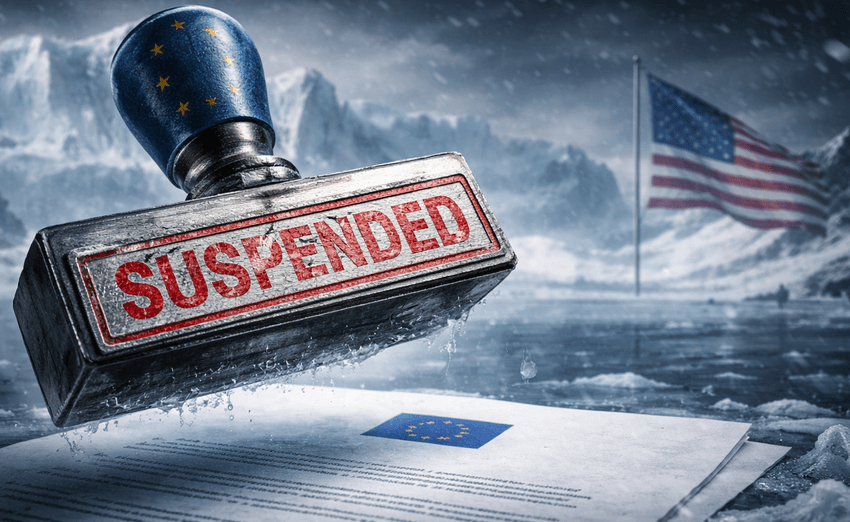

Europe has formally halted approval of a key U.S.–EU trade arrangement, escalating a rapidly intensifying dispute triggered by President Donald Trump’s demands over Greenland and renewed threats of punitive tariffs on European goods.
European Parliament Draws a Red Line
The European Parliament suspended ratification of the transatlantic trade agreement reached with Washington last July, citing what lawmakers described as a clear breach of trust by the White House. The decision came just hours after Donald Trump used his speech at the World Economic Forum in Davos to call for “immediate negotiations” on acquiring Greenland.
At the center of the response is Bernd Lange, chair of the Parliament’s Committee on International Trade (INTA), who said Trump’s actions violate the terms of the Turnberry agreement signed last year.

Tariffs Seen as Political Coercion
Lange accused the U.S. president of using tariffs as a tool of political pressure, arguing that Europe cannot proceed while economic threats remain on the table. Although Trump promised in Davos not to use military force, Lange dismissed that assurance as insufficient.
The proposed duties are widely viewed in Brussels as a direct violation of the trade pact, prompting INTA to consider deploying the EU’s Anti-Coercion Instrument (ACI)-a powerful legal mechanism designed to counter economic intimidation.
Europe’s “Trade Bazooka” on the Table
Often dubbed a “trade bazooka” the ACI would allow the EU to severely restrict U.S. companies’ access to the European market. Measures could include excluding American firms from public tenders, slowing capital flows, limiting foreign investment, and reducing market access across the bloc.
A formal debate on activating the ACI is scheduled for Monday.
Washington Pushes Back
The White House rejected Europe’s stance. Jamieson Greer, the U.S. Trade Representative, blamed the EU for stalling implementation of the agreement. Speaking to CNBC, Greer said Europe was hiding behind unrelated political disputes.
ECB Warns of Wider Fallout
The dispute has also raised alarms among monetary policymakers. Joachim Nagel, president of Germany’s central bank and a member of the European Central Bank, warned that the standoff could spill over into monetary policy.
Trump Signals a Sudden Climbdown
Shortly after news of the suspension broke, Trump appeared to soften his stance, posting on Truth Social that he had reached “the framework of a future deal with respect to Greenland” following what he described as a “very productive meeting” with Mark Rutte.
Trump claimed the framework would benefit both the U.S. and NATO allies and said he would not impose the tariffs scheduled for February 1. He also announced a negotiation team including Vice President JD Vance, Secretary of State Marco Rubio, and Special Envoy Steve Witkoff, all reporting directly to him.
For now, however, Europe’s suspension remains in place, underscoring how quickly geopolitical ambitions can derail trade diplomacy-and how close the transatlantic relationship has come to a full-blown economic confrontation.


