

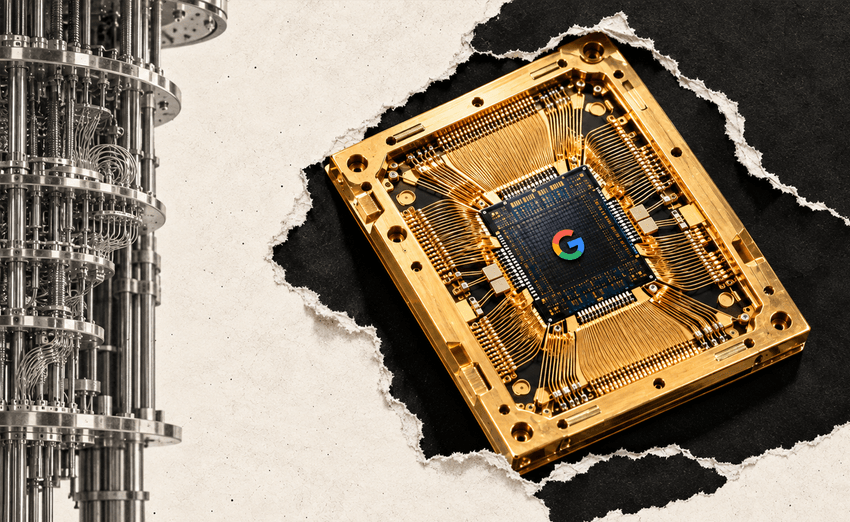

Google has announced a significant advancement in quantum computing, demonstrating a technique that reduces errors by approximately 40 times on its Willow quantum processor.
The findings, published in the scientific journal Science, represent an important step toward developing more powerful and efficient quantum computers.
Researchers at Google Quantum AI successfully implemented a technique called magic state cultivation, previously explored primarily through theoretical research and computer simulations.
The experiment achieved a reported 99.99% logical fidelity for specialized quantum states required to perform advanced calculations.

The breakthrough could eventually help reduce the hardware resources required for practical quantum computing.
How Google's New Quantum Technology Works
Quantum computers use qubits instead of traditional binary bits, allowing them to perform certain types of calculations differently from conventional computers.
However, qubits are extremely sensitive to environmental interference, making errors one of the biggest obstacles to building reliable quantum systems.
Advanced quantum calculations require specialized resources known as magic states, which enable operations that ordinary quantum error correction cannot easily protect.
Producing these states has traditionally required enormous computing resources, potentially consuming up to 95% of a quantum computer's capacity.
Google's magic state cultivation technique offers a more efficient approach by repeatedly checking quantum states for errors and rejecting unsuccessful attempts.
During the experiment, approximately 8% of attempts passed every verification stage.
Although most attempts were discarded, the surviving states achieved substantially higher accuracy.
This approach could eventually reduce reliance on the large quantum processing facilities traditionally needed to produce reliable magic states.
Breakthrough Raises Questions About Bitcoin Encryption
The advancement also carries potential implications for Bitcoin and other cryptocurrencies that rely on public-key cryptography.
Powerful fault-tolerant quantum computers could theoretically use specialized algorithms to derive private keys from exposed public keys, potentially compromising cryptocurrency wallets.
Google researchers previously estimated that breaking Bitcoin's elliptic curve cryptography could require fewer than 500,000 physical qubits under certain assumptions.
That estimate followed earlier research suggesting that RSA-2048 encryption could eventually be broken using fewer than one million noisy qubits.
These projections are considerably lower than some previous estimates, partly because researchers have identified more efficient quantum computing techniques.
However, Google's latest experiment does not demonstrate an ability to break Bitcoin encryption.
Instead, it advances one component needed to construct sufficiently powerful quantum computers.
Current Quantum Computers Remain Far From Breaking Bitcoin
Despite the promising results, existing quantum hardware remains far below the capabilities required to attack modern cryptocurrency encryption.
Google's experiment used no more than 54 qubits from its 105-qubit Willow processor.
By comparison, theoretical attacks against widely used cryptographic systems would require vastly larger machines with significantly stronger error correction.
The researchers noted that breaking RSA-2048 encryption would require magic states with error rates around one in 10 billion.
That is approximately one million times more accurate than the results achieved in the latest experiment.
Consequently, Bitcoin wallets are not facing an immediate practical threat from Google's announcement.
Nevertheless, the research highlights why developers are increasingly examining quantum-resistant cryptographic alternatives.
Google Plans to Scale Quantum Error Correction
Google's next objective is to expand magic state cultivation to larger quantum systems while improving the underlying hardware.
The research team estimates that reducing Willow's physical error rates by half could lower magic state errors to approximately two in 100,000.
Such improvements could make advanced quantum operations considerably more efficient and reduce the resources required for useful calculations.
Beyond cryptocurrency, reliable quantum computers could eventually support drug discovery, materials science and complex scientific simulations.
For the blockchain industry, however, continued progress reinforces the importance of preparing cryptographic systems for future technological developments.
While Google's breakthrough does not place Bitcoin's encryption in immediate danger, it represents another measurable step toward the fault-tolerant quantum computers that could eventually challenge today's digital security standards.


