

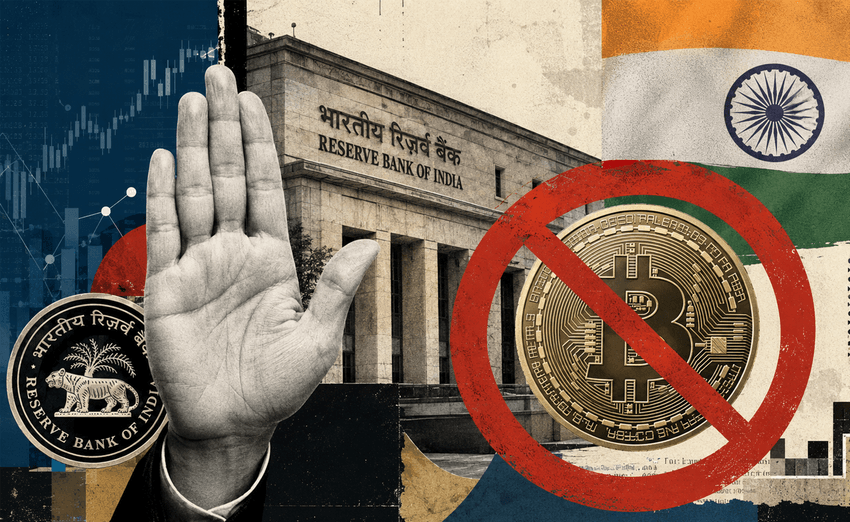

India's cryptocurrency debate has taken another decisive turn after the Income Tax Department formally backed the Reserve Bank of India (RBI) in opposing the legalization of digital assets. Government documents reviewed by Reuters reveal that both authorities are urging policymakers to adopt a far stricter approach toward cryptocurrencies, arguing that widespread crypto adoption creates financial, regulatory, and economic risks.
The latest position signals that India remains reluctant to embrace digital assets despite being one of the world's largest crypto markets by user count.
Tax Authorities Back RBI's Anti-Crypto Position
According to government documents dated May and June 2026, the RBI continues to advocate a policy that leans toward effectively prohibiting cryptocurrencies rather than regulating them as conventional financial assets.
The central bank wants banks and financial institutions to remain prohibited from holding, trading, or maintaining any exposure to cryptocurrencies or privately issued stablecoins.
Officials argue that allowing closer integration between the banking sector and digital assets could expose India's financial system to additional instability during periods of market stress.
The Income Tax Department has now publicly endorsed that position, highlighting serious enforcement challenges.
Authorities reported that cryptocurrency transactions conducted through overseas exchanges and peer-to-peer platforms remain extremely difficult to monitor, making tax collection and compliance increasingly complicated.
Crypto Tax Compliance Remains Low
The government also pointed to significant underreporting of crypto-related income.
Official data shows that during the financial year ending in March 2023, fewer than 25% of the approximately 645,000 individuals who traded cryptocurrencies reported those gains on their tax returns.
Officials believe offshore trading platforms make it significantly harder to identify taxable activity, particularly when transactions are settled outside India's regulated financial infrastructure.
These concerns have strengthened calls for tighter oversight rather than broader legalization.
RBI Warns Stablecoins Threaten Monetary Sovereignty
The RBI remains particularly concerned about foreign currency-backed stablecoins, especially those pegged to the U.S. dollar.
According to the central bank, widespread adoption of privately issued dollar-backed stablecoins could weaken India's monetary sovereignty by encouraging greater reliance on foreign-denominated digital assets.
In briefing documents submitted to the Standing Committee on Finance, the RBI argued that treating cryptocurrencies like traditional financial products would effectively legitimize highly speculative assets that offer little economic benefit.
The central bank estimates that India currently has 54 registered Virtual Asset Service Providers (VASPs) under the Financial Intelligence Unit, serving roughly 39.3 million KYC-verified users who collectively hold digital assets valued at approximately 20,437 crore rupees, or roughly $2.4 billion.
Industry Calls for Regulation Instead of Prohibition
Not everyone agrees with the RBI's restrictive approach.
The Institute of Chartered Accountants of India (ICAI) has urged lawmakers to introduce a comprehensive legal framework governing digital assets instead of pursuing policies that discourage their use.
The organization argues that India's strong fintech ecosystem provides an opportunity to become a global leader in blockchain innovation if clear regulations covering issuance, trading, and custody are introduced.
Similar views have been expressed by several lawmakers.
Earlier this year, Member of Parliament Raghav Chadha argued that heavy taxation has failed to reduce crypto activity and has instead pushed users toward overseas platforms.

India's Crypto Policy Remains Uncertain
India has operated in regulatory uncertainty since 2020, when the country's Supreme Court overturned the RBI's previous banking ban on cryptocurrency businesses.
Although the government drafted legislation in 2021 proposing a ban on private cryptocurrencies, the bill was never introduced in Parliament.
Instead, authorities have relied primarily on taxation and compliance measures.
India currently imposes a 30% tax on crypto gains alongside a 1% tax deducted at source (TDS) on digital asset transactions.
Critics argue these policies have simply encouraged users to migrate to offshore exchanges rather than reducing crypto adoption.
According to Chadha, roughly 73% of India's crypto trading volume now occurs on foreign platforms, involving an estimated 120 million Indian users.
The RBI also maintains that large-scale cryptocurrency adoption could increase capital outflows and place additional pressure on India's external balance, particularly during periods of global economic instability such as the recent surge in oil prices following geopolitical tensions in the Middle East.
As policymakers continue debating the future of digital assets, India's regulatory direction remains firmly tilted toward tighter restrictions rather than broader legalization.


