

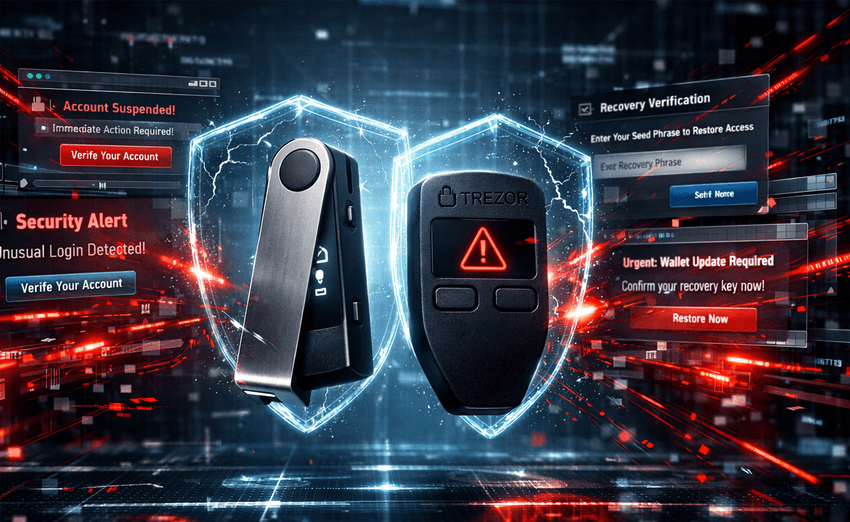

A new wave of crypto theft attacks is targeting users of Ledger and Trezor, but this time the approach is far more unsettling. Instead of relying solely on emails or fake social media messages, scammers are mailing physical letters directly to users’ homes, impersonating official security teams in an attempt to extract wallet recovery phrases. The tactic represents a significant escalation in social engineering methods within the crypto space.
Fake Compliance Notices Create Urgency
Victims report receiving professionally printed letters bearing official-looking branding and compliance language. The documents claim that users must complete a mandatory authentication or transaction verification process to avoid losing access to wallet features. A strict deadline, often set within days, is included to pressure recipients into acting quickly.
One letter reviewed by cybersecurity expert Dmitry Smilyanets instructed Trezor customers to complete what it called an “Authentication Check” before February 15. The message warned that failure to comply could result in limited wallet functionality. The tone was authoritative and urgent, mimicking legitimate compliance communications that users may expect from financial service providers.
A new scam affecting @Trezor customers:
— 𝕯𝖒𝖎𝖙𝖗𝖞 𝕾𝖒𝖎𝖑𝖞𝖆𝖓𝖊𝖙𝖘 (@ddd1ms) February 12, 2026
- a physical mail ✅
- a hologram ✅
- a QR code leading to the scam website ✅
- a signature of @Ledger CEO 😂😂😂
- mailed from 🇺🇸 PA pic.twitter.com/ou60qtsVmK
A new scam affecting @Trezor customers:
— 𝕯𝖒𝖎𝖙𝖗𝖞 𝕾𝖒𝖎𝖑𝖞𝖆𝖓𝖊𝖙𝖘 (@ddd1ms) February 12, 2026
- a physical mail ✅
- a hologram ✅
- a QR code leading to the scam website ✅
- a signature of @Ledger CEO 😂😂😂
- mailed from 🇺🇸 PA pic.twitter.com/ou60qtsVmK
QR Codes Lead to Sophisticated Phishing Sites
Once scanned, the QR codes redirect users to fake websites designed to closely resemble official wallet domains. These sites prompt victims to complete verification by entering their wallet recovery phrase under the pretense of device synchronization or ownership confirmation.
Before being flagged by browser security systems, one such phishing page displayed a message warning users that failing to complete verification would restrict device access. The design and structure closely mirrored authentic wallet interfaces, increasing the likelihood of deception.
However, entering a recovery phrase on these pages sends the data directly to scammers through hidden backend systems. At that moment, attackers gain complete control over the wallet and all associated funds.
Recovery Phrases Remain the Critical Vulnerability
A wallet recovery phrase, typically consisting of 12 or 24 words, functions as the master key to a crypto wallet. Anyone with access to it can restore the wallet and transfer assets without restriction. Hardware wallet manufacturers have repeatedly emphasized that recovery phrases should never be shared and should only be entered directly on the device itself.
Both companies have consistently stated that they will never request seed phrases under any circumstance. The scam exploits confusion around firmware updates and security improvements, areas where users may expect occasional action, making the deception more convincing.
Data Breach Concerns Resurface
It remains unclear how scammers obtained mailing addresses for targeted users. However, previous data breaches involving wallet providers have exposed customer contact information in past years. Such leaks may have enabled attackers to identify legitimate customers and execute highly personalized physical mail campaigns.
The shift to traditional mail adds a new psychological layer. Physical letters can feel more legitimate than emails, especially when printed on branded stationery. This tactic blurs the line between digital and offline fraud, demonstrating how crypto-related scams are evolving beyond purely online methods.
Growing Sophistication in Crypto Scams
This campaign highlights how social engineering attacks are becoming increasingly hybrid and sophisticated. By combining physical correspondence with digital phishing infrastructure, criminals are exploiting both trust and urgency. The incident serves as a reminder that even hardware wallet users, often considered among the most security-conscious participants in crypto, remain vulnerable if recovery phrases are exposed.
Security experts stress that users should ignore unsolicited verification requests and confirm updates only through official websites accessed manually, not via QR codes or embedded links. Hardware wallets remain highly secure when used correctly, but their security ultimately depends on keeping seed phrases private.
As crypto adoption expands, scammers are adapting just as quickly. Vigilance and education remain the strongest defenses against evolving threats.


