

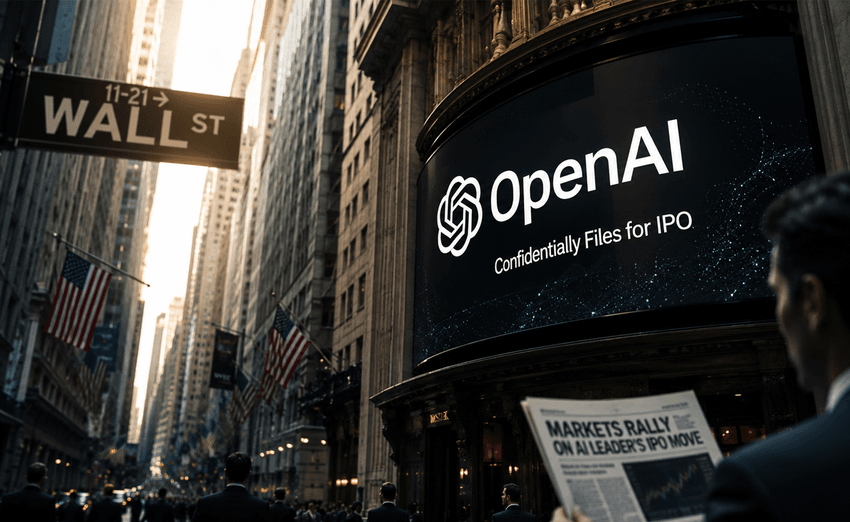

OpenAI Files Confidential IPO Registration With SEC
OpenAI has officially confirmed that it has confidentially submitted an S-1 registration statement to the U.S. Securities and Exchange Commission (SEC), marking the company's first formal step toward a potential initial public offering.
The announcement comes as the battle for dominance in artificial intelligence continues to accelerate, with leading developers seeking massive amounts of capital to finance next-generation AI models and computing infrastructure.
Although OpenAI stressed that no IPO timeline has been established, the confidential filing allows the company to prepare for a future public listing while keeping financial details private until a later stage of the regulatory process.
The move positions OpenAI alongside several high-profile technology firms that are increasingly turning to Wall Street to fund the next phase of AI development.
We recently submitted a confidential S-1. We expect it to leak so we’re just announcing it. We have not decided on timing yet; it may be a while because there are things we want to do that are likely easier as a private company. But it’s a complicated set of tradeoffs and this…
— OpenAI Newsroom (@OpenAINewsroom) June 8, 2026
We recently submitted a confidential S-1. We expect it to leak so we’re just announcing it. We have not decided on timing yet; it may be a while because there are things we want to do that are likely easier as a private company. But it’s a complicated set of tradeoffs and this…
— OpenAI Newsroom (@OpenAINewsroom) June 8, 2026
AI Competition Is Becoming a Capital Race
The artificial intelligence industry has evolved into one of the most expensive sectors in technology. Building advanced AI systems now requires billions of dollars in investments for data centers, graphics processing units (GPUs), cloud infrastructure, and top engineering talent. As development costs continue to rise, even the largest private AI companies are looking for new sources of long-term financing.
OpenAI remains one of the industry's leaders thanks to ChatGPT and its expanding suite of AI products, but competition from firms such as Anthropic, Google, xAI, and other emerging developers continues to intensify.
Rather than relying solely on private funding rounds, many AI companies now see public markets as a strategic tool for securing the enormous capital needed to remain competitive.
Going Public Could Unlock Massive Funding Opportunities
While OpenAI has not committed to listing its shares anytime soon, becoming a public company would provide access to significantly larger pools of investment capital.
That funding could support further expansion of AI infrastructure, accelerate research into more powerful models, and strengthen the company's position as demand for AI solutions grows across industries including software, healthcare, finance, education, and enterprise services.
OpenAI stated that operating as a public company could improve its long-term flexibility and better support future strategic priorities.
The confidential filing keeps those options available without forcing the company into an immediate market debut.
IPO Speculation Has Been Building for Months
Rumors surrounding an OpenAI public offering have circulated throughout 2026.
Earlier reports suggested that the company had been working with major investment banks, including Goldman Sachs and Morgan Stanley, to prepare for a possible listing while evaluating favorable market conditions.
Investor interest in artificial intelligence remains exceptionally strong, fueled by rapid adoption of AI tools across both businesses and consumers.
An eventual OpenAI IPO would likely become one of the largest and most anticipated technology offerings in recent years, potentially attracting enormous institutional and retail demand.
The company's recent legal victories and improving corporate structure have also reduced uncertainties that previously complicated discussions around a public listing.
A New Phase for the Global AI Industry
If OpenAI ultimately enters public markets, it would represent more than just another technology IPO.
The company would become one of the highest-profile AI firms available to public investors while also facing greater regulatory oversight, financial disclosure obligations, and shareholder expectations. At the same time, access to public capital could provide OpenAI with a significant competitive advantage as AI development becomes increasingly resource-intensive.
While no official launch date has been announced, the confidential SEC filing sends a clear signal that the race to dominate artificial intelligence is no longer driven solely by technological innovation-it is equally becoming a race for capital.


