

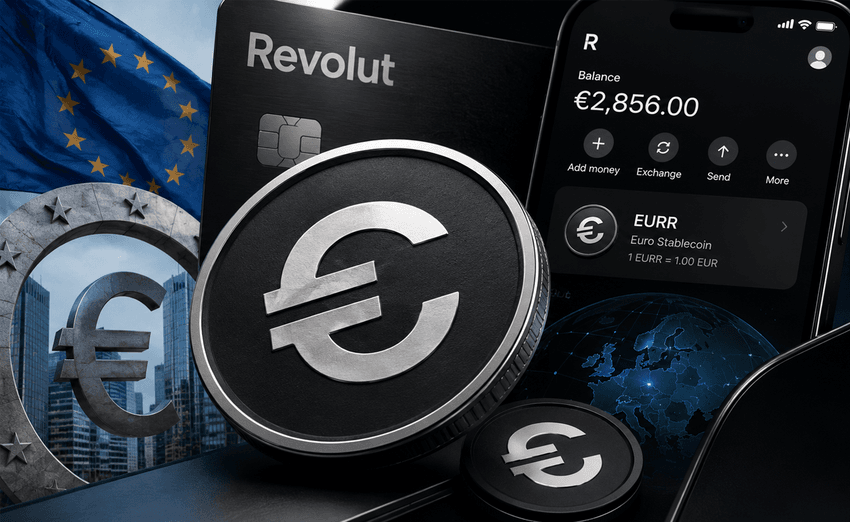

Revolut has launched EURR, its first euro-backed stablecoin, initially making the token available to customers in Denmark, Poland and Portugal. The rollout brings an on-chain version of the euro directly into Revolut's retail ecosystem.
The three initial markets represent approximately 2 million Revolut customers, with the fintech company planning to expand EURR across additional European Economic Area markets later this year.
EURR launches first on Ethereum, allowing eligible customers to access the stablecoin alongside their traditional fiat balances. Revolut also plans to introduce the token on additional blockchain networks and expand support for transfers to external crypto wallets.
The launch comes as Revolut adjusts its European stablecoin offering to comply with the EU's Markets in Crypto-Assets Regulation, or MiCA.
We’re rolling out EURR, our first euro-backed stablecoin, in the Revolut app. pic.twitter.com/UVcns1mytF
— Revolut (@Revolut) August 26, 2026
We’re rolling out EURR, our first euro-backed stablecoin, in the Revolut app. pic.twitter.com/UVcns1mytF
— Revolut (@Revolut) August 26, 2026
Stripe-Owned Bridge Issues EURR
EURR is issued by Bridge Building S.A. in Luxembourg, rather than directly by Revolut. Bridge is a stablecoin infrastructure company acquired by Stripe for $1.1 billion in February 2025.
The token is distributed through Revolut Digital Assets Europe and is backed by reserves managed by Bridge under the MiCA framework.
For users, EURR appears alongside their regular balances within the Revolut retail application. Fiat transactions involving the product carry no additional fees, although standard Revolut crypto trading and remittance limits continue to apply.
Selected customers can already transfer EURR to external wallets. Revolut said that functionality will become more widely available as liquidity for the stablecoin increases.
EURR Connects Revolut Users to On-Chain Finance
Revolut sees the stablecoin as a bridge between its traditional banking infrastructure and the growing on-chain financial ecosystem.
Revolut Head of Crypto Emil Urmanshin said “EURR connects 80 million Revolut customers directly to onchain finance” highlighting the company's ability to combine licensed financial infrastructure with euro-denominated access to crypto markets.
That connection could eventually make EURR useful beyond simple payments or transfers. As liquidity develops, the token could potentially interact with decentralized exchanges, lending protocols and other DeFi applications supporting Ethereum-based assets.
Ethereum is only the first network. Revolut has confirmed that additional blockchains are planned, although it has not provided a complete list or timeline for those integrations.
Revolut Removes USDT From European Markets
The launch also arrives as Revolut prepares to remove Tether's USDT from the European Economic Area and Switzerland.
Customers with remaining USDT balances after August 31 will have those holdings converted into their base currencies.
The change is linked to Revolut's MiCA crypto-asset service provider license, issued by Cyprus regulator CySEC. Under its regulatory framework, Revolut cannot continue offering stablecoins whose issuers have not secured the necessary MiCA authorization.
Revolut is not alone in changing its stablecoin lineup. Several major crypto platforms have already restricted or removed USDT for European customers as MiCA's stablecoin requirements have taken effect.
EURR therefore gives Revolut a euro-denominated alternative designed specifically to operate within Europe's evolving regulatory environment.
MiCA Reshapes Europe's Stablecoin Market
The transition illustrates how MiCA is changing the competitive landscape for stablecoins across Europe. Rather than simply limiting access to non-compliant tokens, regulated financial companies are beginning to introduce new products designed around the EU framework.
For Revolut, EURR is described as only “the first step” in a broader stablecoin strategy. The company plans to expand the token throughout the EEA later in 2026, depending on regulatory, operational and product readiness.
Revolut is also exploring stablecoins linked to other fiat currencies, potentially giving the company a broader range of blockchain-based payment and settlement products.
The move comes as stablecoins increasingly connect traditional finance with crypto infrastructure. Banks, payment companies and fintech platforms are exploring tokens for cross-border payments, settlement, trading and on-chain financial services.
With EURR, Revolut is positioning itself directly within that shift. The combination of Ethereum infrastructure, euro backing and MiCA compliance could give the company a foundation for expanding stablecoin services across its wider European customer base.


