

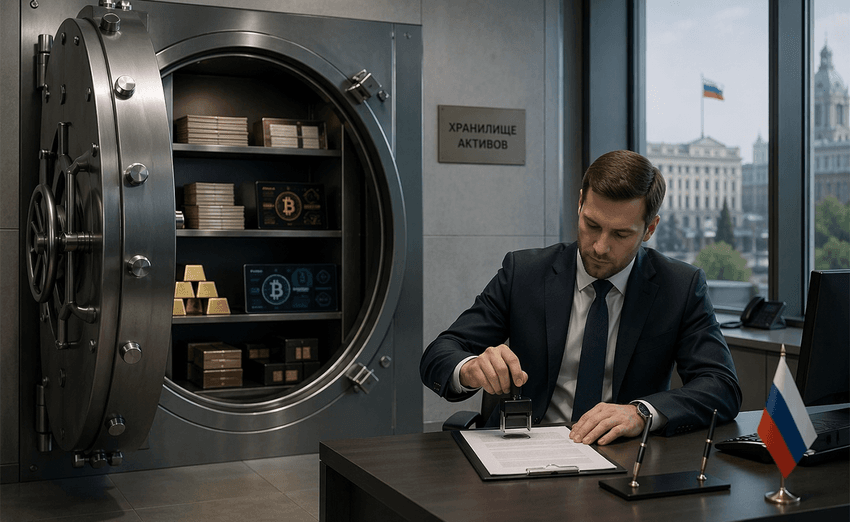

Russia Takes First Step Toward Full Crypto Framework
Russia’s lower house, the State Duma, has officially passed the first reading of a major crypto bill that could reshape how digital assets are used across the country.
The legislation sets the foundation for a regulated crypto market, with the Bank of Russia positioned as the main authority overseeing licensing, compliance, and market activity. This signals a clear shift from uncertainty toward structured oversight, even if the approach remains tightly controlled.
If approved in the coming stages, the law is expected to take effect on July 1, 2026, aligning with broader global efforts to formalize crypto markets.
Crypto Recognized as Property - A Major Legal Shift
One of the most important elements of the bill is its decision to classify cryptocurrency as property under Russian law.
That might sound technical, but it’s a big deal. According to Kaplan Panesh, this classification means crypto can now be legally protected in situations like bankruptcy disputes, asset division, and court proceedings.
This effectively brings crypto into the traditional legal system, giving holders clearer rights and protections-something that has long been a gray area in Russia.
At the same time, the government is drawing a hard line: crypto will not be allowed as a domestic payment method. The Russian ruble remains the only officially recognized currency for everyday transactions inside the country.
Domestic Ban, Global Use - Russia’s Strategic Play
Here’s where things get interesting.
While crypto is restricted at home, the bill explicitly allows its use in cross-border transactions. That creates a dual system where digital assets are controlled domestically but encouraged for international trade.
Panesh made the intent clear, stating that this framework allows Russian companies to “settle with foreign counterparties in cryptocurrency, bypassing sanctions restrictions.”
In other words, crypto is being positioned as a financial workaround-a tool to maintain global trade flows despite ongoing geopolitical and economic pressure.
This approach reflects a growing trend among sanctioned or restricted economies exploring crypto as an alternative settlement layer.
Tiered Access: Not Everyone Gets the Same Freedom
The bill also introduces a tiered system for investors, dividing participants into qualified and non-qualified categories.
Retail investors will face strict limits, with non-qualified individuals allowed to purchase only up to 300,000 rubles (around $3,900) worth of crypto annually. Meanwhile, professional investors and institutions will have far fewer restrictions.
This structure suggests that Russia wants to control retail exposure while still enabling institutional participation and market growth.
Additionally, entities already operating under Russia’s experimental crypto regime will benefit from a simplified onboarding process, making it easier for banks and brokers to expand into digital assets.
A Controlled but Expanding Crypto Market
The bill outlines a clear vision: crypto is allowed, but only within tightly defined boundaries.
Licensed exchanges, brokers, and financial institutions will be the only entities permitted to facilitate crypto circulation. This ensures that the state maintains visibility and control over the ecosystem, even as it opens the door to broader adoption.
The move also signals that Russia is no longer treating crypto as a fringe technology, but as a strategic financial tool-especially in the context of international trade.
What Happens Next
The legislation still needs to pass second and third readings in the State Duma before moving to the Federation Council and ultimately to the president for final approval.
If it clears all stages, Russia will join a growing list of countries that are formalizing crypto within legal and financial systems, but with its own unique twist-restricting internal use while leveraging it externally.
Why This Matters Beyond Russia
This isn’t just a local policy shift.
By recognizing crypto as property and enabling its use in foreign trade, Russia is effectively testing a model where digital assets become part of global settlement infrastructure, especially in environments shaped by sanctions and financial restrictions.
It’s a reminder that crypto’s role isn’t just about speculation-it’s increasingly tied to real-world economic strategy.


