

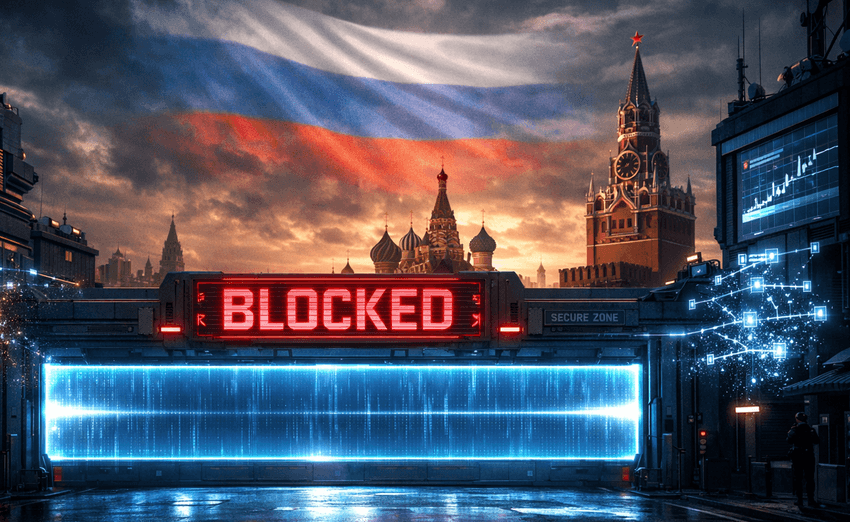

Russia is preparing to tighten its grip on the cryptocurrency market, with industry analysts warning that foreign crypto exchanges could be blocked as early as this summer once the country completes its long-awaited regulatory overhaul.
The shift comes amid broader digital restrictions that have already impacted global platforms like Telegram, WhatsApp, and YouTube. Now, major international crypto exchanges may be next.
Moscow Moves Toward Full Crypto Regulation
Russian authorities are working to implement legislative changes that will formally regulate crypto investment and exchange operations by July 1. The upcoming framework will replace the current temporary regime governing digital asset activity.
Regulators have gradually softened their stance over the past year. In 2025, the Bank of Russia proposed an “experimental legal regime” for crypto transactions and later legalized crypto derivatives for “highly qualified investors.” In December, it introduced a new concept recognizing cryptocurrencies and stablecoins as “monetary assets” potentially expanding access even to retail investors under certain conditions.
However, with licensing for domestic platforms expected to begin soon, analysts believe that access to global exchanges such as Bybit and OKX may be restricted once local alternatives are operational.

Russia’s telecom watchdog, Roskomnadzor, has previously used DNS-level blocking to restrict access to foreign platforms. Similar measures could be applied to crypto exchanges that fail to obtain Russian licenses or partner with domestic intermediaries.
Risk of Market Fragmentation
Experts caution that a blanket ban could push a large portion of trading activity into the shadow economy.
Zuborev noted that if foreign exchanges are not allowed to operate through local brokers or agents, the market could fragment and become far harder to regulate, undermining the very goal of the new framework.
Legal analyst Ignat Likhunov of Cartesius highlighted another enforcement challenge: most global exchanges do not store Russian user data on domestic servers, potentially violating Russia’s data localization laws. This could provide authorities with legal grounds for blocking access.
Still, enforcing restrictions may prove difficult. Dmitry Machikhin, founder of AML firm BitOK, suggested Russia could follow a “Belarusian scenario,” where only companies registered within a state-controlled tech hub can process crypto transactions.
Belarus banned citizens from trading on foreign exchanges in 2024, but Machikhin questioned whether Russia could realistically replicate that model. Even after Binance officially exited the Russian market, at least one million Russian users reportedly continue to access the platform.
Financial Institutions Eye Crypto Fees
Behind the regulatory push lies a clear economic incentive.
Russian authorities are keen to redirect the estimated $15 billion in annual commissions currently flowing to foreign crypto exchanges back into domestic financial infrastructure.
Established institutions such as the Moscow Exchange (MOEX) have already signaled interest in entering the crypto market once regulations allow it. Sergey Shvetsov, Chairman of MOEX’s Supervisory Board, recently stated that Russia’s largest stock exchange intends to attract crypto trading activity as soon as the legal framework is in place.
The move reflects growing appetite among Russian financial firms to capitalize on crypto-related revenue streams rather than allowing foreign platforms to dominate the market.
A Turning Point for Russia’s Crypto Market
Russia’s evolving stance represents a pivotal shift. After years of regulatory ambiguity, the government now appears ready to formalize crypto trading - but under tighter state control.
If implemented, restrictions on foreign exchanges could reshape how Russian users access digital assets, potentially driving consolidation toward licensed domestic platforms.
Whether Moscow can effectively enforce such measures without pushing users underground remains uncertain. What is clear is that Russia is moving toward a more centralized and controlled crypto ecosystem, with global exchanges potentially facing significant barriers in one of the world’s largest emerging digital asset markets.

![The COMPLETE Beginner’s Crypto Mistakes Guide [2026]](/_next/image?url=https%3A%2F%2Fcdn.airdrops.com%2Fnews%2Fthe-complete-beginners-crypto-mistakes-guide-2026%2Fimage-featured.png%3F1771329185049&w=3840&q=75)

