

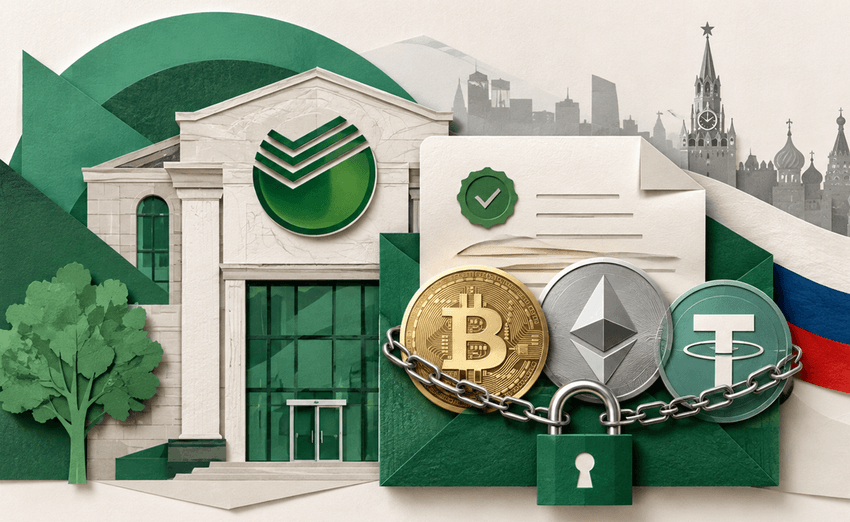

Sberbank, Russia’s largest bank, plans to accept Bitcoin, Ethereum and Tether’s USDT as collateral for conventional loans, expanding its involvement in the country’s emerging regulated cryptocurrency market.
Deputy Chairman Anatoly Popov revealed the plans on August 28, saying the bank intends to broaden its existing work with crypto-backed lending. However, Ethereum and USDT will only become eligible after receiving the necessary approval from the Bank of Russia.

Sberbank has not yet announced a launch date, lending rates, collateral requirements or which customers will initially qualify for the service.
Bitcoin-Backed Lending Already Tested
The initiative builds on Sberbank’s earlier experiments with cryptocurrency-backed loans. In December 2025, the bank confirmed it was exploring ruble-denominated lending secured by digital assets while working with regulators on the necessary infrastructure.
Sberbank subsequently completed a pilot Bitcoin-backed loan involving Russian mining company Intelion Data. Bitcoin produced through mining operations was pledged as collateral, giving the bank practical experience with custody, collateral valuation and enforcement procedures.
The latest announcement suggests Sberbank now wants to expand that model beyond Bitcoin once Russia’s regulatory framework allows additional cryptocurrencies to be incorporated into banking products.
The planned offering would remain fundamentally different from decentralized lending protocols. Sberbank would issue traditional loans while holding crypto inside a regulated custody structure, rather than connecting borrowers to permissionless DeFi markets.
Russia's New Crypto Framework Takes Effect
Sberbank’s plans coincide with a major shift in Russia’s approach to digital assets. The country’s new comprehensive cryptocurrency framework takes effect on September 1, 2026, creating a regulated market for crypto trading and custody.
Banks, brokers, asset managers, cryptocurrency exchanges and digital depositories will be able to participate through approved structures.
Retail investors classified as non-qualified will need to pass a knowledge test before purchasing eligible cryptocurrencies. Their purchases will also be capped at 300,000 rubles annually through each intermediary.
Qualified investors will have broader access and will not face the same monetary restriction, although testing requirements will still apply.
Importantly, the framework does not legalize cryptocurrency payments for everyday goods and services in Russia. Crypto can be traded and held under regulated conditions, while its use for domestic payments remains prohibited.
Cross-border settlements involving exporters and importers can still be permitted under separate rules.
Sberbank Builds Crypto Trading and Custody Infrastructure
Sberbank is simultaneously developing the infrastructure needed to support Russia's regulated crypto market.
The bank aims to launch a digital depository by December 1, 2026, designed to record customer ownership, manage wallets and facilitate cryptocurrency deposits, withdrawals and settlements.
However, Sberbank has not yet disclosed which cryptocurrencies the system will support or provided details about fees, withdrawal limits and custody arrangements.
The bank already has experience with tokenized financial infrastructure. Sberbank joined the Bank of Russia's register of approved information system operators in 2022 and has since issued digital financial products through its platform.
Adding crypto-backed lending would bring another traditional banking service into that ecosystem.
ETH and USDT Still Need Regulatory Approval
Despite Sberbank's ambitions, the final decision rests with the Bank of Russia.
The central bank must complete additional standards covering which cryptocurrencies can circulate publicly, along with requirements for custody, accounting and customer protection.
Those decisions will determine whether Ethereum and USDT can officially become collateral within Sberbank's lending products.
The bank will also need to establish how it manages one of the biggest challenges surrounding crypto-backed loans: rapid changes in collateral value. Commercial terms will need to explain loan-to-value ratios, margin requirements and what happens when cryptocurrency prices fall sharply.
Market participants have until July 1, 2027, to obtain the necessary licenses and comply with Russia's new framework, giving financial institutions a transition period to build their infrastructure.
For now, Sberbank's expansion remains a plan rather than a product customers can access immediately. Still, the move demonstrates how Russia's new crypto regulations could begin connecting Bitcoin, Ethereum and stablecoins with traditional banking services as the country's regulated digital asset market takes shape.


