

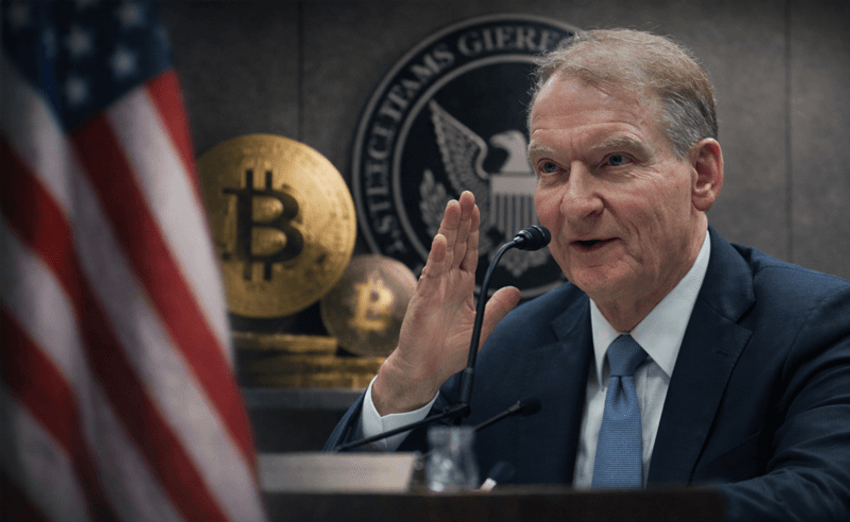

A Clean Break From the Gensler Era
When Paul Atkins officially took over the U.S. Securities and Exchange Commission (SEC) on April 21, 2025, the direction of U.S. crypto regulation changed almost immediately.
His appointment followed a political reset. During the 2024 campaign, Donald Trump made removing former SEC chair Gary Gensler a central promise to the crypto industry. That pledge became reality after Trump’s election win, with Gensler stepping down in early 2025.
Before Atkins was even confirmed, interim chair Mark Uyeda had already started softening the agency’s tone, signaling that a broader shift was underway.
When I took office 1 year ago, I promised a new day at the SEC. And we've delivered.
— Paul Atkins (@SECPaulSAtkins) April 20, 2026
With our agenda to restore regulatory clarity, strengthen competitiveness, and accelerate innovation, we are making sure the U.S. remains the world’s strongest and safest place to invest. pic.twitter.com/HtZ4tdB3gw
When I took office 1 year ago, I promised a new day at the SEC. And we've delivered.
— Paul Atkins (@SECPaulSAtkins) April 20, 2026
With our agenda to restore regulatory clarity, strengthen competitiveness, and accelerate innovation, we are making sure the U.S. remains the world’s strongest and safest place to invest. pic.twitter.com/HtZ4tdB3gw
Enforcement Pullback and Policy Reset
The most visible change over the past year has been the SEC’s retreat from aggressive enforcement.
Under Atkins, the agency began dropping cases and investigations against several crypto firms, including Coinbase, which had previously been at the center of regulatory battles. This marked a sharp contrast to the prior strategy, where enforcement actions were often used to define policy in the absence of clear legislation.

The shift wasn’t just rhetorical. SEC activity data suggests a meaningful slowdown in enforcement, reflecting a deliberate pivot toward a more industry-friendly approach.
Crypto-Friendly Moves Gain Momentum
Beyond pulling back on enforcement, the SEC under Atkins actively moved to open doors for the crypto industry.
Over the past 12 months, the regulator approved multiple exchange-traded funds (ETFs) tied to digital assets, expanding institutional access and legitimizing crypto exposure within traditional financial markets.
At the same time, the SEC signed a coordination agreement with the Commodity Futures Trading Commission (CFTC), aiming to reduce turf battles over who controls what in crypto regulation.
One of the most consequential moves came through an interpretative notice, where the SEC indicated that most cryptocurrencies would not be treated as securities under federal law. While not a full legal overhaul, the statement provided much-needed clarity for companies operating in the space.
The Missing Piece: Market Structure Law
Despite the regulatory shift, one major issue remains unresolved.
The SEC still lacks a comprehensive legal framework defining its authority over digital assets. That clarity depends on Congress passing a market structure bill, which has been debated but not finalized.
Without it, the current approach relies heavily on interpretation rather than codified law, leaving room for future reversals depending on political shifts.
In practice, this means the industry is operating in a more favorable environment-but still without long-term certainty.
Political Pressure Builds
While many crypto companies and investors have welcomed the SEC’s new direction, the changes have not gone unchallenged.
Democratic lawmakers have raised concerns about potential conflicts of interest, particularly in cases where enforcement actions were dropped against firms linked to Trump or his associates.
Among the most vocal critics is Elizabeth Warren, who accused Atkins of misleading Congress regarding the agency’s enforcement record.
In an April 15 letter, she pointed to SEC data showing that 2025 saw the lowest number of enforcement actions in a decade, arguing that the agency may be pulling back too far from its oversight responsibilities.
A Different SEC, But Not a Finished Story
One year into Atkins’ tenure, the contrast with the previous administration is clear.
The SEC has moved from confrontation to cooperation, from lawsuits to guidance, and from uncertainty to partial clarity. The crypto industry now faces fewer legal threats and more opportunities to operate within the U.S. financial system.
But the broader picture is still evolving. Without a finalized market structure law, the long-term direction of U.S. crypto regulation remains tied to politics as much as policy.
For now, the industry is benefiting from a friendlier regulator-but whether that approach becomes permanent will depend on what happens next in Congress.


