

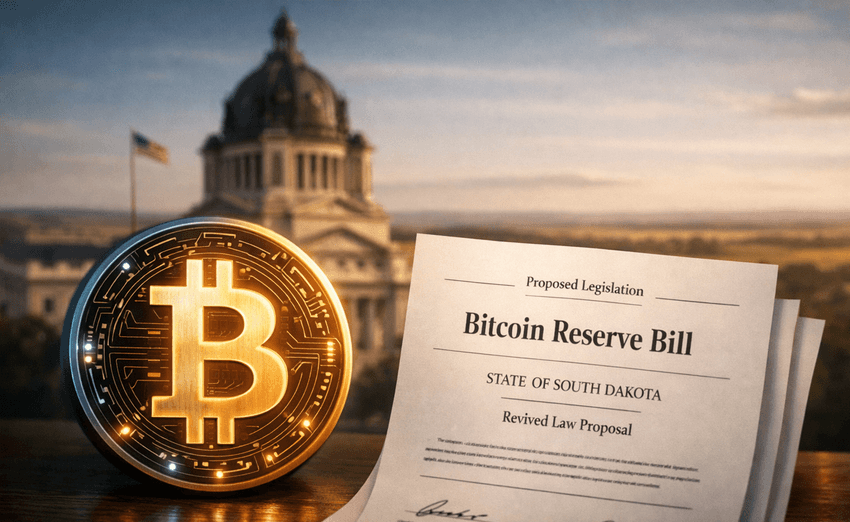

South Dakota is once again weighing whether Bitcoin belongs on its balance sheet. A Republican lawmaker has revived a long-dormant proposal that would allow the state to invest a portion of public funds into Bitcoin, reopening a debate that has been gaining momentum across the United States.
South Dakota Advances a Bitcoin Investment Plan
On Tuesday, Logan Manhart, a member of the South Dakota House of Representatives, reintroduced a Bitcoin reserve proposal that had been shelved roughly a year ago. The updated bill, House Bill 1155, would authorize the State Investment Council to allocate up to 10% of state revenues to Bitcoin as part of a broader strategy to promote what Manhart describes as “strong money” and a “strong state.”
While the core idea mirrors his earlier 2025 proposal, the revived version adds far more detailed provisions around custody, security, and governance, reflecting lawmakers’ growing focus on operational risk.
Tight Custody and Security Requirements
Under HB 1155, any Bitcoin purchased by the state would need to be held directly by the State Investment Council using a secure custody solution or managed by a qualified custodian acting on the council’s behalf. As an alternative, the bill allows exposure through a regulated exchange-traded product, rather than direct ownership.
The proposal goes into granular detail on how private keys must be handled. Keys would be required to remain in hardware-secured and encrypted environments, used only through end-to-end encrypted channels, and kept under the exclusive authority of the State Investment Council. Access controls would rely on password-less authentication stored on government devices, while private-key hardware would be distributed across at least two geographically distinct secure data centers.
To further reduce risk, the bill mandates a multi-party governance structure, comprehensive transaction logging, regular code audits, penetration testing, and a formal disaster recovery strategy maintained by any custody provider.
A Familiar Proposal With Sharper Edges
Despite the expanded security language, the overall structure of the bill remains largely unchanged from Manhart’s earlier effort. The proposal would legally add Bitcoin to the list of assets the State Investment Council may hold, alongside traditional investments such as government bonds and exchange-traded funds.
If passed and signed into law, South Dakota would join a small but growing group of U.S. states that have moved toward Bitcoin or crypto reserves. As of January 2026, Texas, Arizona, and New Hampshire had enacted legislation allowing states to either store confiscated crypto or invest directly in Bitcoin, while similar proposals continue to surface elsewhere.
State Momentum, Federal Friction
South Dakota’s renewed push comes amid a broader wave of state-level experimentation. Earlier this month, Chris Rose introduced West Virginia’s Inflation Protection Act, which would permit the state treasury to invest in precious metals, certain digital assets, and stablecoins. Under that proposal, only assets with a market capitalization above $750 billion would qualify, a threshold currently met only by Bitcoin.
At the federal level, however, progress has been slower. Although President Donald Trump signed an executive order in March 2025 establishing a Strategic Bitcoin Reserve and a Digital Asset Stockpile, implementation has been bogged down by legal and administrative hurdles.
According to Patrick Witt, the executive order did not explicitly authorize direct Bitcoin purchases, complicating efforts to operationalize a national reserve. Those constraints have left states to move ahead independently, crafting their own frameworks while Washington debates its next steps.
A Signal, Not a Guarantee
HB 1155 still faces legislative scrutiny, and passage is far from guaranteed. Yet its revival underscores a clear trend: Bitcoin is increasingly being discussed not just as a speculative asset, but as a strategic reserve candidate. Whether South Dakota ultimately joins that list will depend on lawmakers’ appetite for risk-and their confidence that the safeguards outlined in the bill are enough.


