

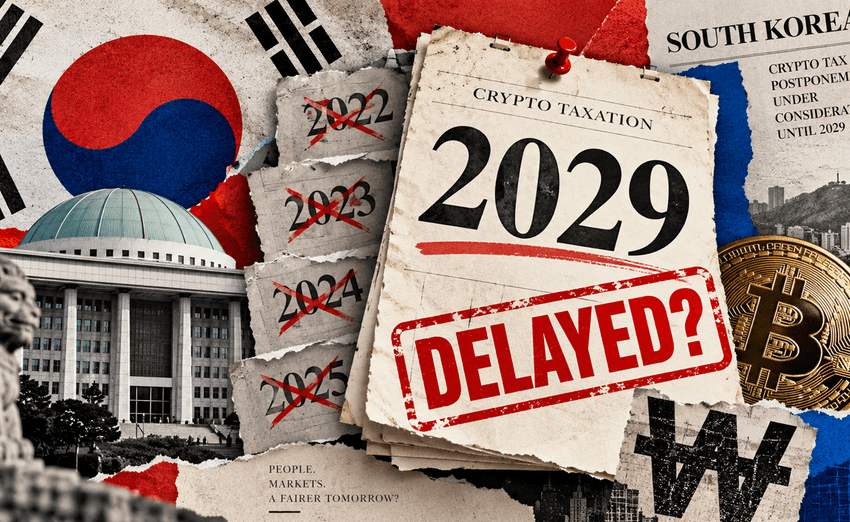

South Korea is considering delaying its cryptocurrency capital gains tax for a fourth time, potentially pushing implementation from January 2027 to 2029.
According to local publication Business Korea, lawmakers and government officials are increasingly concerned about whether the country can enforce the tax consistently across domestic and international cryptocurrency platforms.
Under existing legislation, annual cryptocurrency gains exceeding 2.5 million won (approximately $1,800) would face a combined 22% tax, consisting of a 20% national levy and a 2% local tax.
The framework also does not allow investors to carry losses forward into subsequent tax years.
Originally scheduled for 2022, the tax was postponed to 2023, then 2025, and subsequently January 1, 2027.
Despite years of legislative debate, South Korea has yet to begin collecting the proposed cryptocurrency gains tax.
US Reporting Delays Complicate Tax Enforcement
A major obstacle involves the OECD's Crypto-Asset Reporting Framework (CARF), which facilitates the exchange of cryptocurrency transaction information between participating jurisdictions.
South Korea expects to begin exchanging information under the framework in 2027.
However, the United States is not scheduled to participate until 2029, potentially creating a two-year information gap.
Officials are concerned that investors using overseas cryptocurrency platforms could be harder to monitor than those trading through domestic exchanges.
This discrepancy could create unequal enforcement conditions for Korean cryptocurrency investors, particularly when international transaction records remain unavailable.
On October 16, Democratic Party lawmaker Park Min-gyu introduced legislation linking tax implementation to the second year following South Korea's first CARF information exchange.
Under the anticipated timetable, that would move the starting date to 2029.
Lawmakers Propose Delays Until 2030
Support for postponing cryptocurrency taxation extends across South Korea's political parties, although lawmakers differ on the appropriate approach.
Some opposition People Power Party lawmakers have proposed extending implementation until 2030, while others have suggested eliminating the tax altogether.
A National Assembly petition requesting another two-year delay collected more than 50,000 signatures, qualifying it for formal legislative review.
The debate also reflects concerns among younger investors who view cryptocurrency as an alternative investment opportunity amid housing affordability and financial pressures.
However, none of the proposed postponements has become law, and the current January 2027 implementation deadline remains legally binding.
Crypto Exchanges Warn of Compliance Challenges
On October 20, finance ministry officials met representatives from South Korea's five major cryptocurrency exchanges and the Digital Asset Exchange Alliance (DAXA) to discuss implementation readiness.
Industry representatives warned that premature taxation could encourage investors to move their trading activity toward overseas platforms or decentralized finance services.
Domestic exchanges also face technical difficulties calculating acquisition costs for assets transferred from external wallets and international platforms.
Questions remain over the treatment of more complex cryptocurrency activities, including staking and airdrops.
Meanwhile, critics of another postponement argue that repeated delays undermine tax fairness and regulatory predictability, particularly when other major economies already tax cryptocurrency profits.
Final Decision Expected Before December
South Korea's broader cryptocurrency regulatory framework also remains unfinished, including proposed legislation covering stablecoins and digital asset service providers.
The National Assembly is expected to review cryptocurrency tax amendments during November, with a decision potentially arriving in late November or early December.
Until lawmakers approve changes, January 1, 2027, remains the official starting date for the country's 22% cryptocurrency gains tax.
A postponement until 2029 would give regulators additional time to establish international reporting arrangements and improve domestic compliance systems.
For now, South Korea's latest debate centers on whether tax enforcement can be applied consistently across domestic and overseas cryptocurrency markets.


