

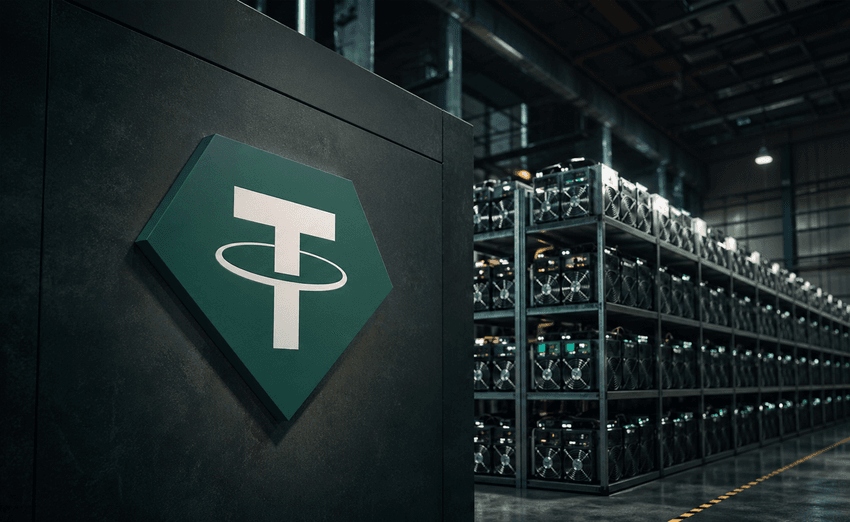

Tether Unveils New Mining Hardware Strategy
Stablecoin giant Tether has revealed plans to develop a new generation of modular Bitcoin mining systems, marking a major expansion beyond its core USDT business.
The initiative is being built in partnership with Canaan Inc. and ACME Swisstech, combining hardware expertise with Tether’s growing ambitions in mining and infrastructure.
Unlike traditional rigs, these new systems are designed to separate compute, power, and cooling components, allowing operators to optimize each element independently.
A Break From Traditional Mining Machines
Most Bitcoin mining hardware today is built as fixed, all-in-one units. That approach makes upgrades expensive and limits flexibility.
Tether’s new design flips that model.

This means mining operators could upgrade specific parts of their systems without replacing entire machines, improving both efficiency and cost control.
Built for Industrial-Scale Mining
This isn’t hardware for hobbyists.
The project is focused on large-scale mining operations, with a design philosophy that moves away from retail plug-and-play devices toward a more industrial, customizable setup.
According to ACME Swisstech President Giv Zanganeh, the goal is to create systems that are “radically different” from what’s currently available, using a full-stack engineering approach tailored for high-performance environments.
Competing With Big Players
Tether isn’t alone in exploring modular mining.
Companies like Block, led by Jack Dorsey, have already introduced similar concepts with their Proto Rig systems.
This suggests a broader industry shift toward flexible, upgradeable mining infrastructure, especially as profitability pressures increase.
Mining Economics Are Changing
The timing of Tether’s move isn’t random.
Bitcoin mining has become more challenging in recent months, with Bitcoin dropping nearly 40% from its previous highs. Lower prices and rising costs are forcing miners to rethink efficiency and scalability.
At the same time, many mining firms are pivoting toward AI computing, using their hardware and energy infrastructure for alternative revenue streams.
Tether’s modular approach could help operators stay competitive by improving hash rate efficiency and operational flexibility.
Part of a Bigger Expansion Strategy
This mining initiative is just one piece of Tether’s broader growth plan.
The company has already released an open-source Mining OS and SDK, and is also investing in decentralized AI infrastructure through its QVAC technology.
Together, these moves show that Tether is evolving from a stablecoin issuer into a full-stack infrastructure player across crypto and computing.
What’s Still Unknown
Despite the announcement, key details are still missing.
Tether has not revealed a release timeline, pricing, or visual designs for the new mining hardware. That suggests the project is still in early development stages.
However, the direction is clear: Tether wants more control over the foundations of Bitcoin mining, not just the financial layer built on top of it.


