

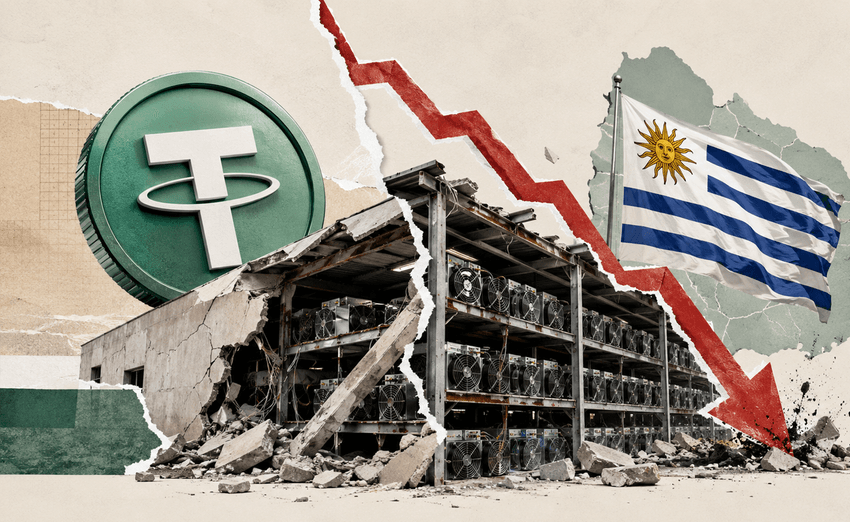

Tether has abandoned an estimated $120 million Bitcoin mining project in Uruguay after a contractual dispute with state-owned electricity provider UTE brought operations at two mining sites to an end. The project had originally been positioned as a testing ground for a broader expansion across South America.
At the heart of the dispute was how much electricity Tether’s facilities were entitled to receive. According to Reuters, Tether interpreted the contracted power level as a minimum that could potentially increase as its operations expanded. UTE, however, considered the agreed amount to be a fixed maximum limit.
The two mining facilities, located in Uruguay’s Florida department, initially operated successfully and generated revenue. Problems emerged as electricity demand increased, with the facilities reportedly experiencing periods when they could not obtain enough power to maintain full operations.
Attempts to Renegotiate the Contract Fail
Both parties attempted to resolve the disagreement through a revised electricity agreement, but negotiations ultimately broke down. Reuters reported that Tether representatives did not attend a planned signing of the updated contract, according to meeting records.
The disagreement reportedly became more difficult following the arrival of President Yamandú Orsi’s government in March 2025 and subsequent changes to UTE’s leadership. Sources cited by Reuters said the utility’s new management adopted a tougher approach toward the negotiations.
Tether’s local entity, Microfin, eventually stopped paying its electricity bills. In June 2025, it informed UTE that it intended to terminate the contracts. With payments outstanding and no revised agreement signed, UTE disconnected electricity to both mining sites on July 25, 2025.
Several months later, Tether notified Uruguayan labor authorities that it would close the operations and lay off most employees associated with the project.
A $120 Million Experiment Comes to an End
A source familiar with the project estimated that Tether invested approximately $120 million in the Uruguay operation, although the company never publicly confirmed the exact amount.
When Tether announced its entry into Uruguay in May 2023, it highlighted the country's renewable energy production, reliable electricity grid and political stability. The company viewed the country as an attractive location for testing its Bitcoin mining strategy.
One former contractor told Reuters that Uruguay was intended to serve as a “first step” toward expansion into Brazil, Paraguay and Argentina.
Tether’s ambitions extended far beyond the two facilities. In June 2025, CEO Paolo Ardoino said the company intended to become the world’s largest Bitcoin miner by the end of that year. At the time, Tether said it had invested more than $2 billion across 15 energy and mining sites in Uruguay, Paraguay and El Salvador.
Tether Continues Mining Expansion Elsewhere
Despite withdrawing from the Uruguay facilities, Tether has not abandoned its broader Bitcoin mining strategy. The company has continued investing in energy and mining infrastructure throughout Latin America.
Among its moves, Tether acquired a 70% stake in renewable energy producer Adecoagro and later reached an agreement to use surplus electricity generated by the company for Bitcoin mining.
It has also developed an open-source operating system for mining, acquired an 8.2% stake in mining finance company Antalpha and pursued modular mining infrastructure alongside Canaan and ACME Swisstech.
These investments form part of a much broader diversification strategy for the issuer behind USDT, the world's largest stablecoin, which has approximately $183 billion in circulation.
Bitcoin Mining Economics Remain Challenging
The Uruguay collapse also highlights the increasingly difficult economics of large-scale Bitcoin mining. Electricity prices remain one of the industry's most important variables, particularly when Bitcoin prices are under pressure.
Mining companies are simultaneously facing competition from another potentially more lucrative use for energy-intensive infrastructure: high-performance computing and artificial intelligence. Some miners have already redirected electricity and data center capacity toward AI workloads.
Crypto mining specialist Nicolas Ribeiro described the mining industry as “extremely dynamic” with companies regularly relocating or shutting facilities depending on electricity costs and market conditions.
While Uruguay offers reliable infrastructure and substantial renewable energy generation, its relatively high electricity prices make large-scale Bitcoin mining less competitive than in jurisdictions offering cheaper power.
For Tether, the failed Uruguay experiment represents a significant setback, but its continued investments elsewhere suggest the company’s broader Bitcoin mining ambitions remain intact.


