

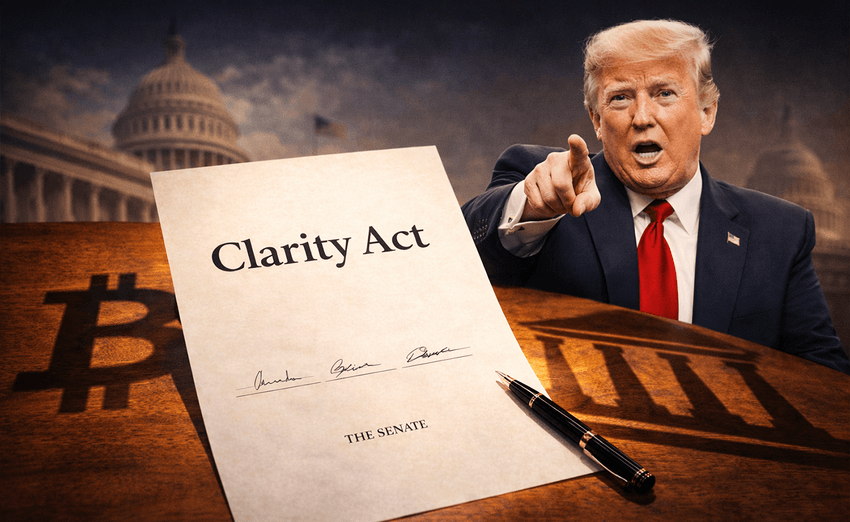

Trump Targets Banks Over Crypto Legislation
Donald Trump has criticized major banking groups for delaying progress on the Digital Asset Market CLARITY Act, accusing them of trying to undermine the stablecoin framework already established under the GENIUS Act.
In a post on Truth Social, Trump argued that banks were attempting to weaken the legislation by pushing for stricter restrictions on stablecoin yield payments.

He added that the United States must finalize its crypto market structure rules quickly, warning that regulatory uncertainty could drive innovation toward other jurisdictions.
Stablecoin Yield Debate at the Center
The dispute centers on how stablecoins should handle yield or interest-like rewards.
The GENIUS Act, passed by Congress in July, created the first federal framework for stablecoin issuers in the United States. While the law established licensing, reserve, and custody requirements, it also prohibits issuers from directly offering yield payments to token holders.
However, the legislation still allows third-party platforms such as crypto exchanges to provide yield incentives, which banking groups argue creates a regulatory loophole.
Banks are pushing lawmakers to include language in the CLARITY Act that would ban all forms of stablecoin yield payments. They claim that allowing such rewards could encourage consumers to move funds out of traditional bank deposits and into digital assets.
Crypto Industry Pushback
Crypto companies and industry advocates have strongly opposed the banks’ proposal, arguing that banning stablecoin rewards would harm innovation and limit competition.
The disagreement has already disrupted legislative progress. Major industry lobbyist Coinbase withdrew its support for the bill earlier this year over the issue, leading the Senate Banking Committee to postpone its markup session.
Since then, lawmakers have yet to schedule another vote.
Despite multiple negotiations, the divide between the banking sector and the crypto industry remains unresolved.
White House Mediation Efforts
The dispute has prompted a series of negotiations at the White House. Representatives from banks, crypto firms, and advocacy groups have participated in at least three meetings aimed at reaching compromise language that could move the bill forward.
So far, those talks have not produced a final agreement.
The stalemate leaves the broader U.S. crypto regulatory framework incomplete at a time when policymakers are increasingly concerned about global competition in digital asset innovation.
Pressure Ahead of the Midterms
Trump has framed passage of the CLARITY Act as a major policy objective ahead of the upcoming midterm elections.
Crypto lobbying groups have reportedly raised more than $200 million to support candidates who favor digital asset legislation, making the industry a growing political force in Washington.
The president has repeatedly argued that clear rules are necessary to keep crypto development within the United States rather than allowing it to migrate overseas.
House Leaders Offer Alternative Path
Meanwhile, French Hill, chairman of the House Financial Services Committee, suggested that the Senate could simply adopt the House version of the CLARITY Act if it cannot reach consensus on its own draft.
Hill noted that the House bill passed with bipartisan support, including votes from 78 Democrats, and already reinforces the GENIUS Act’s core principle that stablecoins function as payment instruments rather than investment products.
For now, however, negotiations remain ongoing - leaving one of the most consequential pieces of U.S. crypto legislation still unresolved.


