

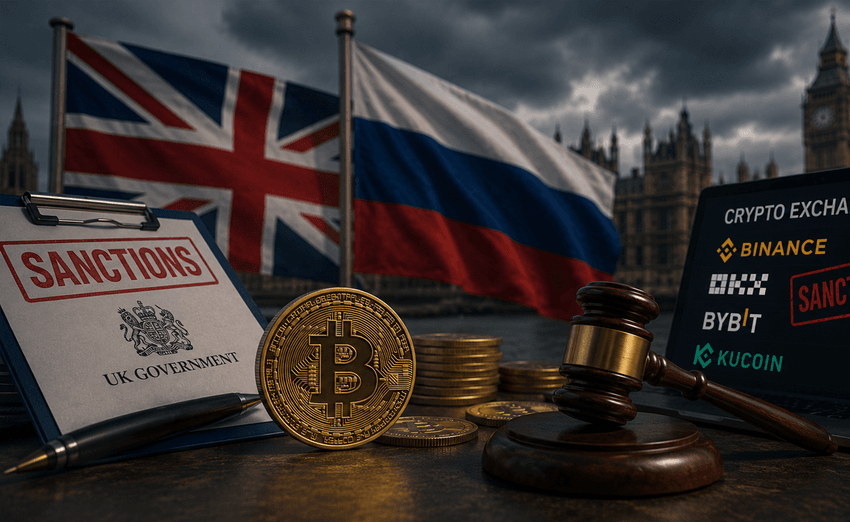

UK Expands Russia Sanctions Into Crypto Sector
The government of the United Kingdom announced a new wave of sanctions targeting 18 individuals and organizations allegedly connected to Russia’s sanctions evasion infrastructure.
For the first time ever, the UK applied its Russia sanctions framework directly against cryptocurrency exchanges and virtual asset businesses accused of helping facilitate financial flows linked to the Kremlin.
The sanctions were introduced under the Russia (Sanctions) (EU Exit) Regulations 2019 and automatically freeze any UK-linked assets tied to the designated entities.
The measures also prohibit British citizens and companies from engaging in business with the sanctioned organizations.
Crypto Exchanges Accused of Supporting Russian Financial Networks
Several crypto-related firms were included in the sanctions package.
Among the targeted entities were Exmo Exchange Limited, Bitpapa, Aifory LLC, and Rapira Group LLC.
UK authorities allege these firms provided financial services and economic resources linked to A7 Limited Liability Company, which officials describe as a critical component of Russia’s sanctions circumvention infrastructure.
Other crypto and financial entities sanctioned include Huobi, Nueva Cryptologia Sociedad, and several financial institutions tied to Russia and Kyrgyzstan.
The UK also sanctioned multiple Georgian firms accused of facilitating transactions on behalf of Russian networks.
UK Says Russia Used Crypto and Shadow Banking Networks
British authorities say Russia increasingly relies on crypto infrastructure and informal financial systems to bypass international sanctions imposed after the invasion of Ukraine.
The sanctions package specifically targeted the so-called A7 network, which reportedly moved more than $90 billion last year through oil transactions and alternative payment channels.
Officials claim the network helped funnel money into Russia’s military economy while circumventing restrictions imposed by Western governments.
A Kyrgyz financial institution identified as Open Joint Stock Company Eurasian Savings Bank was also sanctioned for allegedly assisting A7-linked payment activity.
According to blockchain analytics firm Elliptic, this marks the first time the UK has formally used its Russia sanctions powers against crypto exchanges.
UK Warns There Will Be “No Safe Haven”
UK Foreign Secretary Yvette Cooper said the government is adapting its sanctions strategy to counter Russia’s evolving financial tactics.

She added that Britain intends to continue evolving its enforcement capabilities alongside international partners to protect the global financial system.
The UK government emphasized that the new sanctions are specifically designed to target gaps inside Russia’s crypto and shadow banking sectors that have allowed sanctions evasion to continue.
More Than 3,300 Targets Already Sanctioned
Since the start of the war in Ukraine, the UK has sanctioned more than 3,300 individuals, companies, and financial entities connected to Russia.
British officials estimate the measures have denied Russia approximately $450 billion in potential economic support, an amount London says equals roughly two years of funding for Moscow’s war effort.
The UK also pointed to Russia’s weakening economic forecasts as evidence that sanctions pressure is having an effect.
According to officials, Russia has lowered its projected economic growth outlook for 2026 from 1.3% to just 0.4%.
Crypto Industry Faces Growing Geopolitical Pressure
The sanctions highlight the growing role cryptocurrencies now play in geopolitical enforcement and international financial restrictions.
While blockchain networks can provide faster and more decentralized transfers, regulators increasingly view crypto platforms as potential channels for sanctions evasion, capital flight, and illicit finance.
The latest UK measures could also increase pressure on global exchanges to strengthen compliance controls, transaction monitoring, and sanctions screening procedures.
As Western governments continue tightening oversight, crypto firms operating internationally may face growing scrutiny over how their platforms interact with sanctioned jurisdictions and politically exposed networks.


