

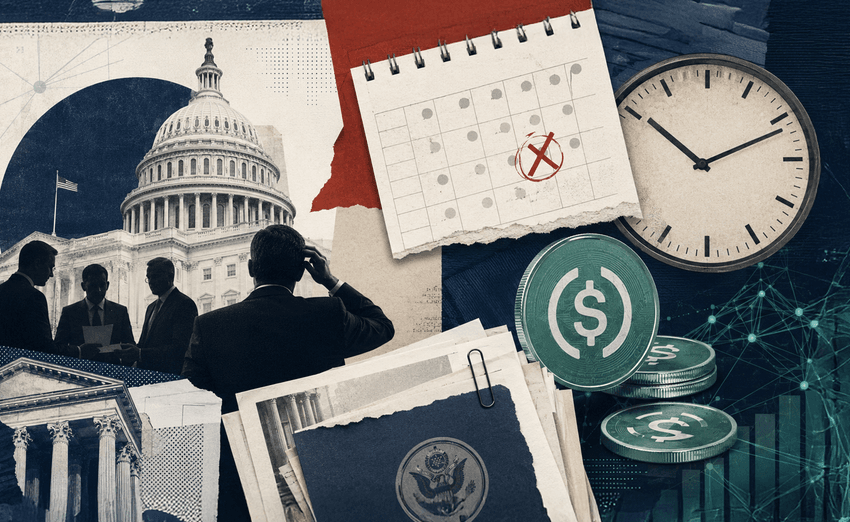

U.S. financial regulators have missed the one-year deadline to finalize the rules needed to fully implement the GENIUS Act, the landmark legislation establishing the country's first comprehensive federal framework for payment stablecoins. Although the deadline expired on July 18, 2026, several of the most important regulatory packages remain in the proposal stage.
The Guiding and Establishing National Innovation for U.S. Stablecoins (GENIUS) Act, signed into law by President Donald Trump on July 18, 2025, introduced nationwide standards covering stablecoin reserves, redemption rights, disclosures, licensing, and regulatory oversight.
Under Section 13 of the law, agencies including the Office of the Comptroller of the Currency (OCC), Federal Reserve, Federal Deposit Insurance Corporation (FDIC), National Credit Union Administration (NCUA), the Treasury Department, and state regulators were instructed to complete implementing regulations within one year. However, the legislation does not automatically delay the law's implementation if regulators miss that deadline, leaving the overall framework intact.
Several Major Rules Remain Unfinished
Although regulators have published multiple proposals, none of the key rule packages have been finalized. The OCC has proposed regulations covering reserve assets, liquidity requirements, custody, capital standards, reporting obligations, and risk management, while the FDIC has issued its own proposals addressing reserve requirements, redemption procedures, and deposit insurance treatment.
Meanwhile, the NCUA has released separate proposals covering licensing, operational standards, and risk management, but public consultation on several of those measures only concluded shortly before the statutory deadline, making final approval impossible within the required timeframe.
Additional proposals involving the Federal Reserve, Financial Crimes Enforcement Network (FinCEN), and Office of Foreign Assets Control (OFAC) also remain under review. These include new customer identification requirements, anti-money laundering standards, sanctions compliance rules, and record-keeping obligations, with some consultation periods extending well beyond July.
As a result, important parts of the stablecoin regulatory framework remain incomplete, even though financial institutions continue preparing for future compliance.
Industry and States Await Final Guidance
The unfinished rules leave several major policy questions unresolved. Industry participants have submitted extensive feedback on the proposed regulations, requesting modifications before the final framework is adopted.
Among the most notable recommendations, BlackRock urged the OCC to remove a proposed 20% limit on tokenized reserve assets, formally recognize certain U.S. Treasury exchange-traded funds as eligible reserves, and expand the list of approved reserve assets to include selected floating-rate Treasury securities.
State regulators are also waiting for greater clarity. The Treasury Department has yet to finalize standards determining when state regulatory systems will be considered "substantially similar" to the federal framework. That decision will determine whether issuers managing less than $10 billion in outstanding stablecoins can continue operating primarily under state supervision.
Meanwhile, New York's Department of Financial Services has already proposed its own GENIUS Act-aligned framework but may still need to revise it once the federal rules are finalized.
Effective Date Remains Unchanged
Despite the missed deadline, the GENIUS Act itself remains on schedule. Under Section 20, the law becomes effective on the earlier of January 18, 2027, or 120 days after regulators publish their final implementing rules.
Because several agencies have yet to complete their work, the opportunity to accelerate the implementation date is rapidly narrowing. Rules finalized after September 20, 2026, would no longer move the effective date forward, meaning January 18, 2027, is becoming the most likely starting point.
For now, stablecoin issuers must continue preparing under draft regulations that could still change before becoming legally binding. While many of the core requirements-such as maintaining one-to-one liquid reserves, publishing monthly reserve disclosures, honoring redemption rights, and prohibiting direct interest payments to holders-are already established in law, the remaining regulations will determine how those requirements are supervised, interpreted, and enforced across the U.S. financial system.


