

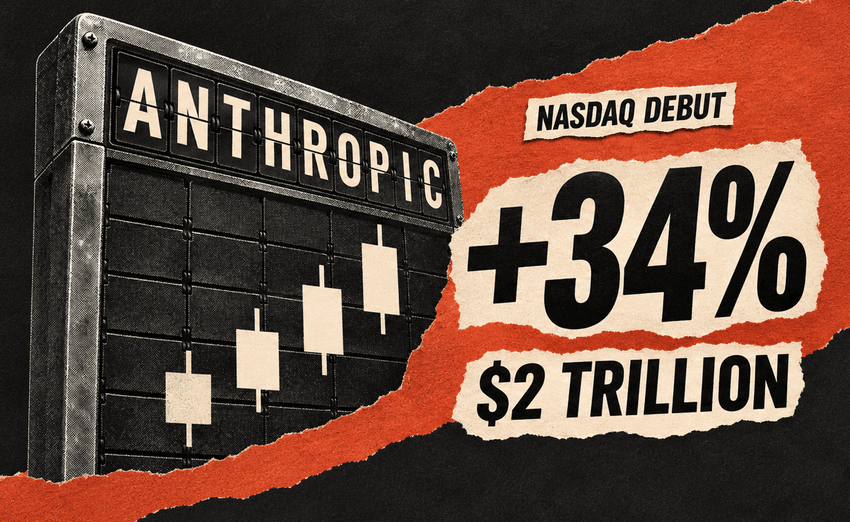

Anthropic has officially made its stock market debut on the Nasdaq, with shares opening at $111.50 on November 19, 2026, approximately 34% above their initial public offering price.
The company behind the Claude artificial intelligence models priced its IPO at $83 per share, attracting substantial investor interest despite recent volatility across technology stocks.
Anthropic trades under the ticker symbol ANT, becoming one of the most prominent publicly listed artificial intelligence companies.
At its opening price, the company's fully diluted valuation approached $2 trillion, up from approximately $1.5 trillion at the offering price.
However, shares later retreated, finishing their first trading session at $97.17, still approximately 17% above the IPO price.
Anthropic Raises Record $81.3 Billion in Historic IPO
Anthropic raised approximately $81.34 billion through the sale of 980 million shares, establishing a new record for an initial public offering.
The listing surpassed SpaceX's earlier $75 billion IPO, demonstrating the enormous investor demand for leading artificial intelligence businesses.
Before trading began, indications suggested Anthropic shares could open near $108, with estimates rising as Nasdaq processed buy and sell orders.
The eventual opening price of $111.50 represented an immediate paper gain of $28.50 per share for investors allocated stock at $83.
The strong debut also pushed Anthropic's implied valuation roughly $500 billion higher than its IPO valuation.
However, the subsequent decline from its opening price highlighted the volatility surrounding highly anticipated technology listings.
Claude AI Developer Celebrates Nasdaq Milestone
Anthropic co-founders Dario and Daniela Amodei attended Nasdaq's opening bell ceremony, marking a significant milestone for the company.
Dario serves as chief executive officer, while Daniela is Anthropic's president.
During the ceremony, Daniela addressed concerns surrounding artificial intelligence and emphasized the importance of public participation in shaping its development.

She also emphasized that society still has choices about how increasingly powerful artificial intelligence systems are developed and deployed.
The IPO represents a major transition for Anthropic, providing public investors with direct exposure to the company behind Claude.
AI Stocks React to Anthropic's Historic Listing
Anthropic's debut initially encouraged interest in artificial intelligence-related stocks, particularly companies supplying computing infrastructure.
Semiconductor manufacturers, optical equipment providers and AI cloud infrastructure businesses attracted attention as investors assessed the listing.
However, broader US stock indexes ultimately declined during Thursday's session amid concerns about borrowing costs and technology valuations.
The mixed reaction highlights the market's uncertainty surrounding the enormous capital requirements of advanced artificial intelligence development.
Just weeks before the IPO, some investors had questioned whether Anthropic could justify a $1.5 trillion valuation.
Its opening performance demonstrated substantial demand, although the first-day pullback showed that enthusiasm was not unlimited.
Anthropic IPO Raises Questions About AI Valuations
Anthropic's historic listing comes as investors debate the financial sustainability of the global AI investment boom.
Technology companies are spending enormous sums on computing infrastructure, data centers and increasingly sophisticated AI models.
The central question is whether future revenue growth will justify those investments and the valuations attached to leading AI developers.
Anthropic's successful offering demonstrates that investors remain willing to commit substantial capital to prominent AI companies, even during periods of market uncertainty.
Nevertheless, the stock's retreat from its opening high illustrates the risks associated with highly anticipated public offerings.
For now, Anthropic's Nasdaq debut establishes a significant milestone for the artificial intelligence industry, with its future performance likely to depend on revenue growth, competition and long-term profitability.


