


Traditional Finance Finally Opens the Door to Crypto
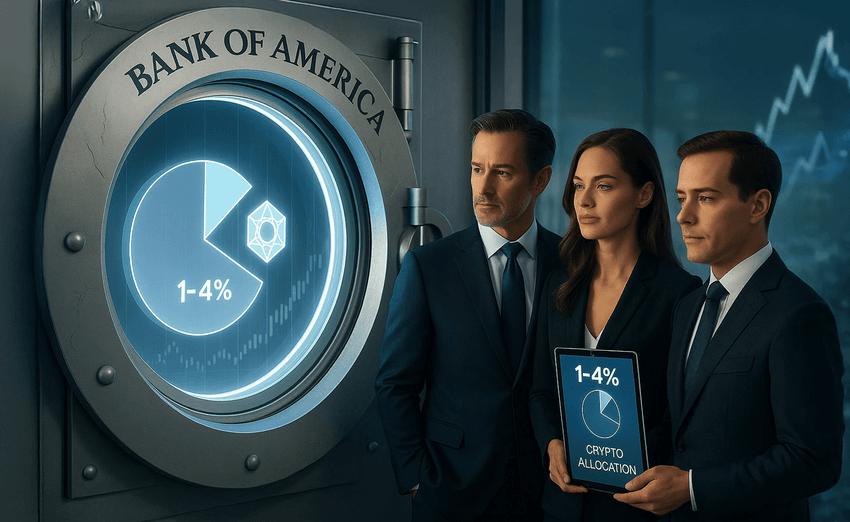
Bank of America, one of the United States most influential financial giants, is officially telling its wealth management clients that crypto belongs in a modern investment portfolio. Beginning next year, the bank will allow customers across Merrill, Bank of America Private Bank, and Merrill Edge to allocate up to 4% of their portfolios to digital assets - marking a major shift in the firm’s stance toward the industry.

Hyzy emphasized that 1% suits conservative investors, while the higher end is designed for those with stronger risk tolerance. It’s a decisive endorsement from a bank long known for its cautious approach to crypto exposure.
The change aligns Bank of America with a growing roster of major institutions - including Fidelity and Vanguard - that have pivoted toward digital assets following increased demand from clients and the explosive rise of Bitcoin throughout 2024 and 2025.
A Major Policy Shift Unlocks Crypto for 15,000 Wealth Advisors
Historically, Bank of America’s wealth advisors were not permitted to proactively recommend crypto, leaving many investors unable to receive direct guidance even as Bitcoin ETFs gained traction. According to reports, more than 15,000 advisors could only provide crypto products upon specific client request - a barrier that sharply limited mainstream adoption.
Starting January 5, that roadblock disappears. Advisors will be fully equipped to offer exposure through Bitcoin ETFs issued by:
- Bitwise
- Fidelity
- Grayscale
- BlackRock
The move comes as Bitcoin surged back above $91,000 this week, recovering from a sharp pullback but still down roughly 30% from its record high above $126,000 earlier in the year. With increased volatility and institutional participation, Bank of America appears eager to align its strategies with shifting market dynamics.
Wall Street’s Crypto Pivot Accelerates
Bank of America’s pivot mirrors a wider transformation across global finance. In just the past year:
- Vanguard reversed its anti-crypto stance and is preparing to list crypto ETFs and mutual funds.
- Fidelity reaffirmed its own guidelines, suggesting 2–5% Bitcoin allocations, and even up to 7.5% for younger, higher-risk investors.
- BlackRock’s Bitcoin ETF became one of the fastest-growing ETFs in history.
This sudden alignment marks a watershed moment: crypto is now being treated as a legitimate, strategic asset class by the biggest wealth managers on Earth.
Hyzy described Bitcoin as a “unique asset”, noting that digital assets now function as a recognized part of thematic innovation portfolios - similar to AI, biotech, or clean energy.
Crypto’s Volatile Year Brings Renewed Confidence
Bitcoin’s dramatic surge, retreat, and recovery throughout 2024 and 2025 have done little to shake institutional interest. Instead, volatility has reinforced the notion that small allocations can meaningfully impact long-term performance without destabilizing portfolios.
For Bank of America, opening the door to crypto is less about speculation and more about meeting client demand while staying competitive with rival firms already deep in the sector.
With Bitcoin ETFs now widely available, millions of wealth clients will gain safe, regulated, and advisor-supported access to digital assets - a development that could push institutional adoption into its next major wave.


