

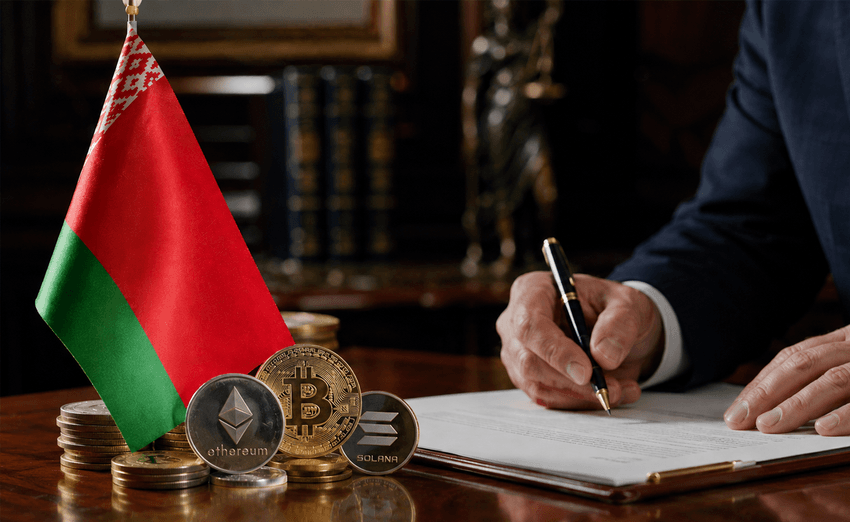

Belarus Expands Legal Recognition of Cryptocurrencies
Authorities in Belarus have officially added cryptocurrencies to the country’s approved list of underlying assets for non-deliverable over-the-counter financial instruments.
The change was introduced through a joint resolution issued by the Council of Ministers and the National Bank of the Republic of Belarus.
Under the updated rules, digital assets such as Bitcoin and Ethereum can now legally serve as reference assets for specific financial contracts traded outside traditional exchanges.
The resolution was signed on May 23 and officially takes effect on May 27.
Crypto Added Alongside Traditional Financial Assets
According to local reports, the updated framework now recognizes several categories of assets for non-deliverable OTC contracts.
These include futures contracts, options, international interest rates, stock index values, and digital tokens including cryptocurrencies.
Non-deliverable OTC instruments typically function as private agreements between market participants without requiring the actual transfer of the underlying asset itself.
Instead of physically delivering Bitcoin or other assets, the parties settle gains or losses in cash based on price movements over a predetermined period.
The structure allows investors and institutions to gain exposure to crypto price fluctuations without directly holding the underlying coins.
Belarus Continues Aggressive Crypto Integration
The latest move is part of Belarus’ broader strategy to integrate digital assets into its financial system.
Over the past several years, the country has emerged as one of the earliest post-Soviet nations to openly legalize and regulate cryptocurrency-related activity.
Back in 2017, President Alexander Lukashenko signed a decree legalizing crypto mining, trading, and blockchain business activity.
The law entered into force in 2018 and allowed companies registered within Minsk’s Hi-Tech Park to operate crypto-related businesses legally.
The country has steadily expanded those rules ever since.
Belarus Recently Introduced “Crypto Banks”
In January 2026, Belarus introduced another major development by approving a framework for so-called “cryptobanks.”
These institutions are designed to combine features of traditional banks with cryptocurrency exchanges and digital asset service providers.
Under the framework, licensed cryptobanks must operate as residents of the Hi-Tech Park and remain registered with the country’s central bank.
Earlier this month, the management of the Hi-Tech Park approved a list of 26 cryptocurrencies that licensed crypto banks will be permitted to support.
The list includes major digital assets such as Bitcoin, Ethereum, XRP, and BNB.
Belarus Moves Faster Than Regional Rivals
Belarus now appears to be moving faster than many neighboring countries when it comes to formal crypto adoption.
While Belarus continues expanding legal pathways for digital assets, Russia is still debating its comprehensive crypto framework inside parliament.
Russian lawmakers are currently reviewing the law “On Digital Currency and Digital Rights” which is expected to legalize broader crypto investment and trading activity by summer 2026.
Meanwhile, Kazakhstan has also introduced new amendments designed to expand crypto operations beyond its fintech hub in Astana.
The competition among former Soviet states to attract blockchain investment and crypto business activity has intensified significantly over the past two years.
Crypto Usage Expanded During International Sanctions
Belarus and Russia have both seen increasing cryptocurrency usage following international sanctions linked to Moscow’s war in Ukraine.
Companies and individuals across the region have reportedly used cryptocurrencies and stablecoins to facilitate cross-border transfers and bypass restrictions imposed on traditional banking systems.
At the same time, Ukraine has also become one of the world’s leading crypto adoption markets since the start of the conflict.
The growing use of digital assets throughout Eastern Europe has pushed governments to accelerate regulatory frameworks rather than attempt outright bans.
Belarus Signals Long-Term Commitment to Crypto
The recognition of cryptocurrencies as underlying financial assets further signals that Belarus intends to deepen crypto integration inside both its financial markets and banking sector.
By allowing digital assets to underpin financial derivatives and OTC products, Belarus is gradually positioning crypto alongside traditional financial instruments rather than treating it as a separate experimental sector.
The latest regulatory move could also open the door for more institutional participation and structured crypto investment products within the country’s financial system.


