

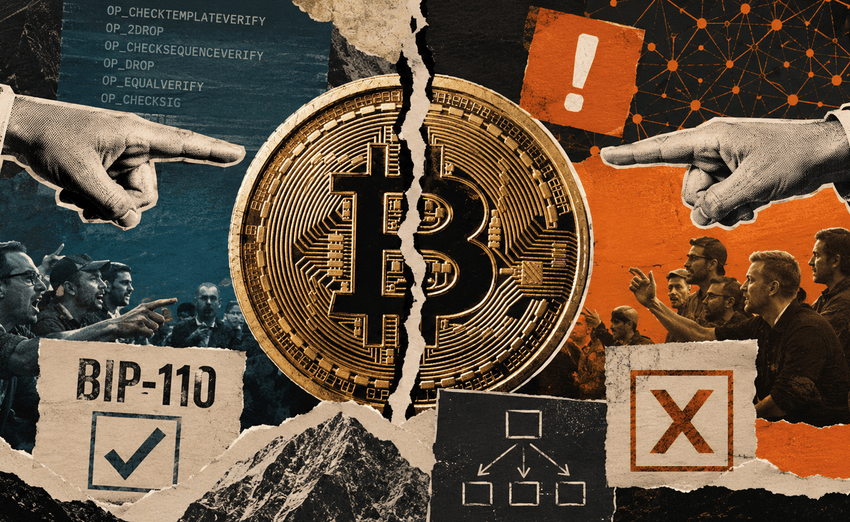

A new proposal to modify Bitcoin's consensus rules has triggered one of the ecosystem's most heated discussions in years, with developers, miners, companies, and investors divided over the future direction of the world's largest cryptocurrency. At the center of the controversy is Bitcoin Improvement Proposal 110 (BIP-110), a soft fork that aims to restrict how non-financial data can be stored on the Bitcoin blockchain.
Supporters argue the proposal would reduce blockchain spam and help preserve Bitcoin's primary role as a decentralized monetary network. Critics, however, warn that the changes could invalidate currently valid transactions, introduce censorship concerns, and potentially lead to another governance conflict reminiscent of the Blocksize Wars.
The debate has attracted high-profile voices across the Bitcoin industry, including Luke Dashjr, Adam Back, Michael Saylor, Jameson Lopp, and Samson Mow, highlighting the importance of the proposal ahead of its upcoming activation window.
What Would BIP-110 Change?
Bitcoin transactions can carry more than simple payments. Thanks to features introduced through SegWit and Taproot, users can embed images, text, token metadata, and inscription data directly into transactions. BIP-110 seeks to limit several of these capabilities by tightening Bitcoin's consensus rules.
If adopted, the proposal would reduce the size of most new transaction outputs to 34 bytes, restore an 83-byte limit for OP_RETURN outputs, limit certain witness elements to 256 bytes, and temporarily restrict several Taproot functions commonly used for Bitcoin inscriptions.
Supporters believe these restrictions would discourage non-financial use of Bitcoin's limited block space, while opponents argue that changing consensus rules to block certain transaction types creates a dangerous precedent.
There are 110 things more dangerous to Bitcoin than spam.
— Michael Saylor (@saylor) July 11, 2026
BIP 110 turns a spam dispute into a consensus change that would invalidate some currently valid, fee-paying transactions.
That precedent is the danger. We should save our energy for threats that really matter. $BTC https://t.co/LoSkl9XSo1
There are 110 things more dangerous to Bitcoin than spam.
— Michael Saylor (@saylor) July 11, 2026
BIP 110 turns a spam dispute into a consensus change that would invalidate some currently valid, fee-paying transactions.
That precedent is the danger. We should save our energy for threats that really matter. $BTC https://t.co/LoSkl9XSo1
Concerns Over Censorship and Consensus
Opponents argue that BIP-110 could weaken Bitcoin's core principles of censorship resistance and predictable monetary rules. Casa Chief Security Officer Jameson Lopp believes the proposal risks allowing subjective judgments about which transactions deserve inclusion on the blockchain.

Meanwhile, Blockstream CEO Adam Back emphasized that Bitcoin's decentralized governance makes major consensus changes intentionally difficult. According to Back, users remain free to create alternative versions of Bitcoin if they disagree with the existing network.
The proposal's mandatory signaling period begins in August, but support remains limited, with only around 1% of miners signaling in favor of BIP-110 so far.
Ordinals Fuel the Latest Dispute
The current controversy can be traced back to the launch of Ordinals in early 2023. Developed by Casey Rodarmor, the protocol allows users to inscribe images, videos, text, and NFT-like assets directly onto individual satoshis using Bitcoin's existing scripting capabilities.
The growing popularity of Ordinals and BRC-20 tokens significantly increased demand for Bitcoin block space, driving transaction fees higher. Many supporters argue that higher fees provide miners with additional revenue, strengthening Bitcoin's long-term network security.
However, critics such as Luke Dashjr view inscriptions as unnecessary blockchain spam rather than legitimate financial activity.
Bitcoin advocate Samson Mow has urged participants to avoid repeating the divisions seen during the 2015–2017 Blocksize Wars, when disagreements over block size ultimately resulted in the creation of Bitcoin Cash and later Bitcoin SV. While Mow agrees that spam is a legitimate concern, he argues that major protocol changes require broad community consensus, warning that the handling of recent policy debates has unnecessarily intensified tensions across the Bitcoin ecosystem.


