

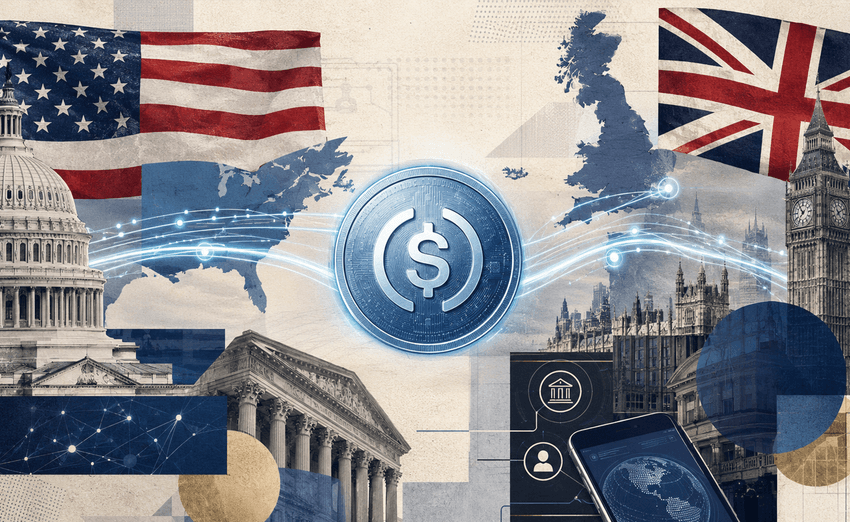

The United States and the United Kingdom have taken another major step toward aligning their digital asset regulations, unveiling a joint roadmap designed to support stablecoin innovation, improve cross-border payments, and strengthen cooperation on tokenized financial markets.
The announcement follows a joint statement released on July 14 by the U.S. Treasury and the UK's HM Treasury, alongside recommendations from the Transatlantic Taskforce for the Markets of the Future. The initiative aims to create greater regulatory consistency between the world's two largest financial centers while encouraging responsible innovation in digital finance.
Stablecoins Take Center Stage
Both governments agreed that well-regulated stablecoins have the potential to lower transaction costs, improve payment efficiency, increase competition, and provide businesses with greater regulatory certainty.
According to the joint statement, both countries intend to "promote convergence between our respective regimes" whenever it serves their shared interests, giving financial institutions and technology firms greater confidence to develop digital payment solutions across borders.
The taskforce itself was launched in September 2025 by U.S. Treasury Secretary Scott Bessent and UK Chancellor Rachel Reeves during President Donald Trump's visit to Britain.
Reeves described the United States and the United Kingdom as "the world's two leading financial centres" emphasizing that closer cooperation could strengthen capital markets while maintaining high regulatory standards.
Stronger Reserve Standards and Consumer Protection
One of the roadmap's primary recommendations focuses on establishing stronger protections for stablecoin holders.
The proposal states that payment stablecoins should remain fully backed by highly liquid reserve assets, while allowing each jurisdiction to determine which specific reserve assets qualify under its domestic framework.
It also recommends keeping customer reserves completely separate from an issuer's operational funds, ensuring faster redemption during periods of financial stress.
Perhaps the most significant recommendation addresses insolvency protection. The taskforce proposes that stablecoin holders should receive a protected legal claim on reserve assets, taking priority over other creditors if an issuer becomes insolvent.
If implemented, this approach could provide stronger legal protections for users than those currently available for several major stablecoins operating today.
Tokenization Requires Global Coordination
The roadmap extends well beyond stablecoins and addresses the broader tokenized asset ecosystem.
The taskforce encourages closer cooperation between the Federal Reserve, Bank of England, Financial Conduct Authority (FCA), U.S. Securities and Exchange Commission (SEC), and the Commodity Futures Trading Commission (CFTC).
Areas identified for collaboration include the treatment of tokenized securities, the use of stablecoins and tokenized money market funds as collateral, and common approaches to settlement finality for digital assets.
The report also recommends creating a private sector working group that would spend one year testing practical cross-border use cases for tokenized financial assets.
Additional recommendations call for regulators to simplify international capital raising while reviewing banking standards governing institutional exposure to cryptocurrencies through ongoing work with the Basel Committee on Banking Supervision.
Stablecoin Rules Continue to Evolve
The transatlantic initiative arrives as both countries continue refining their own stablecoin regulations.
In the United States, implementation of the GENIUS Act is moving forward. The legislation requires payment stablecoins to maintain 100% backing through U.S. dollars or similarly liquid assets while introducing reserve management standards, audit requirements for large issuers, and oversight of foreign stablecoin providers serving American customers.
Federal agencies are currently drafting the detailed rules needed to implement the legislation. Federal Reserve Chairman Kevin Warsh recently told lawmakers that regulators are working quickly to complete payment stablecoin regulations before the law's implementation deadline.
Meanwhile, the Bank of England continues developing its own framework, recently proposing a £40 billion issuance limit for systemic sterling-backed stablecoins. Deputy Governor Sarah Breeden said the proposal seeks to balance financial stability with continued innovation after consulting industry participants.
Not everyone supports the growing role of stablecoins. In its latest Annual Economic Report, the Bank for International Settlements (BIS) argued that current stablecoin designs fail to meet several core characteristics of money and warned that widespread adoption of U.S. dollar-backed stablecoins could increase financial dependence on foreign currencies in emerging markets.
Although the joint roadmap does not replace either country's legislative process, it signals a growing commitment to coordinated regulation rather than competing regulatory frameworks. For cryptocurrency companies developing stablecoins and tokenized financial services, greater alignment between the United States and the United Kingdom could reduce compliance complexity, strengthen institutional confidence, and accelerate the adoption of regulated digital assets across international markets.


