

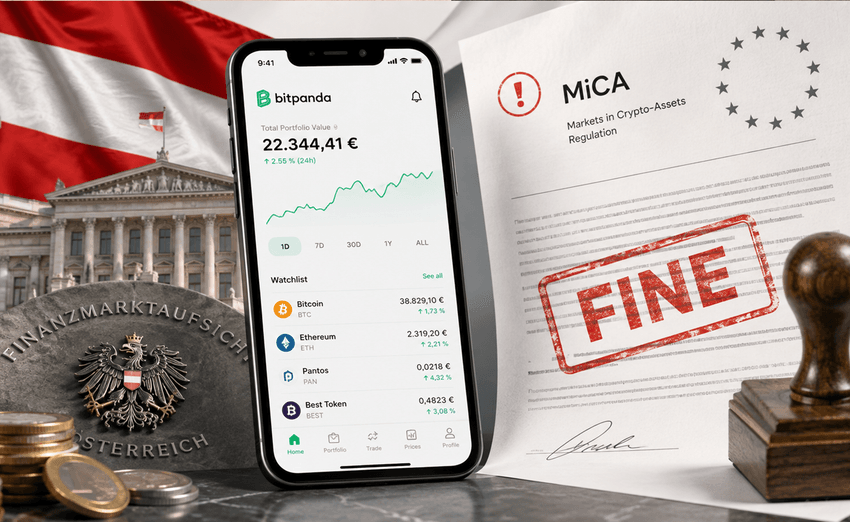

Austria’s Financial Market Authority (FMA) has fined Bitpanda GmbH €70,000, approximately $81,000, for violations of the European Union’s Markets in Crypto-Assets Regulation (MiCA).
The case represents Austria’s first published legally binding penalty under MiCA, making it an early example of how regulators are enforcing the EU’s new crypto framework now that its requirements are fully operational.
According to the FMA, Bitpanda failed to submit a required crypto-asset white paper at least 20 working days before publication. The company also distributed marketing material before the corresponding white paper had been published.
The regulator identified additional problems involving required disclosures and contact information that were missing from a marketing communication.
Bitpanda Says Customer Funds Were Never at Risk
Bitpanda said the regulatory proceedings were connected to a token launch conducted in 2025.
According to the Vienna-based crypto company, it had prepared and submitted a white paper to the FMA while coordinating the process with the regulator. However, the violations concerned the timing and formal requirements surrounding the document and accompanying marketing materials.
Bitpanda stressed that the case did not involve its trading infrastructure, custody operations or customer assets.

The company also said customers suffered no financial losses as a result of the violations identified by the regulator.
Following notification from the FMA, Bitpanda said it immediately corrected the issues in coordination with the authority and chose to reach what it described as a swift and consensual conclusion to the proceedings.
The regulatory case is now closed.
MiCA Enforcement Moves Into Focus
The penalty is significant because MiCA establishes a unified regulatory framework for cryptocurrency businesses operating across the European Economic Area.
Among other requirements, the regulation establishes standards covering crypto-asset disclosures, marketing communications and the information companies must provide before offering certain digital assets.
Austria’s FMA emphasized that publishing sanctions is intended to increase transparency for investors and market participants, rather than give the Bitpanda case any special regulatory status.
The decision nevertheless provides an early indication that European regulators are prepared to enforce MiCA's procedural and disclosure requirements, even when violations do not result in customer losses or compromise assets.
Bitpanda Holds European MiCA Authorization
Founded in Vienna in 2014, Bitpanda provides cryptocurrency custody, exchange and order-execution services across European markets.
Germany’s financial regulator BaFin granted the company a MiCA license in 2025, allowing it to provide regulated services across the European Economic Area.
Austria’s FMA separately authorized Bitpanda GmbH in April 2025 to offer services including crypto custody, exchange and order execution.
The €70,000 penalty therefore does not represent a ban on the company's activities. Instead, it relates specifically to compliance requirements surrounding a previous token launch and its associated documentation and marketing.
Fine Comes as Bitpanda Considers IPO
The regulatory action also arrives while Bitpanda has reportedly been exploring a potential public listing.
Bloomberg reported earlier this year that the company was considering an IPO on the Frankfurt Stock Exchange, potentially targeting a valuation between €4 billion and €5 billion.
Goldman Sachs, Citigroup and Deutsche Bank were reportedly hired to help arrange the potential offering.
For the broader European crypto industry, Austria's first published MiCA penalty illustrates how the regulatory environment is shifting from preparing for MiCA compliance toward active enforcement.
The Bitpanda case shows that regulators are paying attention not only to custody and customer protection but also to white-paper deadlines, marketing communications and disclosure requirements surrounding digital asset offerings.


