

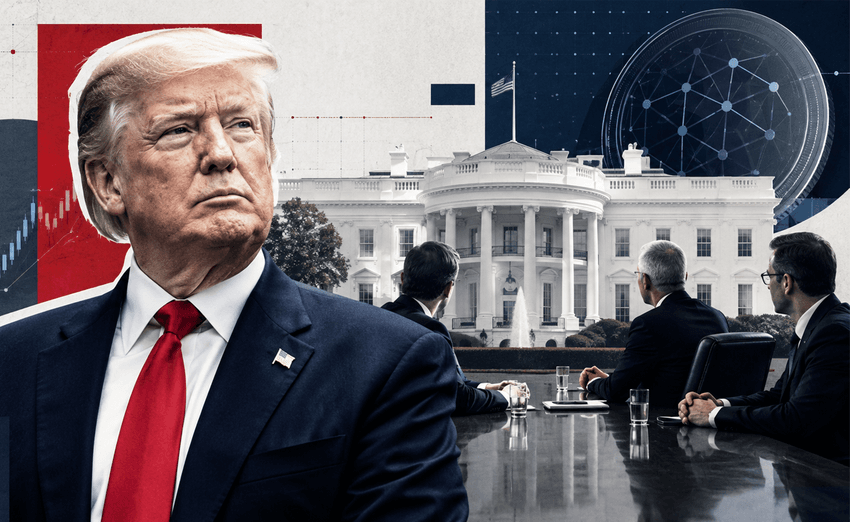

President Donald Trump is expected to host senior cryptocurrency and prediction-market executives at the White House on August 19, bringing some of the industry's biggest names together as Washington approaches a critical stage in its effort to establish federal crypto rules.
The gathering is expected to include executives from Coinbase, Andreessen Horowitz, Ripple, Chainlink, Kalshi and Paradigm, alongside representatives from the Digital Chamber. Executives from Kraken, Gemini, the New York Stock Exchange and Nasdaq have reportedly also been invited, although the final attendance list could still change.
CFTC Chair Michael Selig and SEC Chair Paul Atkins are also expected to participate. Their presence puts both of America's primary financial-market regulators at the table alongside companies directly affected by the regulatory framework under discussion.
CLARITY Act Faces a September Deadline
The meeting comes at a critical moment for the Digital Asset Market Clarity Act, which aims to establish clearer federal rules for digital assets and define the respective responsibilities of the SEC and CFTC.
The legislation once appeared to have significant momentum. The House approved it in July 2025 with a 294-134 bipartisan vote, while the Senate Banking Committee advanced its version 15-9 in May.
Since then, however, disagreements have intensified over government ethics, stablecoin rewards and illicit-finance protections. These disputes have made securing the 60 Senate votes required to advance the legislation increasingly difficult.
Prediction markets have reflected the deteriorating outlook. Polymarket traders recently placed the probability of CLARITY becoming law in 2026 at around 19%, dramatically below its February peak of 82%. Galaxy Digital has reportedly assigned an even lower 10% probability.
Trump's Crypto Interests Complicate Negotiations
One of the biggest obstacles is the debate surrounding Trump's own cryptocurrency business interests.
Democratic lawmakers have pushed for stronger restrictions on senior government officials participating in digital asset businesses. A bipartisan group of senators sent the White House a proposed ethics framework on July 30, but the administration has not publicly accepted it.
The dispute has helped transform what began as a discussion over crypto market structure into a broader political battle.
Stablecoin rewards represent another sticking point. Banking groups have pushed lawmakers to restrict yield and reward programs offered by stablecoin platforms, arguing they could encourage customers to move deposits away from traditional banks.
Despite the disagreements, Senate Majority Leader John Thune filed cloture on the motion to proceed before the August recess, positioning CLARITY for an early procedural test after senators return in September.
SEC and CFTC Move Without Congress
While Congress struggles to finalize legislation, the SEC and CFTC are moving ahead with their own crypto initiatives using existing regulatory powers.
Under Atkins, the SEC has been developing Reg Crypto, a proposed framework for certain digital asset offerings, alongside an Innovation Exemption intended to enable limited experimentation involving tokenized securities and onchain markets.
Progress has been uneven. A planned SEC vote on the crypto offering framework was recently canceled without a replacement date, while the Innovation Exemption has also encountered delays.
The CFTC has moved more aggressively, particularly around prediction markets. Selig has argued that regulators need direct input from companies developing emerging financial products.
The agency will hold its inaugural Innovation Advisory Committee meeting on August 20, one day after the expected White House gathering.
September Could Decide CLARITY's Fate
The White House meeting arrives only weeks before the Senate returns and could therefore become an important opportunity for industry leaders, regulators and the administration to narrow their differences.
Time is increasingly important. The Senate is expected to have only a short legislative window before lawmakers turn their attention toward the 2026 midterm elections.
Even if CLARITY clears the Senate, an amended version would need to return to the House before reaching Trump's desk.
Meanwhile, regulators are already attempting to resolve parts of the uncertainty through existing law. Neither the SEC nor CFTC can provide the same permanent statutory framework as Congress, making the fate of CLARITY particularly significant for the industry's long-term regulatory environment.
The August 19 meeting therefore arrives at a pivotal moment: crypto executives will enter the White House with their biggest legislative priority still alive, but with increasingly little time to get it across the finish line.


