

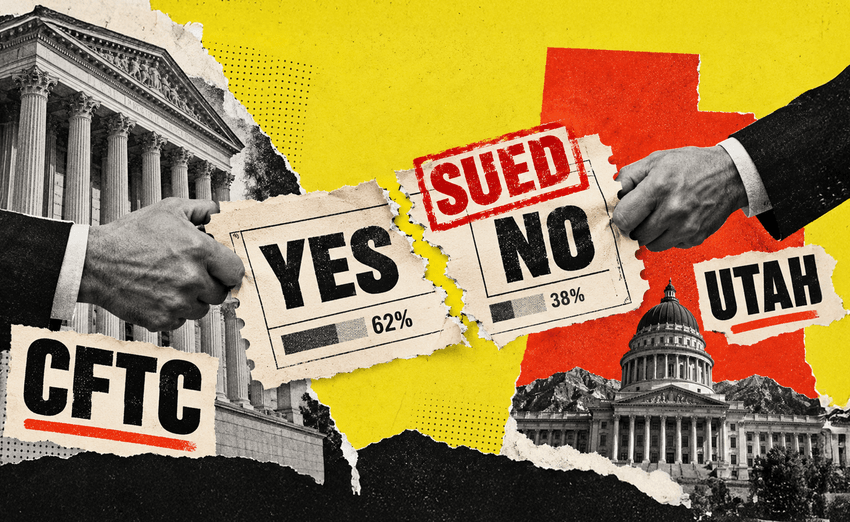

The US Commodity Futures Trading Commission (CFTC) has filed a lawsuit against Utah, seeking to prevent the state from applying gambling laws to federally regulated prediction markets.
Filed on October 27, 2026, the lawsuit challenges Utah's efforts to restrict event contracts offered by platforms such as Kalshi.
The dispute centers on whether prediction markets should operate under federal derivatives regulations or comply with individual state gambling laws.
The outcome could significantly affect platforms offering contracts linked to sports, cryptocurrency prices, elections and other real-world events.
For operators, a federal framework could provide consistent nationwide rules, while state-level restrictions could create different requirements across jurisdictions.
Utah Targets Kalshi and Susquehanna
The federal lawsuit follows legal action initiated by Utah Attorney General Derek Brown on October 20.
Utah sued five entities associated with Kalshi and trading firm Susquehanna, alleging that their activities facilitated illegal gambling.
The state requested an injunction alongside financial remedies estimated between $30.6 million and $61.2 million.
Including Susquehanna expands the dispute beyond prediction market operators to liquidity providers responsible for facilitating trading activity.
Kalshi argues that its event contracts qualify as derivatives regulated under the federal Commodity Exchange Act.
Utah maintains that federal oversight does not eliminate the state's authority to enforce gambling restrictions.
The CFTC's lawsuit directly challenges that interpretation, placing federal and state regulatory powers at the center of the dispute.
US Courts Remain Divided Over Federal Authority
Federal courts have issued conflicting decisions on whether state gambling laws apply to prediction market contracts.
On August 4, a Utah federal judge ruled that the Commodity Exchange Act did not prevent states from enforcing their gambling laws.
Other appellate courts have reached different conclusions.
The Third Circuit supported Kalshi's position in New Jersey, while the Ninth Circuit sided with Nevada.
The Sixth Circuit also supported state regulatory authority in disputes involving Ohio and Tennessee.
Meanwhile, 44 state attorneys general challenged the CFTC's authority over sports-related event contracts in July.
On October 9, the CFTC proposed classifying certain event contracts as swaps, although that proposal has not been finalized.
The agency has now filed lawsuits against ten states, including Utah, as it seeks to establish the boundaries of federal oversight.
Prediction Markets Record $419 Billion in Trading
The regulatory dispute comes as prediction markets experience substantial trading growth.
According to Artemis, the sector recorded approximately $419.1 billion in trading volume through October 27, 2026.
Sports contracts accounted for $173.6 billion, representing 41.4% of activity, followed by exotic event contracts at $149.3 billion and cryptocurrency markets at $60.3 billion.
Kalshi faces considerable financial exposure. Reuters reported a valuation of approximately $40 billion, while CEO Tarek Mansour said sports contracts generated nearly 65% of company revenue.
Additional state restrictions could increase compliance costs, limit market access and affect liquidity.
However, there is currently no evidence that Susquehanna has withdrawn its trading services from Kalshi.
Regulatory Battle Could Reach Supreme Court
Regulatory uncertainty extends beyond the United States, with European authorities also examining prediction market products.
In July, the European Securities and Markets Authority warned that certain derivative-based event contracts could fall under existing retail binary-options restrictions.
Meanwhile, Mansour has suggested that the US dispute could eventually reach the Supreme Court.
New Jersey has already petitioned the Court following its appellate defeat, although the justices have not agreed to hear the case.
For now, Utah's federal lawsuit, Kalshi's ongoing appeals and the CFTC's proposed swaps classification remain central developments.
The outcome could determine whether prediction markets operate under unified federal rules or face separate restrictions across individual states.


