

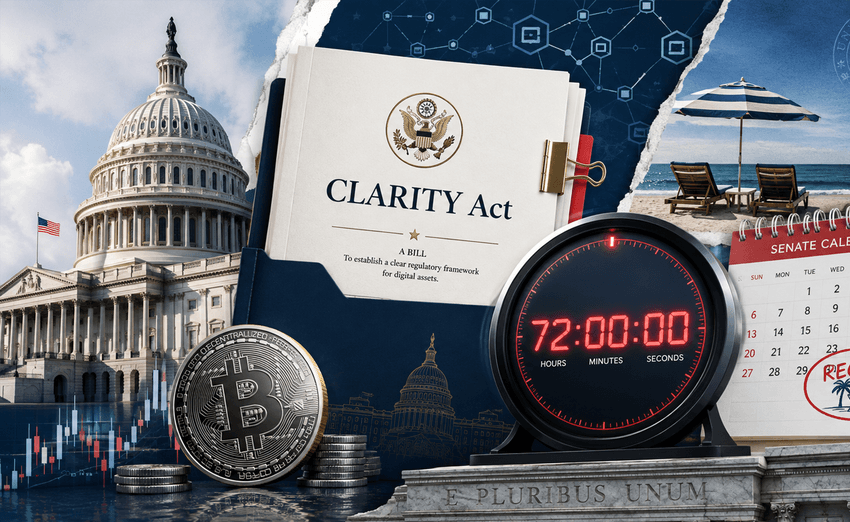

The future of the CLARITY Act has become increasingly uncertain after the legislation failed to appear on the U.S. Senate's official schedule for Monday, August 3.
Instead, senators are scheduled to vote on H.R. 6500, a continuing resolution, with no procedural action listed for H.R. 3633, the Digital Asset Market Clarity Act.
The Senate's latest cloture calendar, updated through July 31, also contains no filing related to the CLARITY Act, suggesting Senate leadership has yet to formally begin the process required to bring the bill to the floor.
While the omission does not prevent lawmakers from considering the legislation later this week, time is rapidly running out before the Senate begins its planned summer recess on August 10, which is expected to last until September 11.
Wednesday Could Be the Last Chance
Under normal Senate procedures, Wednesday represents the final realistic opportunity to keep the legislation moving before the recess.
Under Rule XXII, a cloture petition requires 16 senators' signatures, after which a procedural vote can typically occur two calendar days later.
If Senate leaders file the necessary paperwork on Wednesday, August 5, senators could potentially vote on Friday, August 7, to end debate on the motion to proceed with the bill.
However, even a successful cloture vote would not pass the CLARITY Act.
Instead, it would simply allow the Senate to begin debating the legislation. Under Senate rules, lawmakers could still spend up to 30 additional hours debating the motion before proceeding further, and another cloture vote could ultimately be required before final passage.
Faster Path Requires Bipartisan Support
The Senate does have procedural tools that could accelerate consideration of the legislation, but each depends on significant bipartisan cooperation.
An expedited cloture process would require participation from both Senate leaders as well as seven additional senators from each party, signaling broad political agreement before debate even begins.
Alternatively, senators could approve a unanimous consent agreement limiting debate and scheduling votes more quickly.
However, because any individual senator can block unanimous consent, neither option can move forward without widespread support.
At this stage, no official Senate filing or leadership announcement indicates that either expedited route has been secured.
Democratic Support Remains the Biggest Obstacle
The largest hurdle remains assembling enough Democratic votes.
Republicans currently control 53 Senate seats, meaning they would likely need at least seven Democratic senators to reach the 60 votes normally required to invoke cloture.
On July 22, a group of seven Democratic negotiators-including Catherine Cortez Masto, Cory Booker, Ruben Gallego, Mark Warner, Raphael Warnock, Angela Alsobrooks, and John Hickenlooper-said the latest Republican draft "falls short."
The lawmakers called for stronger provisions covering:
- Consumer protection
- Market integrity
- Conflicts of interest
- Illicit finance
- Ethics standards
While negotiations continue, Senator Elizabeth Warren has taken a firmer stance, describing the latest version of the legislation as "dead on arrival" because she believes its ethics provisions do not go far enough.
Meanwhile, Senator Cynthia Lummis continues working toward a bipartisan compromise after releasing a merged proposal combining recommendations from both the Senate Banking and Agriculture Committees.
A Narrow Window Before the Midterms
Every passing day increases the political pressure surrounding the CLARITY Act.
Without procedural action before the Senate recess, consideration of the bill could be pushed into an already crowded September legislative calendar, bringing it much closer to the 2026 midterm elections.
Any Senate amendments would also require another vote in the House of Representatives, which previously approved the legislation with strong bipartisan support.
Meanwhile, cryptocurrency advocacy groups continue watching developments closely. Reports indicate that more than $125 million in crypto-related political funding remains available ahead of the elections, increasing the stakes surrounding every procedural vote.
Whether Senate leaders act before the recess could ultimately determine both the future of U.S. crypto regulation and the political debate surrounding digital assets heading into the 2026 election cycle.


