

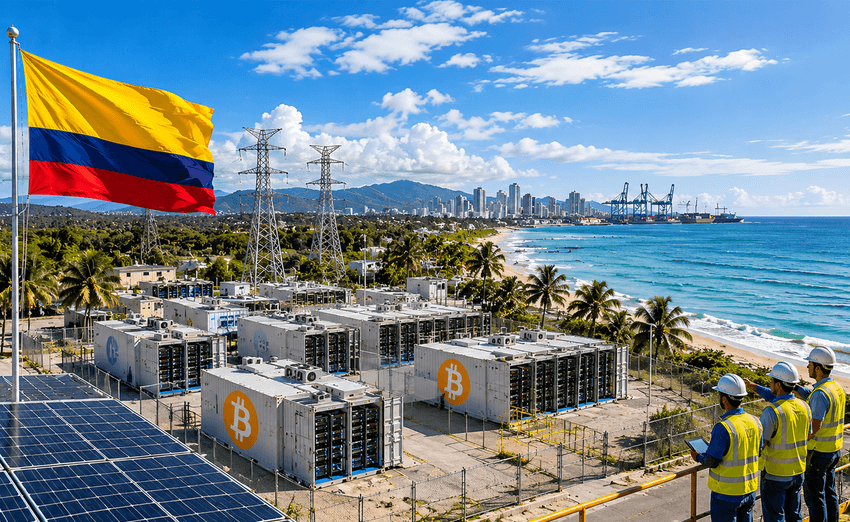

Petro Pushes Bitcoin Mining Vision for Colombia’s Caribbean Region
Colombian President Gustavo Petro says the country’s Caribbean coast could become a major destination for Bitcoin mining, powered by untapped renewable energy resources.
In a post published on X, Petro pointed to the cities of Barranquilla, Santa Marta, and Riohacha as potential locations for future mining operations. He argued that Colombia should follow the path of countries like Paraguay and Venezuela, which attracted mining investment through cheap surplus energy.
Petro described the idea as an “immense boost” for the development of Colombia’s Caribbean region and suggested that the Wayúu community, the country’s largest Indigenous group, could become co-owners of the project.
Si las monedas virtuales se basan en energía fósil estalla el calentamiento mundial y el colapso climático
— Gustavo Petro (@petrogustavo) May 5, 2026
Hoy los países con abundantes energías limpias encerradas como Venezuela y Paraguay, logran atraer las inversiones en minería del bitcoin. La.minería del bitcoin es el… https://t.co/KroCrG9qkD
Si las monedas virtuales se basan en energía fósil estalla el calentamiento mundial y el colapso climático
— Gustavo Petro (@petrogustavo) May 5, 2026
Hoy los países con abundantes energías limpias encerradas como Venezuela y Paraguay, logran atraer las inversiones en minería del bitcoin. La.minería del bitcoin es el… https://t.co/KroCrG9qkD
Colombia’s Renewable Energy Could Be the Key
One of the biggest reasons Colombia is even entering the conversation is energy.
According to a World Bank report referenced in multiple analyses, roughly 75% of Colombia’s electricity already comes from renewable sources, more than double the global average.
The Caribbean coast specifically has significant wind and solar potential that remains underdeveloped commercially. Petro believes Bitcoin mining could turn that unused energy into economic activity instead of letting it go to waste.
The Colombian president also framed the proposal as a cleaner alternative to fossil-fuel-powered mining operations that have faced criticism in other regions.
Paraguay Becomes the Blueprint
Petro’s comments came after mining analysts highlighted Paraguay’s rapid rise in the global mining industry.
Paraguay now controls roughly 4.3% of global Bitcoin hashrate, ranking among the world’s largest mining jurisdictions thanks to ultra-cheap hydroelectric power generated by the Itaipu Dam.
Industrial miners initially flooded into Paraguay because electricity prices were reportedly as low as $0.03-$0.05 per kilowatt-hour, creating one of the most profitable mining environments in the world.
Even though costs have risen since then, large operators continue expanding there, proving that countries with excess renewable energy can still compete globally in Bitcoin mining.
Global Mining Power Is Starting to Shift
The timing of Petro’s proposal is important.
Several major U.S. mining companies have started redirecting resources toward AI infrastructure and high-performance computing, leaving room for emerging countries to capture a larger share of global mining activity.
That shift is opening opportunities for regions with:
- cheaper electricity,
- abundant renewable energy,
- and governments willing to support the industry.
Colombia potentially checks all three boxes.
Big Challenges Still Remain
Despite the enthusiasm, turning an X post into a functioning mining industry will not be easy.
Analysts note that Colombia would still need:
- clear mining regulations,
- licensing frameworks,
- energy agreements,
- and long-term policy stability
before major institutional miners commit capital.
There are also economic concerns. Some industry observers argue that current mining conditions remain difficult globally, especially after Bitcoin’s halving and rising operational costs.
That means Colombia’s success would likely depend on whether it can offer energy prices competitive enough to attract large-scale miners.
Bitcoin Mining Is Becoming a Geopolitical Industry
Petro’s comments highlight a much larger trend developing across emerging economies.
Bitcoin mining is increasingly being viewed not just as a crypto business, but as a way for nations to monetize excess energy, attract infrastructure investment, and create new revenue streams.
Countries that once ignored the industry are now trying to position themselves as future mining hubs-and Colombia clearly does not want to be left behind.


