

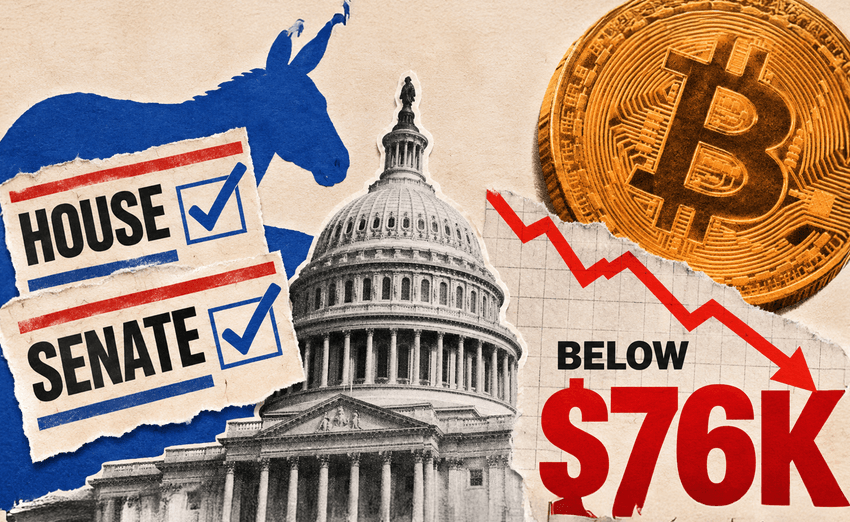

Democrats have won control of the US Senate following the November 3, 2026, midterm elections, dealing a major political setback to President Donald Trump's Republican administration.
Early election results also pointed toward Democratic gains in the House of Representatives, raising expectations of significant changes in Washington's political balance.
Financial markets reacted negatively to the developing results, with US stock futures, the dollar and cryptocurrencies facing selling pressure.
Bitcoin briefly dropped toward $75,700 before recovering some losses during Wednesday's Asian trading session.
Investors are assessing how the election results could affect federal spending, financial regulation and the administration's economic agenda.
Bitcoin Falls Below $76,000 Before Recovering
Bitcoin experienced sharp volatility as election results emerged, falling more than $2,000 from its Tuesday trading levels.
The cryptocurrency had approached $78,000 before declining to approximately $75,700 during the early Wednesday session.
Buyers subsequently pushed Bitcoin back toward $76,700, leaving its 24-hour performance relatively unchanged.
Other major cryptocurrencies recorded mixed movements.
Zcash led the recovery, gaining approximately 5% to trade near $1,200 after falling 10% the previous day. XRP advanced around 1% to $1.27, while Ethereum remained near $2,260. Solana slipped approximately 1% to below $92, and BNB declined more than 1% toward $689.
The mixed performance suggests investors are responding differently across cryptocurrency markets rather than abandoning digital assets uniformly.
US Stock Futures and Dollar Decline
Traditional financial markets also experienced significant selling pressure as investors assessed the prospect of divided government and changing economic policies.
S&P 500 futures fell approximately 1.3%, reversing an earlier 0.5% gain. Meanwhile, Nasdaq 100 futures declined 2.3%, reflecting concerns about potential regulatory scrutiny of major technology and artificial intelligence companies.
The US dollar weakened against several major currencies, while the 10-year Treasury yield dropped six basis points to approximately 4.90%.
Asian markets also reacted, with the MSCI Asia Pacific Index falling nearly 2%.
Treasury bonds attracted buyers amid expectations that congressional gridlock could restrict additional tax cuts and government spending.
Crypto Industry Faces Uncertainty Over CLARITY Act
The election results could complicate negotiations over the CLARITY Act, proposed legislation intended to establish clearer rules for US cryptocurrency markets.
The bill addresses regulatory responsibilities and the treatment of digital assets under federal law.
Crypto exchange BTSE's chief operating officer, Jeff Mei, previously expressed concern that Democratic gains could slow the legislation's progress.
However, Democratic lawmakers hold differing positions on cryptocurrency regulation, and the election outcome does not automatically determine the bill's future.
Any legislation would still require sufficient congressional support and presidential approval.
The industry will therefore be watching whether lawmakers can reach bipartisan agreements on market structure and investor protections.
Bitcoin Investors Watch Washington's Next Moves
Bitcoin's reaction highlights the connection between cryptocurrency markets and broader political uncertainty, particularly when investors anticipate changes to financial regulation.
The latest decline follows an already difficult period for Bitcoin, including October's 7.32% loss and the recent Binance security incident.
For traders, the $75,700 area represents a recent price reference, while recovering above $78,000 could indicate improving short-term sentiment.
Nevertheless, election results alone cannot determine Bitcoin's longer-term direction.
Market participants will continue monitoring congressional developments, institutional investment flows and upcoming economic data.
With Democrats taking control of the Senate, the cryptocurrency industry's focus now shifts toward how the new Congress will approach digital asset legislation and whether bipartisan negotiations can advance.


