

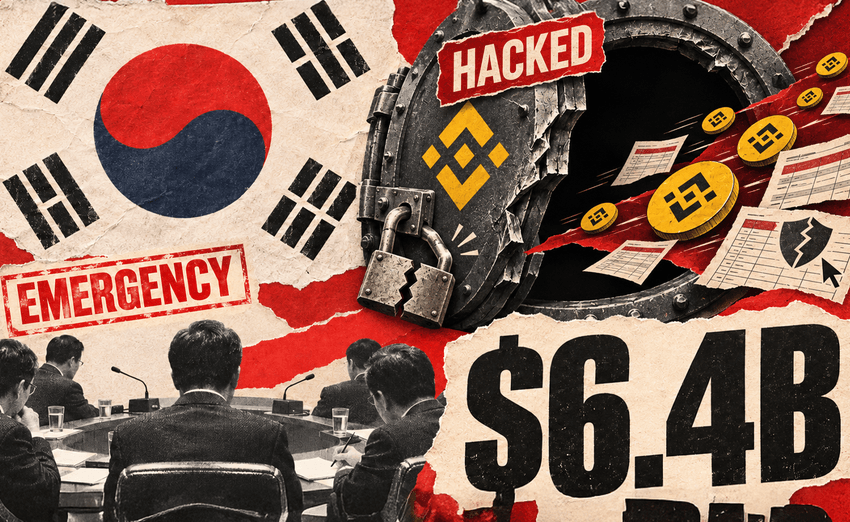

South Korea's Financial Services Commission (FSC) has called an emergency meeting with major cryptocurrency exchanges following the reported $6.3 billion Binance security breach.
The meeting took place on November 2, 2026, bringing together representatives from Upbit, Bithumb, Coinone, DigitalX and Gopax, alongside smaller cryptocurrency trading platforms.
Regulators requested information about exchange security systems, internal controls and preparedness against sophisticated cyberattacks.
The discussions came ahead of a broader financial-sector security inspection scheduled for November 4.
The emergency response reflects growing concerns about North Korean hacking operations and vulnerabilities in cryptocurrency exchange infrastructure.
Regulators Examine Cold Wallet Security
South Korean authorities are reviewing how cryptocurrency exchanges protect customer assets, particularly the proportion stored in offline wallets.
Under the country's Virtual Asset User Protection Act, exchanges must maintain at least 80% of customer cryptocurrency deposits in cold storage.
According to reported figures, Upbit holds more than 99% of deposited assets offline, while Bithumb maintains approximately 94%.
Coinone reportedly stores around 85% in cold wallets, with DigitalX and Gopax operating slightly above the regulatory minimum.
Authorities are considering stricter cold storage requirements following the Binance incident.
Cold wallets reduce exposure to online attacks, although they cannot eliminate every operational or security risk.
The Binance breach reportedly involved hot wallets, which exchanges use to process everyday cryptocurrency transactions.
FBI Links Binance Attack to North Korean Hackers
The FBI has attributed the October 29 Binance hack to North Korea's TraderTraitor hacking group, according to the supplied reporting.
Blockchain intelligence company TRM Labs estimated that approximately $6.36 billion was transferred across ten blockchain networks, with much of the activity occurring within 20 minutes.
The same hacking group has been linked to the $1.5 billion Bybit attack in February 2025.
Investigators reportedly urged cryptocurrency businesses to block addresses associated with the stolen funds.
Meanwhile, Binance pledged to reimburse affected customers, reporting that it had already replaced approximately 90% of the missing assets.
The exchange's recovery efforts remain separate from investigations into the attackers and the stolen cryptocurrency.
AI-Powered Cyberattacks Raise Additional Concerns
South Korea's emergency meeting also follows a series of cybersecurity incidents involving domestic financial institutions.
Authorities have investigated breaches affecting Bithumb, Daishin Securities and Mirae Asset Global Investments.
Daishin reportedly exposed information belonging to 38,490 customers, while earlier incidents across 16 companies affected approximately 100,000 records.
A separate Bithumb breach reportedly exposed sensitive information belonging to 844 customers.
Investigators have examined whether AI-assisted penetration-testing tools contributed to some attacks.
Microsoft Threat Intelligence has also identified North Korean hacking groups incorporating artificial intelligence into cyber operations.
However, there is currently no confirmed evidence that AI was used in the Binance breach.
South Korean regulators previously inspected 555 financial companies and identified security shortcomings at 130 organizations.
South Korea Faces Delays in Crypto Protection Laws
The latest security concerns have renewed attention on South Korea's delayed Digital Asset Basic Act, which would expand cryptocurrency regulation and customer protections.
The proposed legislation includes stronger requirements covering exchange operations, disclosures and compensation for customer losses.
Regulators have discussed introducing no-fault compensation obligations, potentially requiring exchanges to reimburse customers for certain hacking incidents and system failures within their control.
However, these provisions have not yet become law.
During an October parliamentary hearing, lawmakers questioned why the legislation remained unfinished.
FSC Chairman Lee Eog-weon reportedly described the bill as being in the final stages of consultation.
For now, South Korea's immediate priority is strengthening exchange defenses while lawmakers continue debating broader cryptocurrency investor protections.
The Binance incident has highlighted how quickly a major security failure can affect confidence across the global digital asset industry.


