

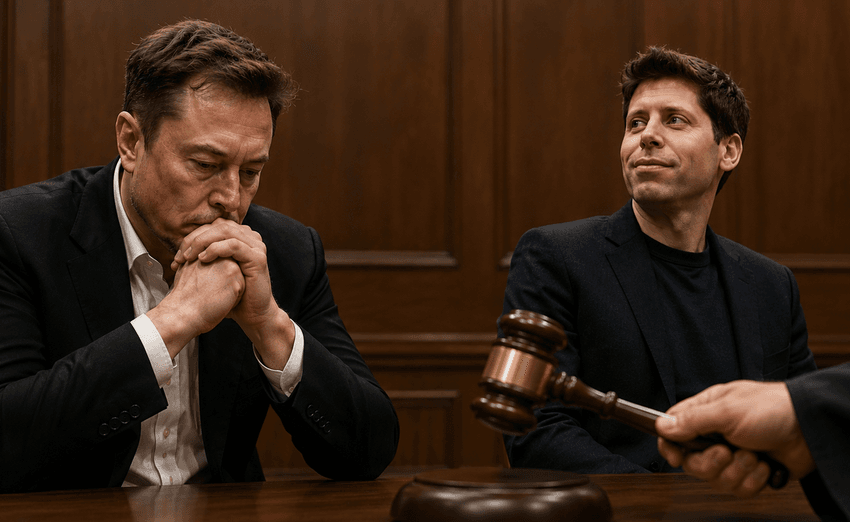

Jury Rejects Musk’s Claims Against OpenAI
The legal battle between Musk and OpenAI officially ended Monday after jurors ruled in favor of OpenAI CEO Sam Altman, co-founder Greg Brockman, and the company itself on every major claim.
According to reports, jurors concluded that Musk waited too long to file several of his accusations regarding OpenAI’s transformation from a nonprofit research organization into a commercial AI powerhouse.
The lawsuit originally accused OpenAI leadership of abandoning the company’s founding mission and improperly prioritizing profits through its partnership with Microsoft.
Jurors also dismissed Musk’s separate allegation that Microsoft played a direct role in steering OpenAI away from its nonprofit commitments.
Musk Claimed OpenAI Betrayed Its Original Mission
The case stemmed from a lawsuit Musk filed in 2024 against OpenAI, Altman, Brockman, and Microsoft.
Musk argued that OpenAI was initially created to develop advanced artificial intelligence for the benefit of humanity rather than for corporate profit. He claimed the company violated that original vision after transitioning toward a more commercial structure and deepening its multi-billion-dollar relationship with Microsoft.
OpenAI’s legal team pushed back aggressively during the trial, arguing that Musk’s lawsuit was heavily influenced by growing competitive pressure following the launch of his own AI startup, xAI, in 2023.
OpenAI Says Competition Fueled the Lawsuit
During testimony, Musk acknowledged that xAI partially relied on OpenAI technology to help train its chatbot, Grok, using a method known as distillation.
That admission became a major talking point during proceedings, with OpenAI lawyers arguing Musk was simultaneously criticizing the company while benefiting from its technology.
The trial highlighted how rapidly the AI arms race has intensified among major tech players since the explosive rise of ChatGPT in late 2022.
Musk testified that he originally supported OpenAI’s nonprofit structure because he believed powerful AI systems should be developed for public benefit instead of corporate gain.
High-Profile Witnesses Took the Stand
The courtroom battle featured testimony from several influential figures across the artificial intelligence industry.
Among the witnesses were Microsoft CEO Satya Nadella, OpenAI co-founder Ilya Sutskever, and former OpenAI board member Shivon Zilis.
The case also drew major public attention because of Musk’s long and complicated relationship with OpenAI. Musk helped co-found the organization in 2015 before departing in 2018 following reported disagreements about leadership and direction.
Since then, OpenAI has grown into one of the most influential companies in the global AI sector, fueled largely by ChatGPT’s mainstream success and Microsoft’s enormous financial backing.
Legal Battles Between Musk and OpenAI Are Far From Over
Although the jury decision marks the end of this specific lawsuit, the broader legal conflict between Musk and OpenAI is still ongoing.
OpenAI has separately filed a countersuit accusing Musk of engaging in “bad-faith tactics,” while xAI continues pursuing antitrust claims involving OpenAI and Apple over AI integrations tied to the iPhone ecosystem.
Additionally, xAI has launched another lawsuit accusing OpenAI of trade secret theft.
The growing legal war reflects how the battle for dominance in artificial intelligence is increasingly spilling into courts, regulation, infrastructure, and global politics.
AI Competition Continues Intensifying
The verdict arrives during a period of fierce competition among major AI companies racing to secure talent, computing power, partnerships, and enterprise adoption.
OpenAI remains one of the industry’s dominant forces through ChatGPT and its broader AI ecosystem, while rivals including xAI, Google, Anthropic, and Microsoft continue investing billions into next-generation AI systems.
For Musk, the failed lawsuit represents a significant setback in his effort to challenge OpenAI’s current structure and influence.
For OpenAI, the ruling removes one of the largest legal threats hanging over the company as it continues expanding its commercial AI products globally.


