

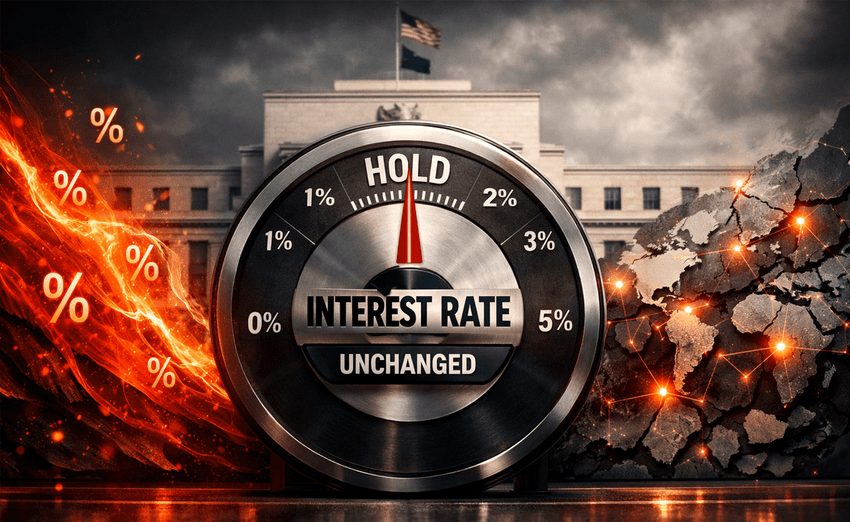

Fed Keeps Rates Unchanged Despite Growing Uncertainty
The Federal Reserve has decided to hold interest rates steady, maintaining the Federal Funds rate at 3.5%–3.75%, as it navigates an increasingly uncertain economic landscape. The decision comes as policymakers weigh persistent inflation pressures and geopolitical risks, particularly from the ongoing conflict in the Middle East.
Federal Reserve Chair Jerome Powell highlighted that the economy remains relatively strong, noting that economic activity continues to expand at a “solid pace.” Consumer spending has held up well, while business investments are still growing, signaling resilience in key sectors.
However, the decision to pause reflects caution. The Fed is clearly balancing short-term stability with long-term risks, choosing to observe rather than act aggressively in either direction.
Inflation Still a Problem, Labor Market Shows Cracks
Despite stable growth, inflation remains above the Fed’s 2% target, continuing to be a major concern for policymakers. Powell described inflation as “somewhat elevated” indicating that price pressures have not yet been fully contained.
At the same time, the labor market is beginning to show signs of softening, while the housing sector remains weak. This combination is creating a difficult policy dilemma, as the Fed’s dual mandate requires both price stability and maximum employment.
Powell acknowledged this tension directly, emphasizing the challenge of navigating conflicting economic signals. On one hand, inflation calls for tighter policy, while on the other, weakening labor conditions suggest the need for support.
Middle East Conflict Adds Another Layer of Risk
Geopolitical tensions are now playing a critical role in shaping the Fed’s outlook. The ongoing war in the Middle East, particularly involving Iran, is expected to impact global energy prices, which in turn could push inflation higher.

This uncertainty is a key reason why the Fed is holding off on any major policy changes, as the full economic impact of the conflict is still unfolding.
What This Means for Crypto and Risk Assets
Interest rate policy plays a major role in shaping markets like crypto and equities. Higher rates typically act as a headwind for risk assets, as investors shift capital toward safer instruments like government bonds. Lower rates, on the other hand, tend to fuel liquidity and boost asset prices.
With rates now on hold, markets are left in a wait-and-see mode, watching closely for any signs of future policy shifts. The Fed’s cautious stance suggests that volatility could remain elevated, especially if inflation continues to rise.
Markets Expect No Cuts - But Liquidity Debate Heats Up
Market expectations are firmly aligned around no immediate rate cuts. Data shows that 97% of traders anticipate no change at the upcoming April 2026 FOMC meeting, while only a small minority expects a potential rate hike of 25 basis points.
If such a hike were to occur, it would push rates to 3.75%–4.00%, adding further pressure on risk assets. Meanwhile, prominent voices in the market are split on what comes next. Arthur Hayes, co-founder of BitMEX, signaled that he is holding off on buying Bitcoin until the Fed pivots:
He also suggested that war-related spending could eventually force monetary easing, as governments seek ways to finance rising costs.
On the other side, macroeconomist Lyn Alden sees a different trend emerging, describing the current phase as a:
This implies that liquidity is slowly increasing, even without explicit rate cuts, which could quietly support asset prices over time.
A Delicate Balancing Act Ahead
The Federal Reserve now finds itself in a complex position, balancing inflation risks, geopolitical uncertainty, and signs of economic slowdown. By holding rates steady, the central bank is effectively buying time to assess how these forces evolve.
For markets-especially crypto-this creates an environment defined by uncertainty, shifting expectations, and potential volatility.
As global tensions rise and economic signals remain mixed, the Fed’s next move could be one of the most critical decisions for financial markets in 2026.


