

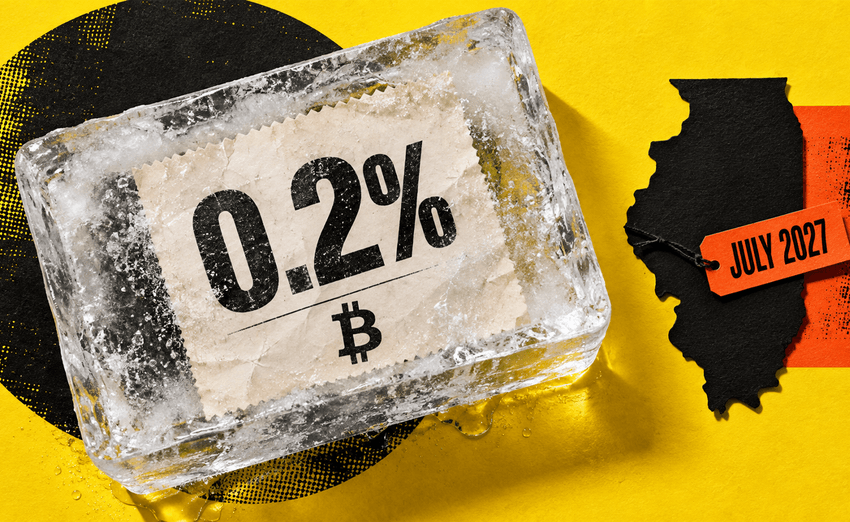

Illinois officials and cryptocurrency industry groups have jointly asked a state court to postpone the state's controversial 0.2% Digital Asset Tax from January 1 to July 1, 2027, while litigation challenging the measure continues.
The stipulated motion was filed Thursday in Sangamon County Circuit Court. Both sides are asking the judge to temporarily block enforcement and stay the tax's effective date for six months. Because the request is an agreement between the parties rather than a unilateral state decision, the court must still approve it before the delay takes effect.
The motion stems from litigation brought by The Digital Chamber and the Illinois Blockchain Association against Illinois Department of Revenue Director David Harris and Attorney General Kwame Raoul.
The Digital Chamber publicly announced the agreement on October 1. The proposed delay does not resolve the underlying lawsuit, meaning the groups can continue challenging the constitutionality and enforceability of the tax.
Illinois has agreed to delay implementation of its Digital Asset Tax from January 1 to July 1, 2027, following a lawsuit brought by The Digital Chamber and Illinois Blockchain Association. We thank @BellementisPLLC attorneys @teresagoody, @AndoniOlta, and Angela Papalaskaris for… pic.twitter.com/GrZ9ggBZHc
— The Digital Chamber (@DigitalChamber) October 1, 2026
Illinois has agreed to delay implementation of its Digital Asset Tax from January 1 to July 1, 2027, following a lawsuit brought by The Digital Chamber and Illinois Blockchain Association. We thank @BellementisPLLC attorneys @teresagoody, @AndoniOlta, and Angela Papalaskaris for… pic.twitter.com/GrZ9ggBZHc
— The Digital Chamber (@DigitalChamber) October 1, 2026
0.2% Tax Was Scheduled for January
Governor JB Pritzker signed the legislation establishing the Digital Asset Tax in June as part of Illinois' broader fiscal package.
Under the law as enacted, the tax is scheduled to begin January 1, 2027, at a rate of 0.2% of the value of the digital asset connected with taxable digital asset business activity. Digital asset brokers are responsible for collecting the tax.
The legislation defines covered activity broadly. It includes certain services involving buying, selling, transferring and storing digital assets, with transfers including moving assets between accounts or storage belonging to the same customer.
This structure has become one of the central points of criticism because the tax is tied to the value of the digital asset involved rather than an investor's realized capital gain.
That means a taxable transaction can potentially generate a liability even when the customer has not made a trading profit.
Crypto Groups Challenge the Tax
Industry organizations have responded with multiple legal challenges.
The Digital Chamber and Illinois Blockchain Association are pursuing the lawsuit behind the latest stipulated delay, while the Blockchain Association and Crypto Council for Innovation have separately asked the same court to prevent the law from taking effect.
The latter groups filed their request on September 9, arguing that companies were already spending substantial amounts preparing compliance systems while lacking sufficient implementation guidance from Illinois officials.
The Crypto Council for Innovation has characterized the measure as the “most punitive digital asset tax” in the United States. That description reflects the organization's position rather than a legal classification of the Illinois tax.
The litigation will determine whether the challengers can ultimately prevent or alter enforcement. The current agreement, by contrast, concerns only the proposed six-month postponement.
Court Approval Is Still Required
The most important distinction is that Illinois has not repealed the Digital Asset Tax.
The statute currently still lists January 1, 2027, as the starting date for the 0.2% levy. The newly filed motion asks the court to suspend that implementation date until July 1 while the broader dispute proceeds.
Because both sides support the request, there is agreement between state officials and the plaintiffs on the temporary delay. However, the judge still needs to approve the stipulated motion before the six-month reprieve becomes effective.
The development gives exchanges and other affected crypto businesses additional time before they may need to collect the tax, while giving the parties more time to litigate the underlying questions surrounding the law.
Federal Crypto Tax Debate Moves Forward
The Illinois dispute is unfolding as lawmakers in Washington consider separate changes to federal cryptocurrency taxation.
In September, the House Ways and Means Committee advanced the Digital Asset Tax Certainty Act, sending the legislation toward consideration by the full House.
That federal proposal addresses several crypto-specific tax issues and is separate from Illinois' transaction-based levy.
For Illinois users and digital asset companies, the immediate question is now whether the Sangamon County court approves the stipulated request. If it does, implementation of the state's 0.2% Digital Asset Tax would move from January 1 to July 1, 2027, while the legal battle over the tax itself continues.


