

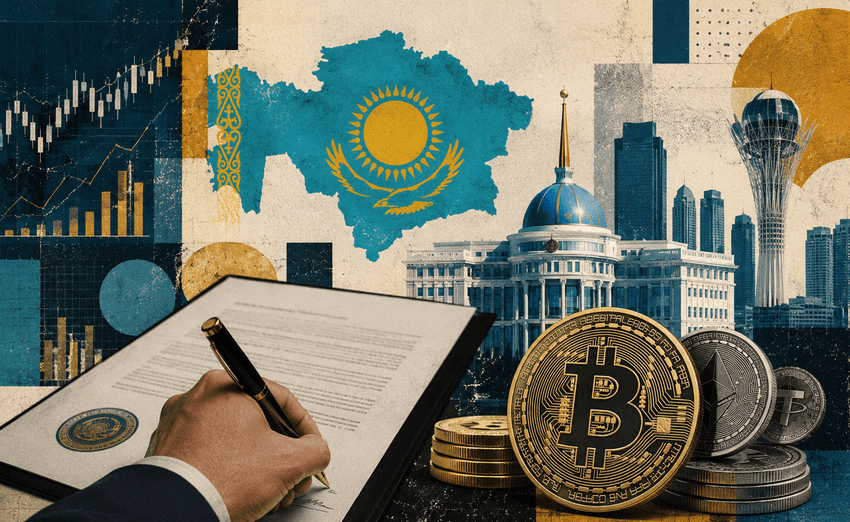

Kazakhstan has taken another major step toward becoming one of the world's leading cryptocurrency jurisdictions after President Kassym-Jomart Tokayev signed a new decree designed to expand the country's digital asset industry. The new framework introduces measures to encourage stablecoin adoption, provide tax incentives for crypto investors, support Bitcoin mining, and develop tokenized financial markets.
Officials hope the reforms will attract international crypto companies, encourage domestic traders to return assets held abroad, and position Kazakhstan as a regional leader in regulated digital finance.
Kazakhstan Opens the Door to Stablecoin Payments
A central objective of the new decree is to expand the use of stablecoins and other digital assets for cross-border settlements.
The government plans to establish mechanisms that allow businesses to use stablecoins when paying for imports or receiving payments from international customers. Officials believe this could provide companies with faster and more flexible payment options alongside traditional banking channels.
The initiative was developed through cooperation between the Ministry of Artificial Intelligence and Digital Development (MAIDD), the National Bank of Kazakhstan, and the Astana International Financial Centre (AIFC).
The decree serves as the legal foundation for a broader regulated digital asset market that Kazakhstan hopes will attract foreign investment and provide greater legal certainty for crypto businesses.
Government Encourages Crypto Assets to Return Home
Kazakhstan also wants to reduce the amount of cryptocurrency held on foreign platforms.
Under the new framework, individuals who currently store digital assets on offshore exchanges or private wallets will be able to voluntarily declare those holdings and transfer them to licensed domestic service providers.
Officials believe bringing these assets back into Kazakhstan's regulated financial system will strengthen the local economy while improving transparency and oversight.
Tax Incentives Aim to Attract Retail Investors
To encourage participation in the regulated market, the government is preparing generous tax incentives.
Authorities are considering exempting personal income tax on profits generated from digital asset transactions, provided those trades take place through licensed cryptocurrency platforms operating within Kazakhstan.

According to Vice Minister of Artificial Intelligence and Digital Development Gizzat Baitursynov, the goal is to create a predictable legal environment that supports innovation while maintaining strong consumer protections and regulatory oversight.
Bitcoin Miners Gain Access to Natural Gas Energy
The decree also introduces new opportunities for Kazakhstan's growing Bitcoin mining industry.
Mining companies will now be permitted to use associated petroleum gas and surplus natural gas that would otherwise go unused to generate electricity for mining operations.
The policy builds on Kazakhstan's existing 70/30 energy model, which allows data centers and cryptocurrency miners to utilize up to 70% of newly created electricity capacity resulting from infrastructure upgrades.
Officials believe the approach can improve energy efficiency while supporting further investment in digital infrastructure.
Tokenized Assets Become Part of Kazakhstan's Financial Strategy
Beyond cryptocurrencies and mining, the decree outlines broader ambitions for tokenized finance.
The government has instructed regulators to develop a national framework for tokenized financial instruments, expand domestic digital trading infrastructure, and explore the future issuance of tokenized government bonds.
These initiatives reflect Kazakhstan's broader strategy of integrating blockchain technology into its financial markets while attracting institutional investment through regulated digital asset products.
By combining stablecoin payments, tax incentives, mining expansion, and tokenized securities under a single regulatory framework, Kazakhstan is positioning itself as one of the most crypto-friendly jurisdictions in Central Asia.
If successfully implemented, the reforms could significantly increase the country's role in the global digital asset industry while providing investors and businesses with one of the region's clearest regulatory environments.


