

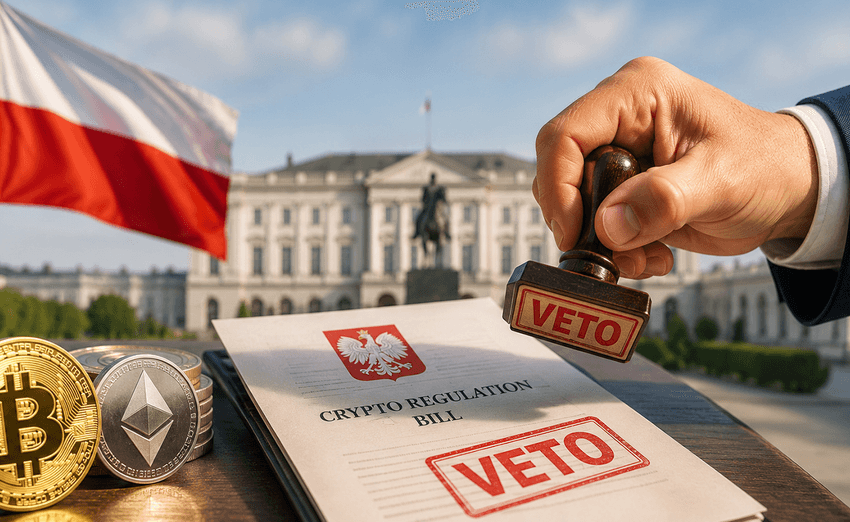

Poland’s efforts to implement the European Union’s Markets in Crypto-Assets (MiCA) framework have suffered another major setback after President Karol Nawrocki vetoed the country’s cryptocurrency regulation bill for a third consecutive time.
The latest rejection leaves Poland in a precarious position ahead of the July 1 MiCA deadline, making it the only EU member state that has yet to adopt national legislation aligned with the bloc’s landmark crypto regulations.
The ongoing political deadlock is raising concerns that domestic crypto companies could soon lose access to licensing opportunities under the European framework while competitors across the EU move forward.
President Says Government Ignored His Amendments
Nawrocki defended his latest veto by arguing that lawmakers ignored nearly every amendment proposed by his office during months of negotiations.
In a video statement, the president declared, "Bad law does not become good law simply because it is passed a hundred times" emphasizing that parliament accepted only one out of sixteen proposed changes.
His objections center on what he describes as overregulation, excessive powers granted to Poland’s Financial Supervision Authority (KNF), and insufficient legal safeguards for consumers and businesses. The president insists he supports crypto regulation but believes the legislation must provide stronger judicial oversight, shorter account-freezing periods, and greater state accountability when authorities improperly freeze customer assets.
Political Clash Intensifies Over Crypto Regulation
The veto immediately reignited tensions between President Nawrocki and Prime Minister Donald Tusk, who questioned the president’s motives in a social media post shortly after the announcement.
Political observers have linked the dispute to the ongoing investigation surrounding Zondacrypto, the Polish-founded cryptocurrency exchange facing allegations of fraud and money laundering after approximately 30,000 customers reportedly lost more than 350 million zloty ($95 million).
Tusk has previously alleged that Zondacrypto maintained connections with conservative political circles and Russian organized crime, accusations that Nawrocki has firmly rejected as politically motivated and based on unreliable sources.
The controversy has further complicated an already divisive debate over how aggressively Poland should regulate its growing crypto industry.
MiCA Deadline Creates Pressure for Lawmakers
Had the legislation been approved, the KNF would have become the country's primary crypto regulator with broad authority to sanction exchanges, freeze accounts, suspend transactions, and maintain a blacklist of suspicious crypto websites.
Critics argue that these powers extend beyond what MiCA itself requires, while supporters believe they are necessary to strengthen consumer protection.
The approaching July 1 deadline now places additional pressure on lawmakers. Without implementing legislation, Polish crypto companies may lose the ability to obtain MiCA licenses domestically, forcing many businesses to seek authorization in other European jurisdictions to continue serving customers. Finance Minister Andrzej Domański criticized the latest veto, arguing that it undermines the financial security of Polish citizens.
For now, the government faces the difficult task of revising the legislation or attempting another parliamentary override, though previous efforts have fallen well short of the required majority. With time running out, Poland's crypto sector now faces increasing uncertainty as Europe moves toward full MiCA implementation.


