

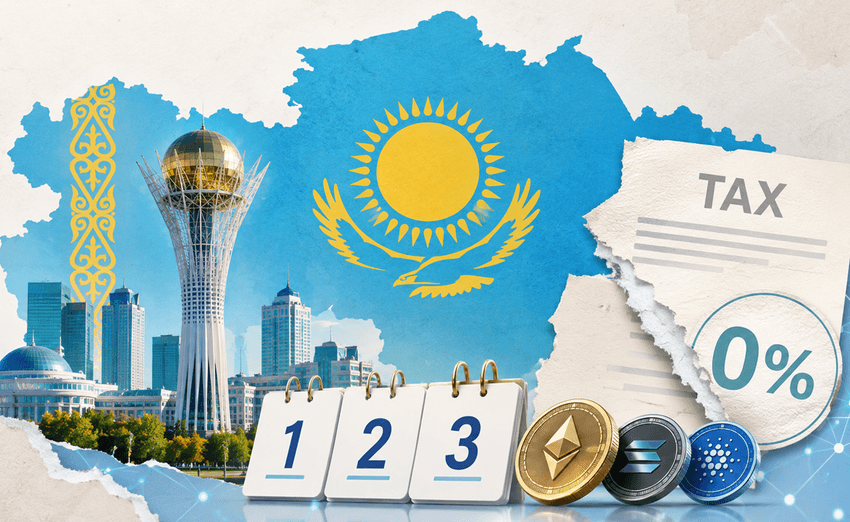

Kazakhstan is offering private cryptocurrency investors a three-year break from personal income tax on digital asset gains, as the government looks to bring more of the country’s crypto activity into its regulated domestic market.
President Kassym-Jomart Tokayev signed the decree, which was developed by the Ministry of Artificial Intelligence and Digital Development, the National Bank of Kazakhstan and the Astana International Financial Centre (AIFC).
Under the new framework, individual investors will not owe personal income tax on qualifying gains from digital asset transactions for three years. However, assets connected to fraud, money laundering or activity through unlicensed crypto services will not qualify for the exemption.
The government hopes the incentive will encourage investors to move away from offshore exchanges and peer-to-peer markets and toward licensed platforms operating within Kazakhstan.
One Million Crypto Wallets Could Be Targeted
The potential market is significant. According to AIFC data, Kazakh citizens hold approximately one million cryptocurrency wallets, while only around 256,900 users were registered with authorized domestic exchanges as of March.
Previous estimates have suggested that roughly 95% of Kazakhstan’s crypto turnover takes place outside the regulated domestic market, including through foreign exchanges and peer-to-peer transactions.
Authorities have already been increasing pressure on unlicensed platforms. In April, the Astana Financial Services Authority identified HTX, Bitget, OKX and MEXC as operators without local authorization.
By removing taxes on qualifying gains, Kazakhstan is attempting to make regulated domestic platforms financially more attractive rather than relying exclusively on enforcement.
Nurkhat Kushimov, general manager of Binance Kazakhstan, described the tax exemption as one of the decree’s most important measures, arguing that it could improve the competitiveness of licensed platforms.
What Happens After the Tax-Free Period?
Kazakhstan is already considering what will replace the exemption once the three-year window expires.
Vice Minister of AI and Digital Development Gizzat Baitursynov said officials are preparing a simplified cryptocurrency tax regime that could take effect after the temporary exemption ends.
Authorities are also reportedly working on plans to cancel tax audits covering investors’ previous three years, potentially reducing concerns among crypto holders considering moving assets into the regulated system.
Bakhytzhan Kenzhebayev, chairman of Kazakhstan’s Association of Fintech, AI and Crypto Industry, said removing tax uncertainty could encourage investors to participate in the legal market.
However, he also warned that unclear legal definitions could create opportunities for abuse, potentially forcing authorities to reconsider the policy earlier than planned.
Kazakhstan Tackles Crypto Mining’s Electricity Problem
The decree also addresses another major challenge for Kazakhstan’s crypto industry: electricity consumption from cryptocurrency mining.
After China restricted Bitcoin mining in 2021, Kazakhstan rapidly became one of the world’s largest mining centers. But the sudden increase in electricity demand placed enormous pressure on the country’s aging power infrastructure.
At its peak, miners were estimated to consume around 8% of Kazakhstan’s national electricity output, while power shortages contributed to blackouts and emergency shutdowns.
The new framework attempts to prevent another strain on the public grid by allowing oil and gas operations to redirect unused associated petroleum gas into independent generators powering mining facilities.
A separate “70/30” model could give data centers and miners direct access to as much as 70% of additional electricity capacity created through infrastructure upgrades.
The approach is designed to support crypto mining growth without forcing ordinary consumers to compete with miners for existing electricity supplies.
Kazakhstan Pushes Crypto Into the Regulated Economy
The tax exemption fits into Kazakhstan’s broader effort to transform itself into a regulated digital asset hub. Rather than pushing crypto activity offshore, authorities are increasingly using licensing, taxation incentives and infrastructure rules to bring the sector under domestic supervision.
The country is also preparing to participate in the OECD Crypto-Asset Reporting Framework (CARF). Kazakhstan is expected to begin automatically exchanging cryptocurrency tax information with participating jurisdictions in 2027.
That creates an interesting combination for investors: crypto gains could temporarily receive favorable tax treatment, while authorities simultaneously gain greater visibility into domestic and overseas digital asset activity.
If the strategy succeeds, Kazakhstan could shift a substantial portion of its estimated one million crypto wallets toward locally regulated platforms while laying the groundwork for a simplified taxation system after the three-year exemption expires.


