

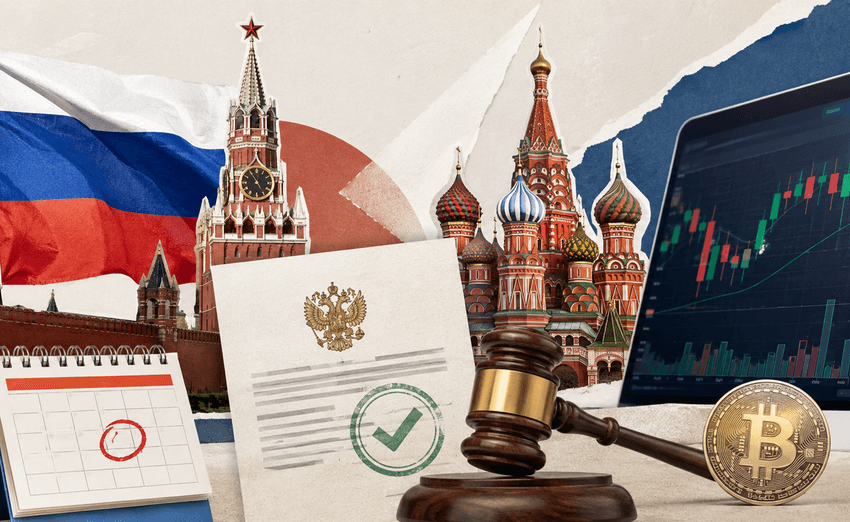

Russia’s comprehensive cryptocurrency framework takes effect on September 1, 2026, formally legalizing certain digital asset transactions while maintaining strict restrictions on how crypto can be used inside the country.
The law, titled “On Digital Currency and Digital Rights” was approved by both houses of Russia’s parliament in July before being signed by President Vladimir Putin in August.
The legislation represents Moscow’s most significant attempt yet to bring cryptocurrency activity into a state-controlled regulatory system, covering investment, trading, custody and cross-border settlements.
Russian citizens will gain legal access to approved cryptocurrencies through regulated intermediaries. However, cryptocurrency payments for domestic goods and services remain prohibited, preserving the ruble as Russia’s sole legal tender.
The rules arrive alongside the broader rollout of the digital ruble, Russia’s central bank digital currency.
Crypto Becomes a Regulated Investment Asset
Inside Russia, cryptocurrency will primarily function as an investment asset rather than money. Residents will be able to purchase digital currencies depending on their investor classification, but transactions must take place through institutions approved by the Bank of Russia.
Crypto will have a different role internationally. Russian companies will be permitted to use digital assets for cross-border settlements with foreign counterparties under the applicable framework.
Russia had already been testing cryptocurrency for international trade through an experimental regime. The new framework creates a more permanent regulatory structure for such transactions as Russian businesses continue navigating restrictions on conventional international payment channels.
Bitcoin, Ethereum and USDT Available to Retail Investors
The legislation also expands access beyond the highly qualified investors previously allowed to trade crypto under Russia's experimental framework.
Non-qualified retail investors will be permitted to purchase Bitcoin, Ethereum and Tether's USDT, which currently satisfy the central bank's liquidity and market capitalization requirements.
Eligible assets must reportedly have a market capitalization exceeding 5 trillion rubles and average daily trading volume above 1 trillion rubles over the previous two years.
The Bank of Russia could add more cryptocurrencies later.
Non-qualified investors will face significant restrictions, however. They must pass a knowledge and risk-awareness test and will be permitted to purchase no more than 300,000 rubles worth of cryptocurrency annually through each intermediary.
Professional investors, exporters and importers will have broader access.
Crypto Trading Moves Through Licensed Institutions
All regulated cryptocurrency trading will be conducted through authorized banks, brokers, asset managers, exchanges and digital depositories.
Existing crypto platforms wishing to continue operating legally will need authorization from the Bank of Russia. The central bank has not yet published a complete list of approved venues.
Crypto exchanges seeking regulated status will reportedly need at least 15 million rubles in equity, while traditional financial institutions will be able to provide certain crypto services through specialized divisions under their existing regulatory structures.
The framework also formalizes cryptocurrency's status as property under Russian law. Digital assets can therefore be transferred, inherited and divided during proceedings such as divorce.
Rules surrounding self-custody remain considerably stricter. Existing holdings can be brought into the regulated system by depositing cryptocurrency with approved custodians, while certain foreign transfers and accounts require notification to Russia's Federal Tax Service and involvement from domestic intermediaries.
Sberbank Expects Billions in Regulated Trading
The size of Russia's existing cryptocurrency market helps explain the government's push toward regulation.
Estimates suggest as many as 30 million Russians may already own cryptocurrency, while daily turnover connected to digital assets could reach approximately 50 billion rubles, or around $580 million.
Sberbank Deputy Chairman Anatoly Popov expects the newly regulated market to generate substantial activity.
According to Popov, annual cryptocurrency trading through licensed Russian exchanges could reach approximately 4 trillion rubles, or around $46 billion, during the first year of the new framework.
He expects that figure could increase to 5.25 trillion rubles by 2028 and 7.5 trillion rubles by 2029 as regulated infrastructure develops.
Market participants have until July 2027 to secure the necessary licenses, meaning the system will continue evolving after its September launch.
Russia Opens Crypto Market Without Legalizing Payments
The new framework marks an important change in Russia's relationship with cryptocurrency, but it does not represent unrestricted legalization.
Bitcoin, Ethereum and USDT can become regulated investment assets, while approved cryptocurrencies can support certain international settlements. Domestic crypto payments, however, remain prohibited.
Russia is therefore creating a controlled cryptocurrency market built around licensed financial institutions, investor limits, custody requirements and central bank oversight.
The distinction will be central to the country's approach: crypto can be owned and traded, but it will not compete with the ruble as domestic money.
If Sberbank's projections prove accurate, regulated trading could quickly become a multibillion-dollar segment of Russia's financial system, with the September 1 rules providing the foundation for a market that had previously operated without a comprehensive legal framework.


