

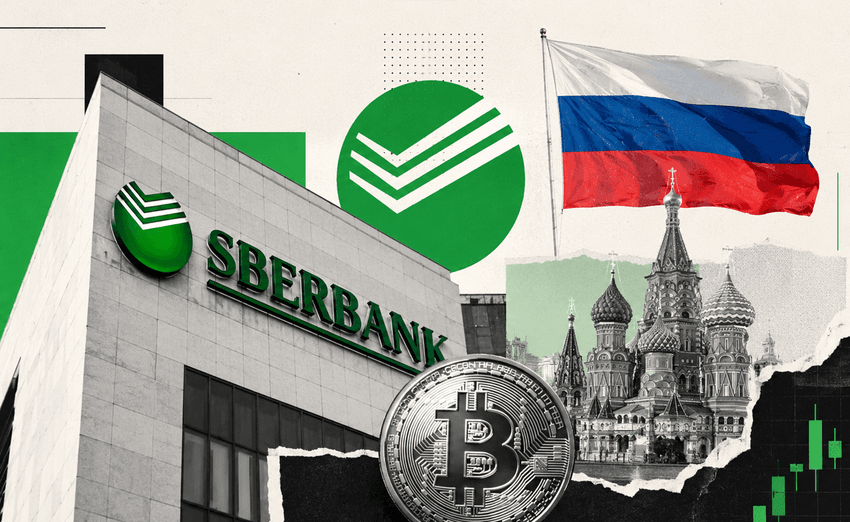

Sberbank is building the infrastructure needed to launch regulated cryptocurrency trading in Russia, with plans to introduce a digital depository and related trading services by December 1, 2026.
According to Interfax, the state-controlled banking giant is developing systems that will enable customers to hold, transfer, and trade cryptocurrencies while complying with Russia's upcoming digital asset legislation.
Alexander Vedyakhin, First Deputy Chairman of Sberbank's Management Board, explained the bank's plans, stating:

The initiative is expected to position Sberbank among the first major financial institutions to offer fully regulated crypto services under Russia's new legal framework.
New Crypto Law Drives Infrastructure Development
Sberbank's project follows the recent approval of Russia's "On Digital Currency and Digital Rights" bill by the State Duma. The legislation establishes comprehensive rules governing cryptocurrency ownership, trading, exchanges, brokers, custodians, and digital depositories.
The bill is now awaiting approval from the Federation Council before requiring the signature of President Vladimir Putin to become law.
Russia already permits cryptocurrency ownership, mining, and investment under various existing regulations. However, the absence of a unified legal framework has forced businesses to operate under multiple overlapping laws covering taxation, anti-money laundering, mining, and digital financial assets.
The new legislation aims to consolidate those rules into a single regulatory system while maintaining the ban on using cryptocurrencies for everyday domestic payments.
Vedyakhin noted that additional regulations still need to be drafted before the market becomes fully operational, adding that Sberbank intends to continue contributing its expertise as authorities finalize the remaining regulatory framework.
Years of Crypto Development Behind the Project
Sberbank's expansion into digital assets has been underway for several years. Since 2022, the bank has been registered as an official Information System Operator, allowing it to participate in Russia's growing Digital Financial Assets (DFA) market.
In 2025, Sberbank introduced structured bonds and digital financial assets linked to Bitcoin, Ethereum, and diversified cryptocurrency baskets for qualified investors.
Later that year, the bank also completed a pilot program for cryptocurrency-backed loans, testing how digital assets could be used as collateral while evaluating operational risks, accounting systems, and regulatory compliance.
These earlier initiatives provide much of the technological foundation for the upcoming regulated trading platform.
Russia Tightens Oversight of Crypto Markets
The new legal framework places cryptocurrency service providers under significantly stronger government supervision. Exchanges, brokers, custodians, and digital depositories will all be required to obtain licenses from the Bank of Russia, which will maintain an official register of approved operators.
Existing companies will benefit from a two-year transition period, allowing them to continue operating while applying for licenses until July 1, 2027.
The legislation also introduces investment limits for retail participants. Non-qualified investors will be permitted to purchase approximately 300,000 rubles (around $3,800) worth of digital assets annually through licensed intermediaries, while qualified investors will not face similar restrictions.
Although the law formally legalizes regulated cryptocurrency trading, it preserves the Russian ruble as the country's only legal tender. Cryptocurrencies cannot be used for everyday domestic purchases but may be utilized in certain cross-border transactions, mining-related settlements, and selected digital asset operations.
If the legislation receives final approval, its primary provisions will take effect on September 1, 2026, paving the way for Sberbank's planned crypto trading platform later that year and marking another major step in Russia's transition toward a regulated digital asset market.


