

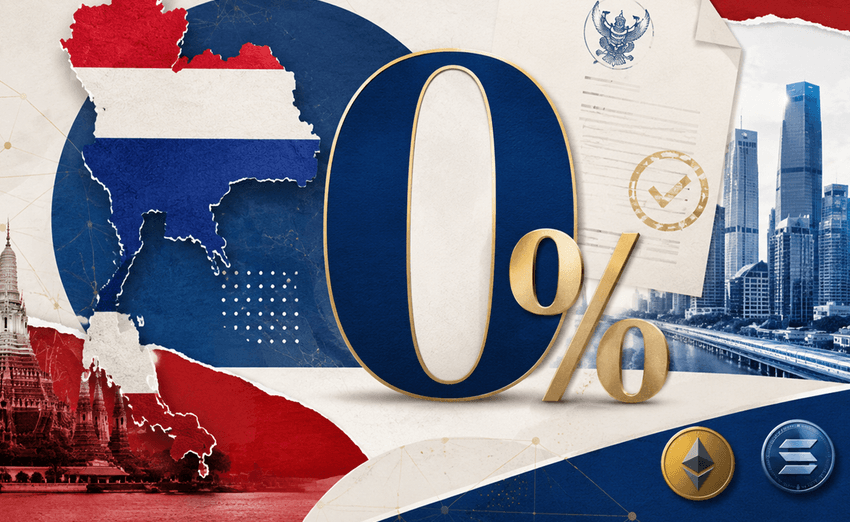

Thailand has officially eliminated personal income tax on qualifying cryptocurrency capital gains, introducing a major incentive for investors to trade through locally regulated digital asset platforms.
The measure was published in the Royal Gazette under Ministerial Regulation No. 399 and applies to eligible transactions conducted between January 1, 2025, and December 31, 2029.
Under the regulation, individual investors can benefit from a 0% personal income tax rate on crypto trading gains when transactions are completed through exchanges, brokers, or dealers licensed by the Securities and Exchange Commission of Thailand (SEC).
The temporary exemption is designed to encourage cryptocurrency activity to migrate toward regulated domestic platforms rather than foreign or unlicensed alternatives.
How Thailand's Crypto Tax Exemption Works
The tax exemption does not cover every type of cryptocurrency transaction or income. Eligibility depends heavily on where and how investors conduct their trades.
Individual investors who buy and sell digital assets through SEC-licensed Thai exchanges, brokers, and dealers can qualify for the exemption on resulting capital gains.
However, normal income tax rules continue to apply to transactions conducted through foreign or unlicensed platforms. Cryptocurrency earned through mining, staking, and airdrops also remains outside the exemption and continues to be taxed under the applicable rules.
The policy therefore creates a clear distinction between crypto activity occurring inside Thailand's supervised financial system and transactions conducted outside approved channels.
Investors Need to Keep Transaction Records
Crypto traders are expected to maintain accurate records demonstrating that their transactions qualify for the tax exemption.
Investors should retain information including purchase prices, sale prices, transaction dates, and exchange receipts. These records could be necessary if Thai tax authorities request evidence showing that the gains were generated through an eligible licensed provider.
By connecting tax relief directly to regulated trading activity, authorities hope to make compliance financially attractive while improving the transparency and traceability of cryptocurrency transactions.
The approach provides investors with a significant tax benefit while simultaneously directing more trading volume toward platforms operating under Thai regulatory oversight.
Thailand Targets Global Digital Asset Hub Status
The tax exemption supports Thailand's broader ambition to establish itself as a major digital asset hub.
The country's cryptocurrency framework already regulates digital asset exchanges, brokers, and dealers under the Emergency Decree on Digital Asset Businesses 2018.
A legal analysis from Nishimura & Asahi said the latest measure is intended to stimulate Thailand's digital asset market and support businesses connected to the industry.
Despite eliminating taxes on qualifying individual capital gains, authorities expect broader growth in the digital asset ecosystem to generate additional government revenue elsewhere. Related businesses are projected to contribute at least 1 billion baht in additional tax revenue during the exemption period.
The policy also directs more activity toward companies supervised by the SEC and Anti-Money Laundering Office, potentially improving transaction monitoring while expanding Thailand's regulated crypto economy.
What Happens After 2029?
Thailand's 0% crypto capital gains tax is currently temporary rather than permanent.
The exemption expires on December 31, 2029, meaning authorities will eventually need to decide whether to extend, modify, or discontinue the policy.
That deadline could become increasingly important for exchanges, cryptocurrency businesses, and international investors considering Thailand as a long-term digital asset destination.
For now, however, the policy gives Thailand one of the region's more attractive tax environments for regulated cryptocurrency trading.
By combining tax incentives with strict licensing requirements, Thailand is attempting to increase crypto adoption without pushing activity outside the regulated financial system, strengthening its position as competition to become a leading digital asset hub in Southeast Asia intensifies.


