

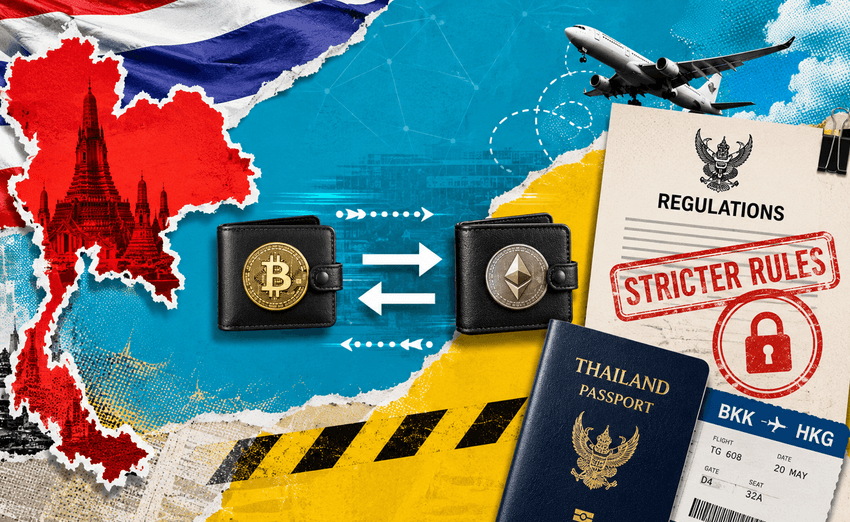

Thailand’s Securities and Exchange Commission has finalized its cryptocurrency Travel Rule, giving licensed digital asset businesses until February 27, 2027, to implement the systems needed to comply.
The new framework will require exchanges and other regulated crypto businesses to identify both the sender and recipient involved in digital asset transfers, bringing cryptocurrency transactions closer to compliance standards already applied to traditional bank transfers.
Operators that fail to implement the required systems by the deadline could lose their ability to legally provide digital asset services in Thailand.
The final rules follow months of consultation between regulators and the country's digital asset industry, with the SEC publishing the completed framework on September 2.
Crypto Firms Face Four Major Requirements
Thailand's new Travel Rule introduces several compliance obligations for licensed digital asset businesses.
Operators must establish internal policies and procedures for identifying and managing risks associated with digital asset transfers. They will also be responsible for collecting identity information about customers and counterparties involved in transactions.
When cryptocurrency is transferred between regulated operators, firms must transmit originator and beneficiary information alongside the transfer instruction, allowing the receiving business to identify both parties.
Transaction records and accompanying information will need to be retained for at least five years.
During the first two years following a transaction, records must reportedly remain in a format that allows regulators to access them promptly when requested.
Operators will additionally face due diligence requirements covering intermediaries involved in transfers and counterparties receiving customer assets.
Self-Custody Creates Major Compliance Challenge
One of the more complicated parts of the framework concerns transfers involving self-hosted cryptocurrency wallets.
Unlike accounts operated by centralized exchanges, self-custodial wallets do not automatically contain the Know Your Customer information collected when users register with regulated platforms.
Thailand's SEC expects regulated businesses to establish whether customers own or control the self-custodial wallets involved in their transfers.
Implementing that requirement could create additional technical and operational challenges for exchanges, particularly when cryptocurrency moves between regulated platforms and private wallets.
The final framework follows two rounds of public consultations held earlier in 2026. The SEC first presented proposed principles during March and April, before consulting on draft notification rules during June and July.
Thailand Aligns Crypto Rules With FATF Standards
The SEC developed the rules alongside Thailand's Anti-Money Laundering Office (AMLO) and a government subcommittee focused on connecting financial information to identify suspicious transactions.
Interim requirements are being introduced while AMLO prepares additional regulations under Thailand's anti-money laundering legislation.
SEC Secretary-General Pornanong Budsaratragoon said the objective is to “reduce the risk of digital asset operators being used for money laundering and terrorist financing.”
Thailand's framework is designed to align the country with standards developed by the Financial Action Task Force, whose Recommendation 16 forms the basis for the crypto Travel Rule internationally.
Thailand is joining an already widespread regulatory trend. By 2026, FATF estimated that 83% of surveyed jurisdictions had passed legislation implementing the Travel Rule.
The framework reflects regulators' broader effort to apply traditional financial transparency requirements to blockchain-based transactions without eliminating the ability to transfer digital assets.


