

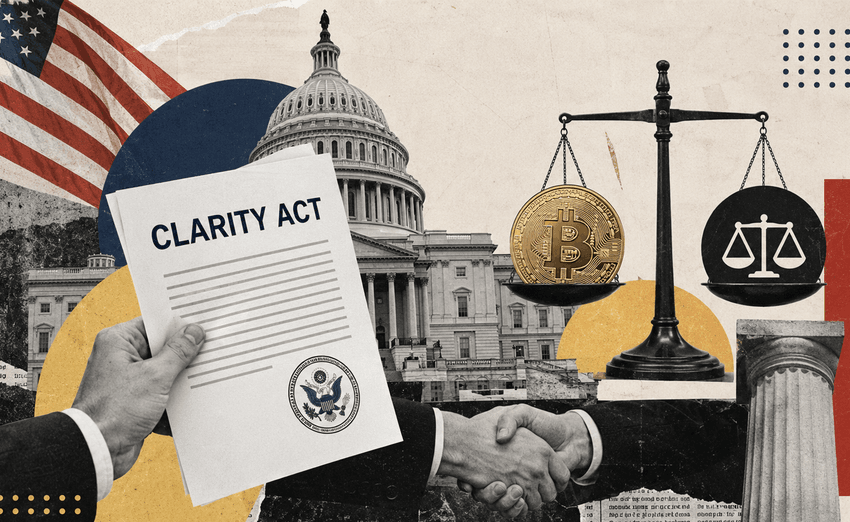

Republican lawmakers have introduced a revised version of the CLARITY Act, bringing the long-awaited cryptocurrency market structure legislation one step closer to a Senate vote. The updated 616-page draft includes a new ethics provision aimed at limiting the involvement of federal officials in digital asset businesses while preserving several core protections sought by the crypto industry.
If approved, the CLARITY Act would establish the first comprehensive federal framework governing cryptocurrency markets in the United States, providing greater legal certainty for digital asset companies, investors, and developers.
One of the most closely watched additions is a provision preventing federal officials, government employees, and their spouses from issuing or sponsoring digital assets while serving in office. However, the proposal still allows public officials to invest in cryptocurrencies, and notably does not extend the restrictions to their children.
The ethics provision is also temporary. According to the draft, it "will have no force and effect on and after noon on January 20, 2029" meaning the restrictions would expire at the end of the current presidential term.
Ethics Debate Remains a Key Obstacle
The ethics language has become one of the most controversial aspects of the legislation. Democrats have repeatedly argued that stronger safeguards are needed following concerns over President Donald Trump's cryptocurrency businesses and his family's involvement with World Liberty Financial.
Recent financial disclosures reportedly showed that Trump earned more than $1.2 billion from crypto-related businesses, fueling calls for broader conflict-of-interest rules. Senator Elizabeth Warren has argued that any market structure legislation should prevent the president, vice president, members of Congress, senior government officials, and their families from profiting from the cryptocurrency industry while holding office.
Because the latest draft does not apply to President Trump's sons, who are involved with World Liberty Financial, and leaves enforcement solely to the U.S. Department of Justice, the revised language is expected to face continued criticism from Democratic lawmakers.
With the bill requiring 60 Senate votes, Republican supporters will still need backing from at least 10 Democrats before it can advance.
Developer Protections Remain Intact
Beyond the ethics provisions, the latest draft preserves one of the crypto industry's highest priorities-the Blockchain Regulatory Certainty Act. This section clarifies that non-custodial software developers should not automatically be classified as money transmitters, removing certain regulatory obligations for developers who build blockchain software without taking custody of customer assets.
Many cryptocurrency companies consider this protection essential for encouraging innovation and preventing developers from facing legal uncertainty when creating wallets, privacy tools, and decentralized applications.
However, the proposal remains controversial. Several law enforcement organizations and a coalition of 82 Catholic leaders have argued that the exemption could weaken efforts to combat money laundering, human trafficking, and child exploitation by limiting regulatory oversight of certain blockchain technologies.
Stablecoin Rules Stay Unchanged
The latest draft leaves stablecoin provisions largely unchanged. One particularly contentious measure continues to restrict the payment of yield on idle stablecoin balances, meaning stablecoin issuers and service providers would be prohibited from offering rewards simply for holding stablecoins.
The banking industry has generally supported these restrictions, arguing they prevent stablecoins from functioning like unregulated interest-bearing bank deposits.

He added that the organization would continue reviewing the proposal as lawmakers work toward final approval.
With Senate Majority Leader John Thune expected to bring the bill to the Senate floor in the coming days, lawmakers face mounting pressure to act before the upcoming August recess. Many observers believe the first week of August represents the final realistic opportunity for the CLARITY Act to advance before congressional attention shifts toward the approaching midterm election cycle.


