

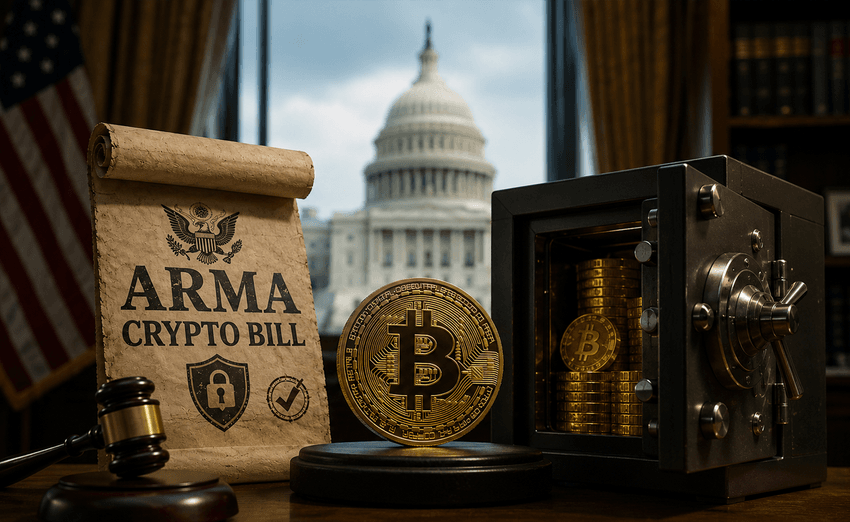

Congressman Nick Begich Introduces ARMA Bill
U.S. Representative Nick Begich has introduced the American Reserve Modernization Act, or ARMA, a bill aimed at formally codifying President Donald Trump’s Strategic Bitcoin Reserve into federal law.
The legislation is designed to prevent future administrations from dismantling or selling off government-held Bitcoin reserves through executive action.
According to Begich, the goal is to create long-term protection for federally controlled digital assets and ensure crypto reserve policy survives changes in political leadership.
In a statement posted on X, Begich said the bill would shield digital reserve assets “from the whims of Congress or future administrations.”
America’s reserves balance sheet is a critical component of our nation’s insurance policy, bolstering our currency and providing assurance during times of uncertainty. Over time, the prevailing sentiment as to what constitutes a durable store of value can shift, and as such it is… pic.twitter.com/7XfBwAWFGi
— Congressman Nick Begich (@RepNickBegich) May 21, 2026
America’s reserves balance sheet is a critical component of our nation’s insurance policy, bolstering our currency and providing assurance during times of uncertainty. Over time, the prevailing sentiment as to what constitutes a durable store of value can shift, and as such it is… pic.twitter.com/7XfBwAWFGi
— Congressman Nick Begich (@RepNickBegich) May 21, 2026
ARMA Replaces the Earlier BITCOIN Act
The new proposal is effectively a rebranded version of the earlier BITCOIN Act introduced in March 2025 alongside Senator Cynthia Lummis.
Lawmakers reportedly renamed the legislation following discussions with the House Financial Services Committee in an effort to broaden political support after the original bill struggled to gain momentum.
Begich summarized the strategy by arguing that executive actions are temporary while congressional legislation can create lasting policy.

Bill Would Create Massive Federal Bitcoin Reserve
The ARMA proposal would establish an official Strategic Bitcoin Reserve inside the U.S. Treasury alongside a separate stockpile for other federally held digital assets.
Under the bill, the Treasury would be authorized to acquire up to 1 million BTC - roughly 5% of Bitcoin’s total supply.
The legislation also mandates that the acquired Bitcoin be stored in cold wallets and held for a minimum period of 20 years.
Supporters say the reserve would function similarly to strategic holdings of gold or oil, positioning Bitcoin as a long-term national reserve asset.
Treasury Purchases Would Use “Budget-Neutral” Funding
One of the most closely watched parts of the proposal involves how the government would pay for such large-scale Bitcoin acquisitions.
According to the bill, purchases would rely on “budget-neutral” mechanisms rather than direct taxpayer funding.
The legislation points to potential funding sources including the Federal Reserve’s discretionary surplus fund and the revaluation of U.S. gold certificates.
Supporters argue this structure would allow the federal government to expand Bitcoin reserves without creating additional federal debt burdens.
Bitcoin Compared to Gold as Strategic Asset
During an interview with Fox Business, Begich argued that Bitcoin now occupies a dominant position within the digital asset economy similar to gold’s role among precious metals.
That comparison reflects a growing narrative among pro-crypto lawmakers who increasingly view Bitcoin as a geopolitical reserve asset rather than merely a speculative investment.
Bill Goes Further Than Trump’s Executive Order
The ARMA proposal would significantly expand on President Trump’s earlier executive order issued in March 2025.
That executive action focused primarily on consolidating seized federal Bitcoin holdings into a single reserve structure.
ARMA, however, would authorize active open-market Bitcoin purchases while simultaneously preventing the Treasury from selling reserve holdings for two decades.
Representative Pat Harrigan, one of the bill’s co-sponsors, described the legislation as a solution to the federal government’s lack of a coherent digital asset custody strategy.
Crypto Legislation Race Intensifies in Washington
The ARMA bill arrives during an increasingly aggressive push by pro-crypto lawmakers to lock major digital asset policies into federal law before election season dominates the political calendar.
Earlier this month, the Senate Banking Committee advanced the CLARITY Act in a 15-9 vote, moving the broader crypto market structure bill closer to a full Senate vote.
At the same time, lawmakers continue debating stablecoin legislation and broader digital asset oversight frameworks.
However, supporters warn the legislative window may be shrinking quickly.
Senator Lummis and Senator Bernie Moreno have reportedly cautioned that if crypto legislation fails to advance before the summer recess, the next realistic opportunity may not arrive until 2030 or later.
Not everyone supports the current direction.
Senator Elizabeth Warren, one of the strongest critics of the crypto industry in Congress, recently described the CLARITY Act as “a bill written by the crypto industry for the crypto industry.”
The debate surrounding ARMA now adds another major battleground to Washington’s rapidly expanding fight over the future role of digital assets inside the American financial system.


