

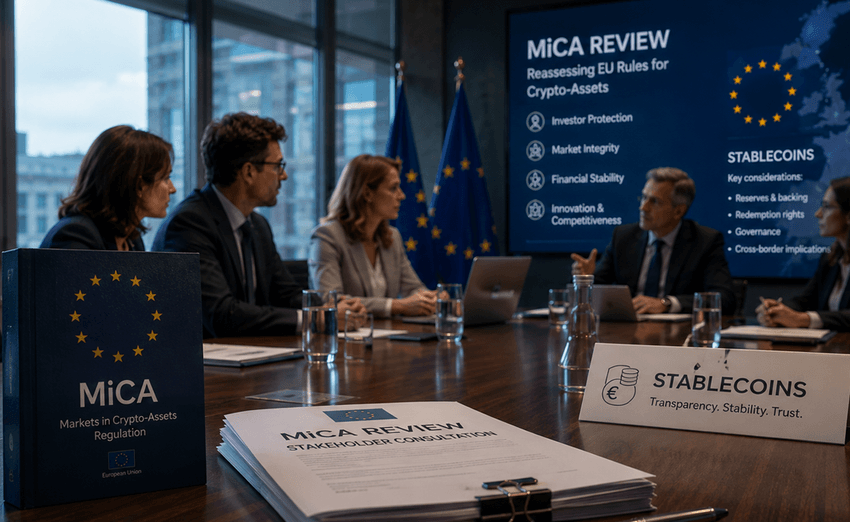

European Commission Begins Major MiCA Consultation
The European Commission announced Wednesday that it is opening a public consultation to evaluate whether the EU’s Markets in Crypto-Assets Regulation, widely known as MiCA, needs significant updates just two years after taking effect.
The consultation will remain open until August 31 and invites feedback from crypto companies, financial institutions, developers, investors, and the general public.
Officials said crypto markets and the global regulatory environment have evolved rapidly since MiCA entered force in 2024, forcing regulators to reassess whether the framework is still “fit for purpose.”
The move is already being described by some industry observers as the beginning of a potential “MiCA 2” era.
Stablecoin Interest Ban Faces New Scrutiny
One of the most closely watched parts of the consultation centers around stablecoins.
Under the current MiCA framework, issuers are prohibited from offering interest or interest-like rewards on stablecoins. That restriction was originally designed to prevent stablecoins from behaving like traditional bank deposits and to limit risks to the broader financial system.
Now the Commission is reconsidering whether that ban should remain in place.
The consultation specifically asks market participants whether stablecoin remuneration rules should be revised alongside broader questions involving reserve requirements, redemption mechanisms, liquidity management, and the thresholds used to classify “significant” stablecoins.
The review could become especially important for companies like Circle and Tether, which continue expanding their operations globally while competing with interest-bearing financial products.
EU Examines DeFi and Tokenization Risks
Another major focus of the consultation is decentralized finance.
DeFi largely sits outside MiCA’s original regulatory scope, but European officials are now openly evaluating whether the sector requires additional oversight.
The Commission’s questionnaire specifically explores risks tied to staking, lending, decentralized protocols, tokenized financial products, wrapped assets, synthetic tokens, and non-fungible tokens.
The review highlights growing concern among regulators that the lines separating traditional finance and crypto markets are becoming increasingly blurred.
Officials are also assessing whether MiCA properly addresses tokenized fund interests and blockchain-based financial instruments that may already resemble regulated securities under existing EU law.
Consumer Trust Becomes a Central Issue
The consultation reveals that the European Commission is not only focused on legal or technical compliance questions.
Regulators are also trying to determine whether everyday consumers actually understand and trust digital assets under the MiCA framework.
Several sections of the review examine public awareness surrounding Bitcoin, Ethereum, stablecoins, DeFi platforms, and tokenized assets.
The Commission is asking respondents what factors would improve confidence in crypto services, including stronger investor protections, better supervision, clearer regulations, and easier integration with banks and regulated payment providers.
That consumer-protection focus reflects Europe’s broader strategy of attempting to balance innovation with financial stability and retail safeguards.
July 2026 Deadline Puts Pressure on Crypto Firms
The consultation arrives as MiCA approaches one of its most important transitional milestones.
Beginning in July 2026, crypto asset service providers operating inside the EU must be fully authorized under MiCA rules or potentially cease operations within the bloc.
That deadline has already triggered major compliance efforts among exchanges, wallet providers, custodians, and crypto firms seeking long-term access to European markets.
The review could therefore have major consequences for companies still adjusting to the original framework while regulators simultaneously consider additional rule changes.
Europe Faces Growing Global Competition
The EU’s reassessment also reflects intensifying international competition around crypto regulation.
The United States is currently debating multiple digital asset bills, including stablecoin legislation under the GENIUS Act, while countries across Asia and the Middle East continue expanding their own blockchain frameworks.
Europe initially positioned MiCA as the world’s first comprehensive crypto regulatory system, but officials now appear increasingly aware that rapid technological change could make portions of the framework outdated faster than expected.
The inclusion of DeFi, tokenization, and stablecoin yield discussions signals that regulators are preparing for a second phase of crypto regulation rather than simply maintaining the original rulebook.
For the industry, the consultation may offer one of the first opportunities to significantly reshape how MiCA evolves over the coming years.


