

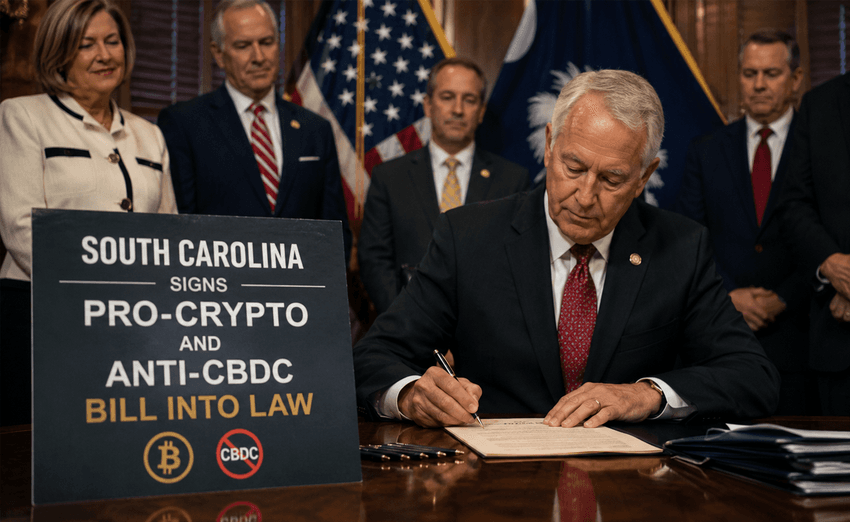

South Carolina Expands Legal Protections for Crypto Users
Governor Henry McMaster signed Senate Bill 163 into law on Tuesday, creating one of the most comprehensive state-level cryptocurrency frameworks in the United States.
The legislation amends South Carolina’s existing legal code to formally recognize and protect several key crypto activities, including digital asset payments, self-custody rights, crypto mining, staking, and blockchain infrastructure operations.
Under the new law, individuals and businesses in South Carolina cannot be prohibited from accepting digital assets as payment for goods or services.
The legislation also guarantees the right to use self-hosted wallets and hardware wallets, reinforcing protections for users who choose to control their own private keys rather than rely on centralized platforms.
State Bans Additional Taxes on Crypto Payments
One of the most notable parts of the bill is its tax treatment of cryptocurrency transactions.
South Carolina’s law specifically exempts crypto used for payments from any additional taxes, withholding requirements, assessments, or charges imposed by either the state government or local municipalities.
The measure is designed to prevent digital asset transactions from facing separate or discriminatory financial treatment compared to traditional payment methods.
Supporters of the legislation argue that this creates a friendlier environment for businesses exploring crypto payments and blockchain-based commerce.
Strong Anti-CBDC Language Included
The bill also contains direct opposition to a future U.S. central bank digital currency.
Under the new rules, no South Carolina government agency, commission, board, or political subdivision may accept or require payments using a CBDC issued by the Federal Reserve.
The legislation further prohibits state entities from participating in testing programs tied to a federal digital currency initiative.
Anti-CBDC sentiment has grown rapidly among several U.S. states, with critics arguing that government-controlled digital currencies could increase financial surveillance and reduce individual privacy.
Supporters of CBDCs, however, claim digital dollar systems could modernize payments and strengthen financial infrastructure.
Bitcoin Mining Receives Legal Protection
South Carolina’s new framework also includes strong protections for crypto mining operations.
The law prevents local governments from banning mining businesses in industrially zoned areas or imposing targeted noise restrictions beyond standard local noise regulations already applied to other industries.
This provision is intended to stop municipalities from singling out crypto mining operations through restrictive zoning or environmental rules.
The legislation also formally defines several crypto-related concepts under state law, including blockchain technology, staking, wallets, nodes, mining, and digital assets.
Several Crypto Activities Exempt From Licensing Rules
Another major part of the bill removes licensing burdens for several blockchain-related activities.
Under the new framework, crypto mining, node operations, developing decentralized applications, and crypto-to-crypto trading activities are exempt from South Carolina’s money transmitter licensing requirements.
That clarification could reduce legal uncertainty for blockchain developers and infrastructure operators working inside the state.
Industry advocates have long argued that outdated money transmission laws were never designed for decentralized blockchain systems and often create unnecessary regulatory barriers for crypto businesses.
South Carolina Joins Growing Pro-Crypto State Movement
South Carolina’s move follows a broader national trend of U.S. states passing their own crypto-focused legislation amid ongoing uncertainty at the federal level.
Earlier in 2025, Kentucky approved House Bill 701, which similarly protected self-custody rights and limited local restrictions on crypto mining operations.
Other states including Texas, Wyoming, and Florida have also advanced legislation supporting Bitcoin mining, blockchain businesses, or anti-CBDC measures.
The growing patchwork of state-level crypto laws reflects increasing competition among states to attract blockchain companies, mining operations, and digital asset investment.
Federal Crypto Debate Continues Intensifying
South Carolina’s law arrives as the United States continues debating broader federal crypto regulation.
Congress is currently reviewing several major digital asset bills, including stablecoin legislation and market structure reforms that could reshape oversight of the industry nationwide.
At the same time, anti-CBDC legislation has become a major political issue among some Republican lawmakers and state governments who oppose the idea of a federally controlled digital dollar.
By passing Senate Bill 163, South Carolina positions itself among the most openly crypto-supportive jurisdictions in the country while signaling strong resistance to future federal CBDC initiatives.


