

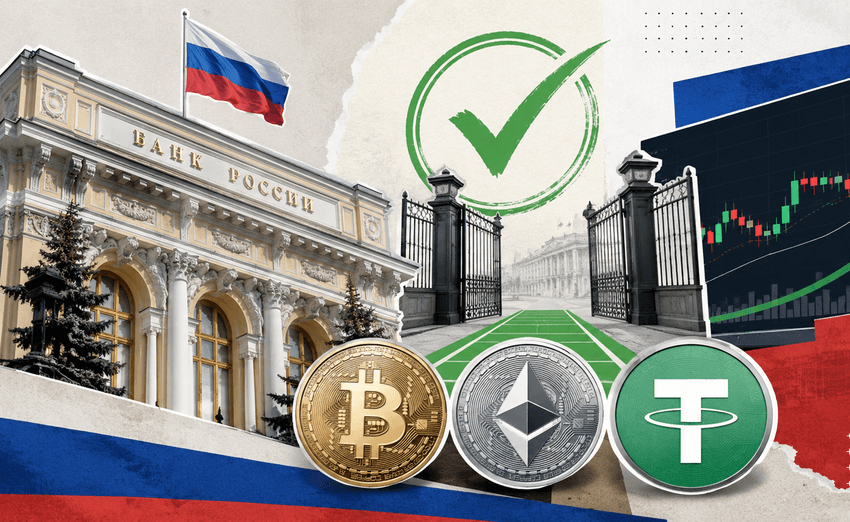

The Central Bank of Russia has approved Bitcoin, Ethereum and Tether’s USDT for trading by non-qualified investors, marking another major step toward the launch of the country’s regulated cryptocurrency market.
The three cryptocurrencies appear in a new draft directive published by the central bank on August 11. The document outlines which digital assets ordinary Russian investors will be permitted to purchase through licensed intermediaries.
The regulator is accepting public feedback on the proposal until August 24, as authorities finalize the rules supporting Russia’s new law “On Digital Currencies and Digital Rights.”
The legislation was approved by both houses of parliament in July and signed by President Vladimir Putin in early August. Its main provisions are scheduled to take effect on September 1, 2026.
Ordinary Investors Face Annual Purchase Limit
While cryptocurrency trading will become available to the general public, retail investors will face strict limits designed to reduce their exposure to volatile digital assets.
Non-qualified investors will be permitted to purchase BTC, ETH and USDT through Central Bank-approved exchanges, brokers, asset managers and other intermediaries.
However, purchases will be limited to 300,000 rubles per year, equivalent to slightly more than $3,600 at current exchange rates.
The Bank of Russia explained that restricting retail investors to highly liquid cryptocurrencies is intended to reduce risks from extreme price movements.

Investors will also need to pass a knowledge test before conducting crypto transactions, regardless of whether they are classified as qualified or non-qualified.
Why Bitcoin, Ethereum and Tether Made the List
Russia’s approved cryptocurrency list is based on specific market capitalization, liquidity and trading-history requirements.
To qualify for public trading, a cryptocurrency must have maintained an average market capitalization exceeding 5 trillion rubles, or more than $60 billion, during the previous two years.
Its average daily trading volume must also exceed 1 trillion rubles, equivalent to more than $12 billion, over the same period.
Additionally, an eligible cryptocurrency must have at least five years of trading history on foreign exchanges before being admitted to Russia’s regulated market.
Central Bank First Deputy Chairman Vladimir Chistyukhin previously indicated that only three cryptocurrencies currently satisfy those requirements.
The criteria effectively place the largest and most established digital assets at the front of Russia’s new retail crypto market.
Qualified Investors Get Broader Access
The restrictions will be considerably lighter for qualified investors, who will be permitted to purchase cryptocurrencies available on Russian exchanges and over-the-counter markets without the same annual purchase cap.
Meanwhile, the central bank is developing a much broader regulatory framework covering crypto exchanges, custody, storage, margin trading and other digital asset services.
Chistyukhin previously said the regulator would need to prepare more than 30 separate directives by November to fully implement the new legal framework.
The rules will cover existing financial institutions as well as newly recognized entities such as digital depositaries, which will provide regulated cryptocurrency custody and accounting services.
Russia Prepares for September Crypto Market Launch
The approval of BTC, ETH and USDT comes as Russia prepares to formally open regulated cryptocurrency trading from September 1.
The new framework represents a major change in Russia’s approach to digital assets, creating legal pathways for investment while keeping the industry under close central bank supervision.
However, legalization does not mean cryptocurrency will become an alternative domestic currency. Crypto payments for ordinary goods and services remain prohibited, keeping the ruble as Russia’s legal tender.
Public enthusiasm may also be limited. A recent survey found that nearly 70% of Russians do not expect significant cryptocurrency use cases to emerge under the government's new restrictions.
Still, the central bank’s decision gives ordinary investors something they previously lacked: a clearly regulated route to buy Bitcoin, Ethereum and USDT through approved Russian financial institutions.
With the new law taking effect in September and dozens of supporting regulations still being prepared, Russia is moving toward a tightly controlled crypto market where digital assets are legal investments-but access, custody and trading remain firmly inside the state’s regulatory framework.


