

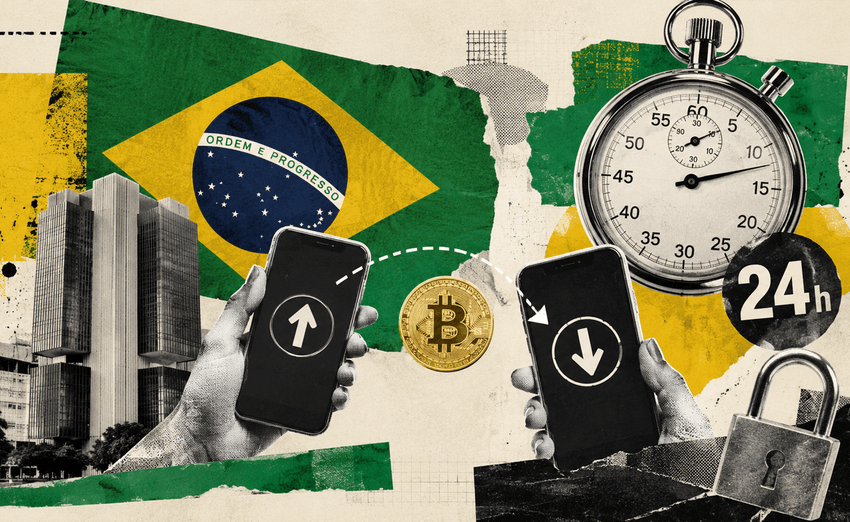

Brazil's central bank is introducing a mandatory 24-hour waiting period for certain cryptocurrency transfers, expanding the country's existing fraud-prevention framework to cover digital assets.
Under Resolution 584, published on Friday, crypto companies will generally be required to delay qualifying transfers to self-custody wallets or offshore cryptocurrency providers for 24 hours after customers fund their accounts.
The requirement will apply when a single transaction or a customer's combined daily transactions exceed $10,000. Smaller transactions may also be temporarily held when a crypto provider's monitoring systems identify potential fraud risks.
The new requirements are scheduled to take effect on January 1, 2027.
How the 24-Hour Crypto Hold Works
The waiting period is designed as a precautionary fraud-control measure rather than a permanent restriction on customer assets.
During the 24-hour window, providers must assess several factors before allowing the cryptocurrency to leave their platforms. These include the customer's risk profile, the nature of the transaction or service, the recipient or counterparty, and the jurisdiction where the funds are being sent.
Smaller transactions flagged as suspicious can also be held. However, a provider may release a transaction earlier if it completes a documented review determining that the transfer does not present an unacceptable fraud risk.
Once the 24-hour period expires, the company must either immediately approve the transfer or reject it.
Customers Must Be Notified About Holds
Crypto providers will be required to inform customers whenever a transfer is placed under the waiting period.
The notification must explain that the restriction is precautionary and temporary, while also telling the customer how long the hold is expected to remain in place.
Importantly, the framework applies to both traditional cryptocurrencies and fiat-backed stablecoins, bringing a broad range of digital asset transfers under the new anti-fraud requirements.
The central bank could impose tougher restrictions on companies that fail to comply. Regulators may require those providers to introduce holds longer than 24 hours, extend waiting periods to transactions below the $10,000 threshold, or prevent companies from releasing transfers before the full waiting period expires.
Existing Fraud Rules Expand to Crypto
Resolution 584 extends Brazil's existing payment fraud-prevention framework into the cryptocurrency sector.
The measure amends regulations introduced in 2021 and will apply to financial institutions, payment institutions, and cryptocurrency service providers operating during Brazil's regulatory transition.
Companies will also be required to maintain detailed daily records of cryptocurrency fraud and attempted fraud, alongside documentation explaining the measures they have implemented to identify and prevent suspicious transactions.
The requirements form part of Brazil's broader effort to integrate digital assets into its existing financial regulatory system.
Brazil Strengthens Its Crypto Framework
Brazil has spent the past year significantly expanding regulatory oversight of cryptocurrency businesses.
Rules introduced earlier in 2026 require crypto service providers to obtain authorization while meeting standards covering governance, cybersecurity, anti-money laundering, and counter-terrorist financing controls.
Brazil has also brought fiat-pegged stablecoins and certain international cryptocurrency transactions under its foreign exchange framework, increasing oversight of digital assets moving across national borders.
The tighter rules come as Brazil remains one of the world's largest cryptocurrency markets. The country ranked fifth in Chainalysis' 2025 Global Crypto Adoption Index and received approximately $318.8 billion in cryptocurrency between July 2024 and June 2025, accounting for nearly one-third of Latin America's activity.
With the new 24-hour waiting period, Brazil is focusing specifically on the short window after accounts are funded, when fraudulent transfers can be difficult to reverse once cryptocurrency reaches an external wallet.
The policy preserves access to self-custody and offshore transfers while giving regulated providers additional time to identify suspicious activity before funds leave their systems.


